'X' is: 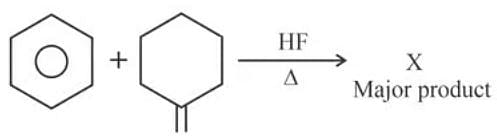
Show Hint
Remember Markovnikov’s rule for electrophilic addition reactions. The most stable carbocation intermediate leads to the major product.


The Correct Option is B
Solution and Explanation
Step 1: Identify the Reactants
The reactants are tetrahydrofuran (THF) and 2-methylpropene. The reaction is catalyzed by HF and takes place under heat.
Step 2: Determine the Reaction Mechanism
This reaction is an electrophilic addition of THF to the alkene. HF protonates the alkene to form a carbocation. The oxygen in THF acts as a nucleophile and attacks the carbocation. Finally, deprotonation occurs to yield the product.
Step 3: Determine the Major Product
The major product is determined by Markovnikov’s rule, which states that the proton adds to the carbon of the double bond with more hydrogens. In this case, the carbocation will form on the more substituted carbon of 2-methylpropene, leading to product (1).
Top JEE Main Chemistry Questions
What will be the equilibrium constant of the given reaction carried out in a \(5 \,L\) vessel and having equilibrium amounts of \(A_2\) and \(A\) as \(0.5\) mole and \(2 \times 10^{-6}\) mole respectively?
The reaction : \(A_2 \rightleftharpoons 2A\)- At equilibrium the concentrations of and in a sealed vessel at . What will be for the reaction
- Find out the major products from the following reactions

Cobalt chloride when dissolved in water forms pink colored complex $X$ which has octahedral geometry. This solution on treating with cone $HCl$ forms deep blue complex, $\underline{Y}$ which has a $\underline{Z}$ geometry $X, Y$ and $Z$, respectively, are
- The correct order of atomic radii is:
Top JEE Main Hydrocarbons Questions
- A \(10\) \(mL\) hydrocarbon \((C_2H_4)\) on combustion give \(40\) \(mL\) \(CO_2\) and \(50\) \(mL\) \(H_20\). Calculate the value of \(x+y\)
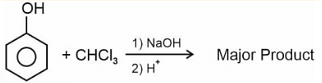
The major product in the above reaction is- 3-Methylhex-2-ene on reaction with HBr in presence of peroxide forms an addition product (A). The number of possible stereoisomers for 'A' is ______.
- Cyclohexene
 is _________ type of an organic compound.
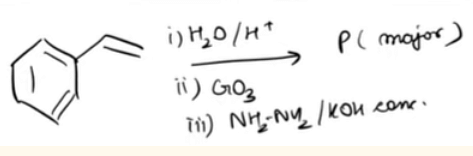
 - Find product P of the following reaction-
Top JEE Main Questions
- Two masses $m$ and $\frac{m}{2}$ are connected at the two ends of a massless rigid rod of length $l$. The rod is suspended by a thin wire of torsional constant $k$ at the centre of mass of the rod-mass system(see figure). Because of torsional constant $k$, the restoring torque is $\tau =k\theta$ for angular displacement $\theta$. If the rod is rota ted by $\theta_0$ and released, the tension in it when it passes through its mean position will be:
What will be the equilibrium constant of the given reaction carried out in a \(5 \,L\) vessel and having equilibrium amounts of \(A_2\) and \(A\) as \(0.5\) mole and \(2 \times 10^{-6}\) mole respectively?
The reaction : \(A_2 \rightleftharpoons 2A\)- The value of is
- The number of terms of an is even. The sum of the odd terms is and of the even terms is . The last term exceeds the first by . Then the number of terms in the series is ______.
A black body is at a temperature of 2880 K. The energy of radiation emitted by this body with wavelength between 499 nm and 500 nm is U1, between 999 nm and 1000 nm is U2 and between 1499 nm and 1500 nm is U3. The Wien's constant, b = 2.88×10⁶ nm-K. Then,
Concepts Used:
Hydrocarbons
Hydrocarbons can be described as organic compounds that consists only hydrogen and carbon atoms. These compounds are of different types and thereby have distinct natures. Hydrocarbons are colorless gases and are known for discharging faint odours. These have been categorized under four major classes named as alkynes, alkanes, alkenes, and aromatic hydrocarbons.
Types of Hydrocarbons
- Saturated hydrocarbons - Saturated hydrocarbons are those compounds where there is a single bond exists between carbon atoms and are saturated with atoms of hydrogen.
- Unsaturated hydrocarbons - Hydrocarbons comprises of at least one double or triple bond between carbon atoms are known as unsaturated hydrocarbons.
- Aliphatic hydrocarbons - The term denotes the hydrocarbons formed as an outcome of the chemical degradation of fats. Aliphatic hydrocarbons are basically chemical compounds.
- Aromatic hydrocarbons - They are distinguished because of the presence of benzene rings in them. They give away distinct types of aroma. These hydrocarbons comprises of only hydrogen and carbon atoms.