Question:
While carrying a heavy suitcase, the downward dislocation of the glenohumeral joint is resisted by all of the following muscles except:
While carrying a heavy suitcase, the downward dislocation of the glenohumeral joint is resisted by all of the following muscles except:
Show Hint
Think about which muscles cross the joint with vertical fibres to hold the humeral head up; this exact question is a known ambiguous one with two accepted answers.
Updated On: Jul 8, 2026
- Deltoid
- Coracobrachialis
- Short head of biceps
- Latissimus dorsi
Show Solution

Verified By Collegedunia
The Correct Option is B, C
Solution and Explanation
Step 1: Understand what "downward dislocation" needs.
Carrying a heavy suitcase pulls the arm straight down. To stop the humeral head sliding out of the bottom of the glenoid cavity, a muscle needs either fibres that run more or less vertically across the joint, holding the head up, or a tendon that crosses below the joint and can act like a sling.
Step 2: Check the deltoid.
The deltoid covers the shoulder from the clavicle, acromion, and scapular spine down to the humeral shaft. Its fibres run almost straight down across the joint, so its resting tone helps hold the humeral head against the glenoid. It is one of the main muscles resisting inferior dislocation, together with supraspinatus.
Step 3: Check the coracobrachialis and short head of biceps.
Both arise from the coracoid process, which sits above and in front of the joint, and travel down obliquely, coracobrachialis to the medial humeral shaft and the short head of biceps across the elbow to the radius. Their pull is more forward and oblique than truly vertical, so classical teaching does not usually credit them as important stabilisers against inferior dislocation, unlike deltoid, supraspinatus, or the long head of triceps.
Step 4: Check the latissimus dorsi.
Latissimus dorsi is mainly an adductor, extensor, and medial rotator, running from the back and lower ribs up into the intertubercular groove of the humerus. It is not part of the classic short list of vertical, joint bridging stabilisers either, but the accepted key for this question groups it with deltoid on the "does resist" side, since its broad insertion also adds tension across the joint when the arm is loaded.
Step 5: Note the ambiguity and give the accepted answer.
This is a recognised borderline question from the original paper. It is kept here as a multiple answer item because the widely used key marks both coracobrachialis and the short head of biceps as the muscles that do not meaningfully resist downward dislocation, leaving deltoid and latissimus dorsi credited with resisting it. This point is genuinely debated among sources, and is flagged here rather than presented as settled fact.
Final Answer:
\[ \boxed{\text{Coracobrachialis and short head of biceps}} \]
Carrying a heavy suitcase pulls the arm straight down. To stop the humeral head sliding out of the bottom of the glenoid cavity, a muscle needs either fibres that run more or less vertically across the joint, holding the head up, or a tendon that crosses below the joint and can act like a sling.
Step 2: Check the deltoid.
The deltoid covers the shoulder from the clavicle, acromion, and scapular spine down to the humeral shaft. Its fibres run almost straight down across the joint, so its resting tone helps hold the humeral head against the glenoid. It is one of the main muscles resisting inferior dislocation, together with supraspinatus.
Step 3: Check the coracobrachialis and short head of biceps.
Both arise from the coracoid process, which sits above and in front of the joint, and travel down obliquely, coracobrachialis to the medial humeral shaft and the short head of biceps across the elbow to the radius. Their pull is more forward and oblique than truly vertical, so classical teaching does not usually credit them as important stabilisers against inferior dislocation, unlike deltoid, supraspinatus, or the long head of triceps.
Step 4: Check the latissimus dorsi.
Latissimus dorsi is mainly an adductor, extensor, and medial rotator, running from the back and lower ribs up into the intertubercular groove of the humerus. It is not part of the classic short list of vertical, joint bridging stabilisers either, but the accepted key for this question groups it with deltoid on the "does resist" side, since its broad insertion also adds tension across the joint when the arm is loaded.
Step 5: Note the ambiguity and give the accepted answer.
This is a recognised borderline question from the original paper. It is kept here as a multiple answer item because the widely used key marks both coracobrachialis and the short head of biceps as the muscles that do not meaningfully resist downward dislocation, leaving deltoid and latissimus dorsi credited with resisting it. This point is genuinely debated among sources, and is flagged here rather than presented as settled fact.
Final Answer:
\[ \boxed{\text{Coracobrachialis and short head of biceps}} \]
Was this answer helpful?
0
0
Top NEET PG Anatomy Questions
- A defect in which of the following forms the structure marked below?

- A student had his jaw locked while yawning. Which of the following muscles is attached to the articular disc of the temporomandibular joint?
- The given histology image is of ?

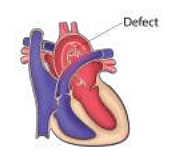
- A defect in which of the following aortic arches causes the defect shown in the image?
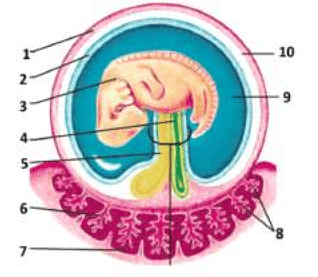
- Which of the following structures develops from the structure marked 4?
View More Questions
Top NEET PG Questions
- A patient hailing from Delhi presents with fever, arthralgia, and extensive petechial rash for 3 days. Lab investigations revealed a hemoglobin of 9 g/ dL, a white blood cell count of 9000 cells/mm3, a platelet count of 20000 cells/mm3, and a prolonged bleeding time. The clotting time was normal. What is the most likely diagnosis?
- Which of the following statements is true about Trichomonas vaginalis?
- A lady from West Rajasthan presented with an ulcer surrounded by erythema on the right leg. Microscopy of the biopsy from the edge of the ulcer showed organisms with dark staining nuclei and kinetoplast. What is the most likely causative agent?
- A child presents with a fever and a rash. Urine examination showed cells with owl's eye appearance. What is the most likely diagnosis?
- Infection with Clonorchis sinensis is associated with an increased risk of__?
View More Questions