Question:
Which type of malignancy occurs in longstanding multinodular goitre?
Which type of malignancy occurs in longstanding multinodular goitre?
Show Hint
Think of the thyroid cancer linked with iodine deficient, chronically enlarged multinodular glands.
Updated On: Jul 8, 2026
- Papillary
- Follicular
- Anaplastic
- Medullary
Show Solution

Verified By Collegedunia
The Correct Option is B
Solution and Explanation
Step 1: Recall what a longstanding multinodular goitre is.
A multinodular goitre (MNG) is an enlarged thyroid gland with many nodules, often from long term iodine deficiency or chronic stimulation of the gland. Over many years, a small number of these glands develop cancer within one of the nodules.
Step 2: Recall the malignancy linked with longstanding MNG.
Follicular carcinoma is the thyroid cancer classically described as arising in a background of longstanding multinodular goitre, especially in areas of iodine deficiency. The chronic overstimulation of follicular cells over years favors this pattern of malignant change.
Step 3: Contrast with the other thyroid cancers.
(A) Papillary carcinoma: This is the most common thyroid cancer overall and is linked mainly to radiation exposure, not to longstanding goitre. It usually arises in an otherwise normal gland.
(C) Anaplastic carcinoma: This is a rare, aggressive cancer seen mostly in elderly patients, and while it can rarely follow a longstanding goitre, it is not the classic association being tested here.
(D) Medullary carcinoma: This arises from the parafollicular C cells and is linked to MEN 2 syndromes, not to iodine deficient multinodular goitre.
Step 4: Final answer.
The malignancy classically linked with longstanding multinodular goitre is follicular carcinoma.
\[ \boxed{\text{Follicular carcinoma}} \]
A multinodular goitre (MNG) is an enlarged thyroid gland with many nodules, often from long term iodine deficiency or chronic stimulation of the gland. Over many years, a small number of these glands develop cancer within one of the nodules.
Step 2: Recall the malignancy linked with longstanding MNG.
Follicular carcinoma is the thyroid cancer classically described as arising in a background of longstanding multinodular goitre, especially in areas of iodine deficiency. The chronic overstimulation of follicular cells over years favors this pattern of malignant change.
Step 3: Contrast with the other thyroid cancers.
(A) Papillary carcinoma: This is the most common thyroid cancer overall and is linked mainly to radiation exposure, not to longstanding goitre. It usually arises in an otherwise normal gland.
(C) Anaplastic carcinoma: This is a rare, aggressive cancer seen mostly in elderly patients, and while it can rarely follow a longstanding goitre, it is not the classic association being tested here.
(D) Medullary carcinoma: This arises from the parafollicular C cells and is linked to MEN 2 syndromes, not to iodine deficient multinodular goitre.
Step 4: Final answer.
The malignancy classically linked with longstanding multinodular goitre is follicular carcinoma.
\[ \boxed{\text{Follicular carcinoma}} \]
Was this answer helpful?
0
0
Top NEET PG Surgery Questions
- A 55-year-old male presented with verrucous carcinoma around the glans of the penis. Examination reveals that the inguinal lymph nodes are not enlarged. What is the appropriate management for this patient?
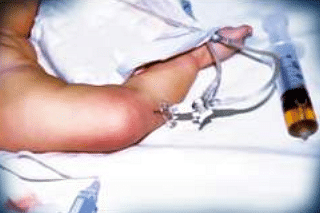
- Identify the procedure being performed in the image given below.
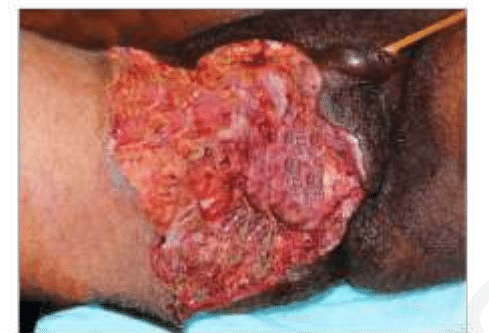
- A diabetic patient presents with sudden-onset perineal pain. On examination, foul-smelling discharge, and necrotic tissue as seen in the image is noted. Which of the following is true about the given condition?
- Which of the following is the most common complication following ligation of the first vessel during abdominoperineal resection for rectal carcinoma?(APR Abdominoperineal resection)
- A patient presents to the clinic with the lesion given in the image. He had a traumatic injury to the chest one year ago. What is the most likely diagnosis?
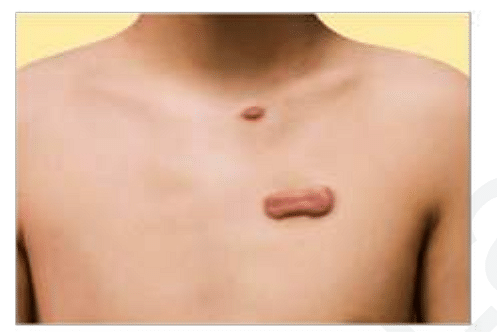
View More Questions
Top NEET PG Questions
- A patient hailing from Delhi presents with fever, arthralgia, and extensive petechial rash for 3 days. Lab investigations revealed a hemoglobin of 9 g/ dL, a white blood cell count of 9000 cells/mm3, a platelet count of 20000 cells/mm3, and a prolonged bleeding time. The clotting time was normal. What is the most likely diagnosis?
- Which of the following statements is true about Trichomonas vaginalis?
- A lady from West Rajasthan presented with an ulcer surrounded by erythema on the right leg. Microscopy of the biopsy from the edge of the ulcer showed organisms with dark staining nuclei and kinetoplast. What is the most likely causative agent?
- A child presents with a fever and a rash. Urine examination showed cells with owl's eye appearance. What is the most likely diagnosis?
- Infection with Clonorchis sinensis is associated with an increased risk of__?
View More Questions