Which one of the options given correctly matches the alkaloids in Group I with their source plants in Group II? 
Which one of the options given correctly matches the alkaloids in Group I with their source plants in Group II?
Show Hint
- P–3; Q–1; R–4; S–2
- P–1; Q–3; R–4; S–2
- P–2; Q–1; R–3; S–4
- P–4; Q–2; R–1; S–3

The Correct Option is A
Solution and Explanation
Step 1: Cocaine.
Cocaine is obtained from the Coca plant (Erythroxylum coca). \(⇒\) P–3.
Step 2: Caffeine.
Caffeine is the stimulant alkaloid in Cocoa, Coffee, and Tea. Here the correct match is Cocoa. \(⇒\) Q–1.
Step 3: Morphine.
Morphine is the famous opiate alkaloid from the Poppy plant (Papaver somniferum). \(⇒\) R–4.
Step 4: Atropine.
Atropine is a tropane alkaloid from Nightshade (Atropa belladonna). \(⇒\) S–2.
Combining all: P–3, Q–1, R–4, S–2. This corresponds to option (A).
Therefore, the correct answer is (A).
Top GATE XL Life Science Questions
- Which one of the following molecules captures \(CO_2\) in the \(CO_4\) cycle?
- Which one of the following methods separates biomolecules based on their hydrodynamic volumes?
- Which one of the following restriction endonucleases is a blunt cutter?
- Which one of the following ion channels opens to repolarize the neuronal membrane when an action potential is generated?
- Which one of the following is the most sensitive immunoassay?
Top GATE XL Plant Sciences Questions
- Which one of the following statements on Casparian strips is correct?
- Rotenone is a chemical often used to kill insect pests on crop plants and fishes in lakes. Rotenone acts by inhibiting electron transport from the NADH dehydrogenase enzyme in Complex I to ubiquinone in the mitochondrial electron transport chain. Which one of the following explains why plants can tolerate rotenone application?
- Although Pseudomonas syringae infection in plants is actively inhibited by the endogenous salicylic acid (SA) of host origin, a successful infection is still established because the bacterium secretes coronatine, an effector molecule. Which one of the following best describes the mode of action of coronatine?
The schematic depicts an unexpanded plant cell within a hypocotyl with the arrangement of cellulose microfibrils marked on its cell wall.

- Which one or more of the following statements is/are NOT CORRECT with respect to pollen development in angiosperm?
Top GATE XL Questions
- The CORRECT order of electronegativity is
- Which one of the following is the CORRECT representation of the variation of the Gibbs free energy (G) of a substance with temperature (T) at constant pressure?
- Among the following, the structure representing histidine is
- The CORRECT order of acidity of the following compounds is
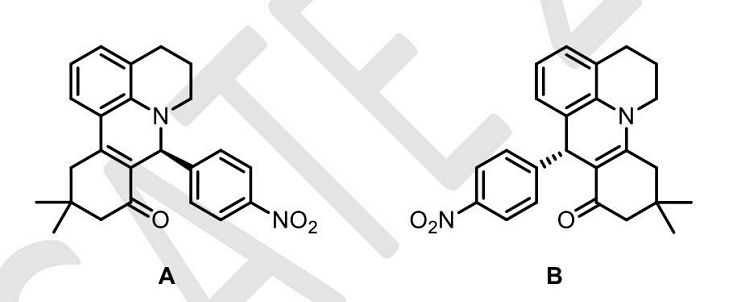
- The molecules A and B are a pair of___