Question:
Which one of the following matrices can be obtained by performing elementary row transformations on the \(3\times3\) identity matrix?
Which one of the following matrices can be obtained by performing elementary row transformations on the \(3\times3\) identity matrix?
Show Hint
A matrix reachable from the identity matrix by row operations must have full rank, meaning none of its rows can be written as a combination of the other two. Before jumping to a determinant calculation, check quickly whether one row is an obvious sum or scaled combination of the other two rows; if it is, that matrix is ruled out right away.
Updated On: Aug 17, 2026
- \[ \begin{bmatrix} 1&1&1 1&1&1 1&1&1 \end{bmatrix} \]
- \[ \begin{bmatrix} 1&1&1 2&3&4 1&2&1 \end{bmatrix} \]
- \[ \begin{bmatrix} 1&1&1 2&3&4 2&5&8 \end{bmatrix} \]
- \[ \begin{bmatrix} 1&1&1 -1&1&2 0&2&3 \end{bmatrix} \]
Show Solution

Verified By Collegedunia
The Correct Option is B
Approach Solution - 1
Step 1: Use the property of elementary row transformations.
A matrix obtained from identity matrix using elementary row operations must be: \[ \mathrm{Non\text{-}singular} \] Thus determinant must satisfy: \[ \det(A)\ne 0 \]
Step 2: Check Option (A).
\[ \begin{vmatrix} 1 & 1 & 1 \\ 1 & 1 & 1 \\ 1 & 1 & 1 \end{vmatrix}=0 \] All rows are identical. \[ \Rightarrow \mathrm{Singular} \] Therefore: \[ \Rightarrow \mathrm{Option\ (A)\ is\ Incorrect} \]
Step 3: Check Option (B).
\[ \begin{vmatrix} 1 & 1 & 1 \\ 2 & 3 & 4 \\ 1 & 2 & 1 \end{vmatrix} \] Expanding: \[ =1(3-8)-1(2-4)+1(4-3) \] \[ =-5+2+1 \] \[ =-2 \] Since determinant is non-zero: \[ \Rightarrow \mathrm{Non\text{-}singular} \] Thus: \[ \Rightarrow \mathrm{Option\ (B)\ can\ be\ obtained} \]
Step 4: Check Option (C).
\[ \begin{vmatrix} 1 & 1 & 1 \\ 2 & 3 & 4 \\ 2 & 5 & 8 \end{vmatrix} \] Expanding: \[ =1(24-20)-1(16-8)+1(10-6) \] \[ =4-8+4 \] \[ =0 \] Therefore: \[ \Rightarrow \mathrm{Option\ (C)\ is\ Incorrect} \]
Step 5: Check Option (D).
\[ \begin{vmatrix} 1 & 1 & 1 \\ -1 & 1 & 2 \\ 0 & 2 & 3 \end{vmatrix} \] Expanding: \[ =1(3-4)-1(-3)+1(-2) \] \[ =-1+3-2 \] \[ =0 \] Thus: \[ \Rightarrow \mathrm{Option\ (D)\ is\ Singular} \]
Step 6: Identify the correct option.
Only option \[ \boxed{\mathrm{(B)}} \] can be obtained from elementary row transformations on identity matrix.
A matrix obtained from identity matrix using elementary row operations must be: \[ \mathrm{Non\text{-}singular} \] Thus determinant must satisfy: \[ \det(A)\ne 0 \]
Step 2: Check Option (A).
\[ \begin{vmatrix} 1 & 1 & 1 \\ 1 & 1 & 1 \\ 1 & 1 & 1 \end{vmatrix}=0 \] All rows are identical. \[ \Rightarrow \mathrm{Singular} \] Therefore: \[ \Rightarrow \mathrm{Option\ (A)\ is\ Incorrect} \]
Step 3: Check Option (B).
\[ \begin{vmatrix} 1 & 1 & 1 \\ 2 & 3 & 4 \\ 1 & 2 & 1 \end{vmatrix} \] Expanding: \[ =1(3-8)-1(2-4)+1(4-3) \] \[ =-5+2+1 \] \[ =-2 \] Since determinant is non-zero: \[ \Rightarrow \mathrm{Non\text{-}singular} \] Thus: \[ \Rightarrow \mathrm{Option\ (B)\ can\ be\ obtained} \]
Step 4: Check Option (C).
\[ \begin{vmatrix} 1 & 1 & 1 \\ 2 & 3 & 4 \\ 2 & 5 & 8 \end{vmatrix} \] Expanding: \[ =1(24-20)-1(16-8)+1(10-6) \] \[ =4-8+4 \] \[ =0 \] Therefore: \[ \Rightarrow \mathrm{Option\ (C)\ is\ Incorrect} \]
Step 5: Check Option (D).
\[ \begin{vmatrix} 1 & 1 & 1 \\ -1 & 1 & 2 \\ 0 & 2 & 3 \end{vmatrix} \] Expanding: \[ =1(3-4)-1(-3)+1(-2) \] \[ =-1+3-2 \] \[ =0 \] Thus: \[ \Rightarrow \mathrm{Option\ (D)\ is\ Singular} \]
Step 6: Identify the correct option.
Only option \[ \boxed{\mathrm{(B)}} \] can be obtained from elementary row transformations on identity matrix.
Was this answer helpful?
0
0
Show Solution
Verified By Collegedunia
Approach Solution -2
Concept:
Step 1: Test option (A).
All three rows are $[1,1,1]$, so $R_2=R_1$ directly. The rows are dependent, rank is less than $3$, so this matrix cannot be obtained from the identity matrix.
Step 2: Test option (C).
Rows are $R_1=[1,1,1]$, $R_2=[2,3,4]$, $R_3=[2,5,8]$. Try $R_3=aR_1+bR_2$:
$a+2b=2$ and $a+3b=5$, so subtracting gives $b=3$, then $a=2-2(3)=-4$.
Check the third entry: $a+4b=-4+12=8$, which matches the third entry of $R_3$. So $R_3=-4R_1+3R_2$, the rows are dependent, rank is less than $3$. This matrix cannot be obtained from the identity matrix.
Step 3: Test option (D).
Rows are $R_1=[1,1,1]$, $R_2=[-1,1,2]$, $R_3=[0,2,3]$. Adding the first two rows directly: $R_1+R_2=[0,2,3]$, which is exactly $R_3$. So $R_3=R_1+R_2$, the rows are dependent, rank is less than $3$. This matrix cannot be obtained from the identity matrix.
Step 4: Test option (B).
Rows are $R_1=[1,1,1]$, $R_2=[2,3,4]$, $R_3=[1,2,1]$. Try $R_3=aR_1+bR_2$:
$a+2b=1$ and $a+3b=2$, so subtracting gives $b=1$, then $a=1-2(1)=-1$.
Check the third entry: $a+4b=-1+4=3$, but the third entry of $R_3$ is $1$, not $3$. The values of $a,b$ that fit the first two entries fail the third, so no such combination exists.
Step 5: Conclude for option (B).
Since $R_3$ cannot be written as a combination of $R_1$ and $R_2$, the three rows are linearly independent, giving full rank $3$. This matrix can be obtained from the identity matrix by elementary row operations.
Final Answer: Option (B)
- Elementary row operations never change the rank of a matrix, and the identity matrix has full rank $3$. So a matrix can be obtained from the identity matrix by row operations only if it also has full rank $3$, that is, its rows are linearly independent. Any full-rank $3\times3$ matrix can likewise be reduced back to the identity matrix, so full rank is exactly the condition needed.
- A row is linearly dependent on the other two if it can be written as $R_3=aR_1+bR_2$ for some numbers $a,b$. This can often be spotted directly, without computing a full determinant.
Step 1: Test option (A).
All three rows are $[1,1,1]$, so $R_2=R_1$ directly. The rows are dependent, rank is less than $3$, so this matrix cannot be obtained from the identity matrix.
Step 2: Test option (C).
Rows are $R_1=[1,1,1]$, $R_2=[2,3,4]$, $R_3=[2,5,8]$. Try $R_3=aR_1+bR_2$:
$a+2b=2$ and $a+3b=5$, so subtracting gives $b=3$, then $a=2-2(3)=-4$.
Check the third entry: $a+4b=-4+12=8$, which matches the third entry of $R_3$. So $R_3=-4R_1+3R_2$, the rows are dependent, rank is less than $3$. This matrix cannot be obtained from the identity matrix.
Step 3: Test option (D).
Rows are $R_1=[1,1,1]$, $R_2=[-1,1,2]$, $R_3=[0,2,3]$. Adding the first two rows directly: $R_1+R_2=[0,2,3]$, which is exactly $R_3$. So $R_3=R_1+R_2$, the rows are dependent, rank is less than $3$. This matrix cannot be obtained from the identity matrix.
Step 4: Test option (B).
Rows are $R_1=[1,1,1]$, $R_2=[2,3,4]$, $R_3=[1,2,1]$. Try $R_3=aR_1+bR_2$:
$a+2b=1$ and $a+3b=2$, so subtracting gives $b=1$, then $a=1-2(1)=-1$.
Check the third entry: $a+4b=-1+4=3$, but the third entry of $R_3$ is $1$, not $3$. The values of $a,b$ that fit the first two entries fail the third, so no such combination exists.
Step 5: Conclude for option (B).
Since $R_3$ cannot be written as a combination of $R_1$ and $R_2$, the three rows are linearly independent, giving full rank $3$. This matrix can be obtained from the identity matrix by elementary row operations.
Final Answer: Option (B)
Was this answer helpful?
0
0
Top JEE Advanced Mathematics Questions
- In a $\triangle$ ABC w ith fixed base BC, the vertex A moves such that cos B + cos C = 4 $ sin^2 \frac{A}{2}$. If a, b and c denote th e lengths of th e sides of th e triangle opposite to the angles A, B and C respectively, then
- Let $P=[a_{ij}]$ be a $3\times3$ matrix and let $Q=[b_{ij}]$ where $b_{ij}=2^{i+j} a_{ij}$ for $1 \le i, j \le $.If the determinant of $P$ is $2$, then the determinant of the matrix $Q$ is
- For the equation $3x^2+px+3=0,p>0,$ if one of the root is square of the other, then p is equal to
- The equation $\sqrt{x+1}-\sqrt{x-1}=\sqrt{4x-1}$ has
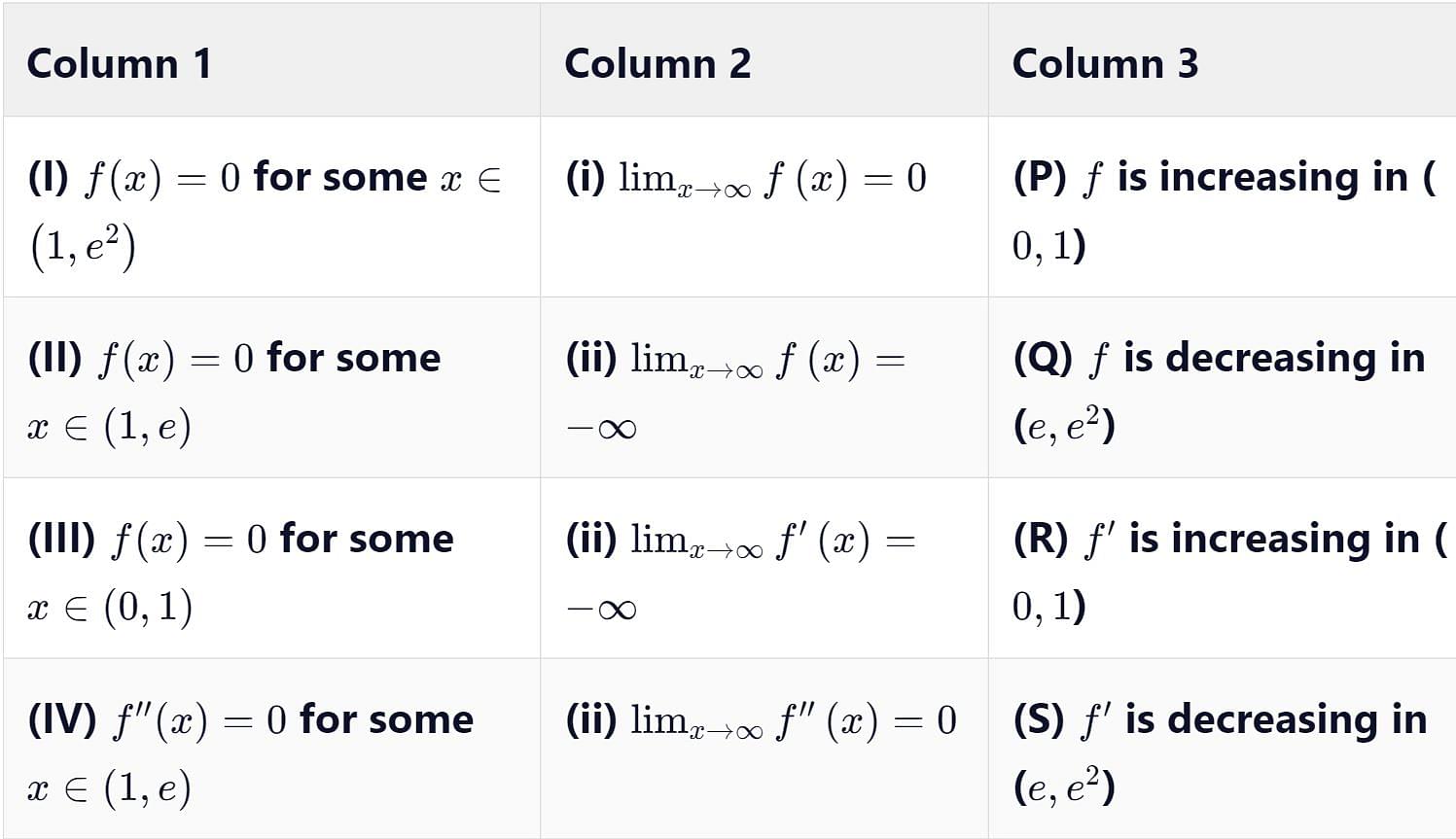
Let \(f(x)=x+log_{e}x−xlog_{e}x,\text{ }x∈(0,∞)\).
- Column 1 contains information about zeros of \(f(x)\), \(f'(x)\) and \(f''(x)\).
- Column 2 contains information about the limiting behavior of \(f(x)\), \(f'(x)\) and \(f''(x)\) at infinity.
- Column 3 contains information about increasing/decreasing nature of \(f(x)\) and \(f'(x)\).
View More Questions
Top JEE Advanced Algebra Questions
Consider the matrix \[ M= \begin{bmatrix} 2 & -1 \\ 1 & 0 \end{bmatrix} \] Let \(p,q,r,s,a,b,c,d\) be integers such that \[ M^{26}= \begin{bmatrix} p & q \\ r & s \end{bmatrix} \] and \[ \sum_{k=1}^{26} M^k= \begin{bmatrix} a & b \\ c & d \end{bmatrix}. \] Then which of the following statements is (are) TRUE?
- Match each entry in List-I to the correct entry in List-II and choose the correct option.

- Match each entry in List-I to the correct entry in List-II and choose the correct option.

- Match each entry in List-I to the correct entry in List-II and choose the correct option.

Top JEE Advanced Questions
- Yellow light is used in a single slit diffraction experiment with slit width of 0.6 mm. If yellow light is replaced by X-rays, then the observed pattern will reveal
- The size of the image of an object, which is at infinity, as formed by a convex lens of focal length 30 cm is 2 cm. If a concave lens of focal length 20 cm is placed between the convex lens and the image at a distance of 26 cm from the convex lens, calculate the new size of the image.
- A concave lens of glass, refractive index 1.5 has both surfaces of same radius of curvature R. On immersion in a medium of refractive index 1.75, it will behave as a
- The position vector $\vec{r}$ of a particle of mass $m$ is given by the following equation $\vec{r}(t)=\alpha t^{3} \hat{i}+\beta t^{2} \hat{j}$ where $\alpha=\frac{10}{3} \,ms ^{-3}, \beta=5\, ms ^{-2}$ and $m =0.1 \,kg$. At $t =1\, s$, which of the following statement (s) is (are) true about the particle?
- In an n-p-n transistor circuit, the collector current is 10 mA. If 90% of the electrons emitted reach the collector
View More Questions