Question:
Which one of the following is an allowed process?
Which one of the following is an allowed process?
Show Hint
Check charge, baryon number and strangeness on both sides of each reaction; also remember pi-zero to 3 photons breaks C-parity and p-pbar to a single photon breaks momentum conservation.
Updated On: Aug 17, 2026
- \( \pi^- + p \to \pi^0 + n \)
- \( \pi^0 \to \gamma + \gamma + \gamma \)
- \( p + \bar{p} \to \Lambda^0 + \Lambda^0 \)
- \( p + \bar{p} \to \gamma \)
Show Solution

Verified By Collegedunia
The Correct Option is A
Solution and Explanation
Step 1: Understanding the Concept:
A particle reaction is allowed only if it obeys all the relevant conservation laws at once: electric charge, baryon number, strangeness (for the strong and electromagnetic interactions), and also more subtle rules like C-parity for photon decays, plus basic kinematics such as energy-momentum conservation. Checking each option against these rules tells us which one can actually happen.
Step 2: Key Formula or Approach:
Go through the four options one at a time, checking charge, baryon number, strangeness, and any special rule that applies.
Step 3: Check option (A).
\(\pi^- + p \to \pi^0 + n\): charge on the left is \(-1 + 1 = 0\), and on the right \(0 + 0 = 0\), so charge is conserved. Baryon number is \(0 + 1 = 1\) on the left and \(0 + 1 = 1\) on the right, conserved. Strangeness is zero on both sides. This is the well-known pion-nucleon charge-exchange reaction, and it goes through the strong interaction with nothing forbidding it. So (A) is ALLOWED.
Step 4: Check option (B).
\(\pi^0 \to \gamma + \gamma + \gamma\): the neutral pion has C-parity \(C = +1\). A system of \(n\) photons has \(C = (-1)^n\). For 3 photons, \(C = -1\), which does not match the pion's \(C = +1\). Since the electromagnetic interaction driving this decay conserves C-parity, three photons cannot come from a \(\pi^0\); only the observed 2-photon decay works. So (B) is FORBIDDEN.
Step 5: Check option (C).
\(p + \bar{p} \to \Lambda^0 + \Lambda^0\): baryon number on the left is \(1 + (-1) = 0\). On the right, each \(\Lambda^0\) carries baryon number \(+1\), so two of them give \(+2\). Since \(0 \ne 2\), baryon number is not conserved. The correct final state for proton-antiproton annihilation into strange baryons would need one \(\Lambda^0\) and one \(\bar{\Lambda}^0\), not two \(\Lambda^0\). So (C) is FORBIDDEN.
Step 6: Check option (D).
\(p + \bar{p} \to \gamma\): in the centre of mass frame the total momentum is zero, so a single photon in the final state would need zero momentum, but a photon with zero momentum also has zero energy, which cannot equal the rest energy of the annihilating pair. A single photon can never balance both energy and momentum for a massive system annihilating together, so annihilation into just one photon is kinematically forbidden. So (D) is FORBIDDEN.
Final Answer:
Only the pion-nucleon charge-exchange reaction respects every conservation law, so option (A) is the allowed process.\[ \boxed{\pi^- + p \to \pi^0 + n} \]
A particle reaction is allowed only if it obeys all the relevant conservation laws at once: electric charge, baryon number, strangeness (for the strong and electromagnetic interactions), and also more subtle rules like C-parity for photon decays, plus basic kinematics such as energy-momentum conservation. Checking each option against these rules tells us which one can actually happen.
Step 2: Key Formula or Approach:
Go through the four options one at a time, checking charge, baryon number, strangeness, and any special rule that applies.
Step 3: Check option (A).
\(\pi^- + p \to \pi^0 + n\): charge on the left is \(-1 + 1 = 0\), and on the right \(0 + 0 = 0\), so charge is conserved. Baryon number is \(0 + 1 = 1\) on the left and \(0 + 1 = 1\) on the right, conserved. Strangeness is zero on both sides. This is the well-known pion-nucleon charge-exchange reaction, and it goes through the strong interaction with nothing forbidding it. So (A) is ALLOWED.
Step 4: Check option (B).
\(\pi^0 \to \gamma + \gamma + \gamma\): the neutral pion has C-parity \(C = +1\). A system of \(n\) photons has \(C = (-1)^n\). For 3 photons, \(C = -1\), which does not match the pion's \(C = +1\). Since the electromagnetic interaction driving this decay conserves C-parity, three photons cannot come from a \(\pi^0\); only the observed 2-photon decay works. So (B) is FORBIDDEN.
Step 5: Check option (C).
\(p + \bar{p} \to \Lambda^0 + \Lambda^0\): baryon number on the left is \(1 + (-1) = 0\). On the right, each \(\Lambda^0\) carries baryon number \(+1\), so two of them give \(+2\). Since \(0 \ne 2\), baryon number is not conserved. The correct final state for proton-antiproton annihilation into strange baryons would need one \(\Lambda^0\) and one \(\bar{\Lambda}^0\), not two \(\Lambda^0\). So (C) is FORBIDDEN.
Step 6: Check option (D).
\(p + \bar{p} \to \gamma\): in the centre of mass frame the total momentum is zero, so a single photon in the final state would need zero momentum, but a photon with zero momentum also has zero energy, which cannot equal the rest energy of the annihilating pair. A single photon can never balance both energy and momentum for a massive system annihilating together, so annihilation into just one photon is kinematically forbidden. So (D) is FORBIDDEN.
Final Answer:
Only the pion-nucleon charge-exchange reaction respects every conservation law, so option (A) is the allowed process.\[ \boxed{\pi^- + p \to \pi^0 + n} \]
Was this answer helpful?
0
0
Top GATE PH Physics Questions
- An infinite one-dimensional lattice extends along the x-axis. At each lattice site, there exists an ion with spin 1/2. The spin can point either in the +z or -z direction only. Let \( S_P \), \( S_F \), and \( S_A \) denote the entropies of paramagnetic, ferromagnetic, and antiferromagnetic configurations, respectively. Which of the following relations is/are true?
- Two point charges of charge \( +q \) each are placed a distance \( 2d \) apart. A grounded solid conducting sphere of radius \( a \) is placed midway between them. Assume \( a^2 \ll d^2 \). Which of the following statements is/are true?
- A particle of mass $m$ is moving in the potential
\[ V(x) = \begin{cases} V_0 + \frac{1}{2} m \omega_{0P}^2 x^2 & \quad \text{if } x > 0 \\ \infty & \quad \text{if } x \leq 0 \end{cases} \]
Figures P, Q, R, and S show different combinations of the values of $ \omega_0 $ and $ V_0 $. - Decays of mesons and baryons can be categorized as weak, strong and electromagnetic decays depending upon the interactions involved in the processes. Which of the following option is/are true?
- The temperature \( T \) dependence of magnetic susceptibility \( \chi \) (Column I) of certain magnetic materials (Column II) are given below. Which of the following options is/are correct?
Column I Column II (1) 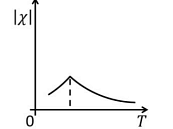
(P) Diamagnetic (2) 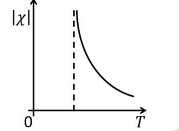
(Q) Paramagnetic (3) 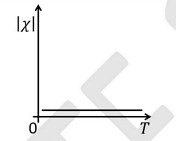
(R) Ferromagnetic (4) 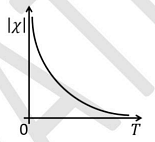
(S) Antiferromagnetic
View More Questions
Top GATE PH Nuclear and Particle Physics Questions
Top GATE PH Questions
- If \( F_1(Q, q) = Qq \) is the generating function of a canonical transformation from \((p, q)\) to \((P, Q)\), then which one of the following relations is correct?
- When an unpolarized plane electromagnetic wave in a dielectric medium with refractive index \( n_1 \) is incident on a plane interface separating it from another dielectric medium with refractive index \( n_2 \) (where \( n_2 > n_1 \)), and the angle of incidence is \(\tan^{-1} \left( \frac{n_2}{n_1} \right) \), the following statement is true:
- The wavefunction of a particle in an infinite one-dimensional potential well at time \( t \) is
\[ \Psi(x, t) = \sqrt{\frac{2}{3}} e^{-iE_1 t/\hbar}\psi_1(x) + \frac{1}{\sqrt{6}} e^{i\pi/6} e^{-iE_2 t/\hbar} \psi_2(x) + \frac{1}{\sqrt{6}} e^{i\pi/4} e^{-iE_3 t/\hbar} \psi_3(x) \]where \(\psi_1\), \(\psi_2\), and \(\psi_3\) are the normalized ground state, the normalized first excited state, and the normalized second excited state, respectively. \(E_1\), \(E_2\), and \(E_3\) are the eigen-energies corresponding to \(\psi_1\), \(\psi_2\), and \(\psi_3\), respectively. The expectation value of energy of the particle in state \(\Psi(x,t)\) is - If a thermodynamical system is adiabatically isolated and experiences a change in volume under an externally applied constant pressure, then the thermodynamical potential minimized at equilibrium is the
- The mean distance between the two atoms of an HD molecule is \( r \), where H and D denote hydrogen and deuterium, respectively. The mass of the hydrogen atom is \( m_H \). The energy difference between the two lowest lying rotational states of HD in multiples of \(\frac{h^2}{m_H r^2}\) is:
View More Questions