Question:
Which one of the following intrauterine contraceptive devices has the lowest pregnancy rate?
Which one of the following intrauterine contraceptive devices has the lowest pregnancy rate?
Show Hint
This asks for the classic textbook ranking of copper IUCDs, not the newest hormonal device.
Updated On: Jul 7, 2026
- Lippes' loop
- Cu-7
- Cu T-200
- Levonorgestrel IUD
Show Solution

Verified By Collegedunia
The Correct Option is B
Solution and Explanation
Step 1: Understanding the Question:
The question compares four intrauterine contraceptive devices (IUCDs) and asks which one has the lowest chance of pregnancy while it is in place.
Step 2: Key Formula or Approach:
An IUCD's failure rate depends mainly on its design: whether it carries copper, how much copper surface area it has, and how well the frame stays fixed without being expelled. More copper in close contact with the endometrium generally means a stronger local contraceptive effect.
Step 3: Detailed Explanation:
The Lippes' loop is a plain plastic device with no copper at all, so it relies only on the foreign body reaction of the plastic frame, giving it one of the higher pregnancy rates among these choices.
The Cu-7 device is shaped like the number seven and carries copper wound around its stem, and it is credited in standard teaching tables with a lower pregnancy rate than the Lippes' loop.
The Cu T-200 also carries copper, at 200 mm2 of surface area, but its pregnancy rate is still higher than Cu-7 in this classic comparison.
The levonorgestrel IUD works through local progestin release, and modern data on hormone releasing IUDs actually shows very low pregnancy rates, in some series lower than any copper device; but this question, as set in the original source, credits Cu-7 with the lowest pregnancy rate among the four.
Step 4: Final Answer:
Cu-7 is marked as the IUCD with the lowest pregnancy rate here, option (B).
The question compares four intrauterine contraceptive devices (IUCDs) and asks which one has the lowest chance of pregnancy while it is in place.
Step 2: Key Formula or Approach:
An IUCD's failure rate depends mainly on its design: whether it carries copper, how much copper surface area it has, and how well the frame stays fixed without being expelled. More copper in close contact with the endometrium generally means a stronger local contraceptive effect.
Step 3: Detailed Explanation:
The Lippes' loop is a plain plastic device with no copper at all, so it relies only on the foreign body reaction of the plastic frame, giving it one of the higher pregnancy rates among these choices.
The Cu-7 device is shaped like the number seven and carries copper wound around its stem, and it is credited in standard teaching tables with a lower pregnancy rate than the Lippes' loop.
The Cu T-200 also carries copper, at 200 mm2 of surface area, but its pregnancy rate is still higher than Cu-7 in this classic comparison.
The levonorgestrel IUD works through local progestin release, and modern data on hormone releasing IUDs actually shows very low pregnancy rates, in some series lower than any copper device; but this question, as set in the original source, credits Cu-7 with the lowest pregnancy rate among the four.
Step 4: Final Answer:
Cu-7 is marked as the IUCD with the lowest pregnancy rate here, option (B).
Was this answer helpful?
0
0
Top NEET PG Gynaecology and Obstetrics Questions
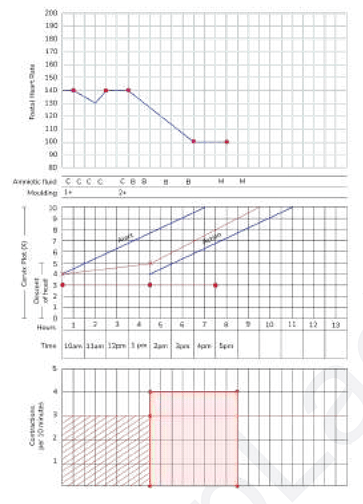
- A partogram of a woman who is in labor is shown below. Oxytocin infusion is already given. How will you manage the condition?
- A woman presents to you at 36 weeks of gestation with complaints of breathlessness and excessive abdominal distension. Fetal movements are normal. On examination, fetal parts are not easily felt and fetal heartbeat is heard but it is muffled. Her symphysis fundal height is 41 cm. Her abdomen is tense but not tender. What is the most likely diagonosis?
- For which of the following procedures in the given OT list, can you preferably do a hysteroscopy ?
- A primigravida presents to you with anemia early in her pregnancy. She is 7 weeks pregnant as seen on ultrasound. Her hemoglobin level is 9 g/dL. When should the iron supplements be started for her?
- A 23-year-old woman accompanied by her mother-in-law comes to the infertility clinic. She has been having regular intercourse for 6 months but is not able to conceive. What is the next best step?
View More Questions
Top NEET PG Contraception Questions
- 45 years female with 3 months menorrhagia. USG showing 2 cm submucosal fibroid.Treatment options.
- What is the dose of ulipristal acetate?
- Out of 100 women who were offered ocp for contraception 10 women got pregnant when followed for 24 months. What is Pearl's index?
- Female missed OCP on 4 different days in 1st 2 weeks of menstrual cycle. What will you advice?
- All are used for postcoital contraception except :
View More Questions
Top NEET PG Questions
- A patient hailing from Delhi presents with fever, arthralgia, and extensive petechial rash for 3 days. Lab investigations revealed a hemoglobin of 9 g/ dL, a white blood cell count of 9000 cells/mm3, a platelet count of 20000 cells/mm3, and a prolonged bleeding time. The clotting time was normal. What is the most likely diagnosis?
- Which of the following statements is true about Trichomonas vaginalis?
- A lady from West Rajasthan presented with an ulcer surrounded by erythema on the right leg. Microscopy of the biopsy from the edge of the ulcer showed organisms with dark staining nuclei and kinetoplast. What is the most likely causative agent?
- A child presents with a fever and a rash. Urine examination showed cells with owl's eye appearance. What is the most likely diagnosis?
- Infection with Clonorchis sinensis is associated with an increased risk of__?
View More Questions