Question:
Which one of the following endometrial histopathological findings is suggestive of an ectopic pregnancy?
Which one of the following endometrial histopathological findings is suggestive of an ectopic pregnancy?
Show Hint
Look for decidua without any villi, that gap is the clue.
Updated On: Jul 7, 2026
- Decidual reaction
- Chorionic villi
- Proliferative endometrium
- Secretory endometrium
Show Solution

Verified By Collegedunia
The Correct Option is A
Solution and Explanation
Step 1: Recall what happens to the endometrium in a normal early pregnancy.
In an intrauterine pregnancy, rising progesterone converts the endometrium into decidua, and chorionic villi from the implanted embryo are found within that decidua on biopsy. Finding villi confirms that the pregnancy has implanted inside the uterine cavity.
Step 2: Think about what happens when the pregnancy is ectopic.
In an ectopic pregnancy, the embryo implants outside the uterus, so no chorionic villi are present in an endometrial sample. But the pregnancy hormones, beta hCG and progesterone, still act on the uterine lining through the bloodstream, so the endometrium still turns into decidua.
Step 3: Name this pattern.
Decidual change without any chorionic villi in the sample, sometimes with the Arias Stella reaction (glands showing hypersecretory, bizarre looking cells), is the classic histological clue that points toward a pregnancy growing outside the uterus.
Step 4: Rule out the other options.
Chorionic villi in the sample would confirm an intrauterine pregnancy, the opposite of what we are looking for. Proliferative endometrium reflects the estrogen driven phase before ovulation and is not linked to any pregnancy state. Secretory endometrium reflects the normal post ovulatory, progesterone driven phase and does not by itself point to pregnancy of any location.
Final Answer:
Decidual change in the endometrium, with no chorionic villi seen, is the finding that raises suspicion for ectopic pregnancy.
\[ \boxed{\text{Decidual reaction}} \]
In an intrauterine pregnancy, rising progesterone converts the endometrium into decidua, and chorionic villi from the implanted embryo are found within that decidua on biopsy. Finding villi confirms that the pregnancy has implanted inside the uterine cavity.
Step 2: Think about what happens when the pregnancy is ectopic.
In an ectopic pregnancy, the embryo implants outside the uterus, so no chorionic villi are present in an endometrial sample. But the pregnancy hormones, beta hCG and progesterone, still act on the uterine lining through the bloodstream, so the endometrium still turns into decidua.
Step 3: Name this pattern.
Decidual change without any chorionic villi in the sample, sometimes with the Arias Stella reaction (glands showing hypersecretory, bizarre looking cells), is the classic histological clue that points toward a pregnancy growing outside the uterus.
Step 4: Rule out the other options.
Chorionic villi in the sample would confirm an intrauterine pregnancy, the opposite of what we are looking for. Proliferative endometrium reflects the estrogen driven phase before ovulation and is not linked to any pregnancy state. Secretory endometrium reflects the normal post ovulatory, progesterone driven phase and does not by itself point to pregnancy of any location.
Final Answer:
Decidual change in the endometrium, with no chorionic villi seen, is the finding that raises suspicion for ectopic pregnancy.
\[ \boxed{\text{Decidual reaction}} \]
Was this answer helpful?
0
0
Top NEET PG Gynaecology and Obstetrics Questions
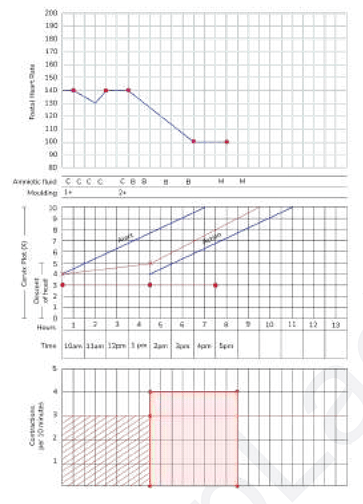
- A partogram of a woman who is in labor is shown below. Oxytocin infusion is already given. How will you manage the condition?
- A woman presents to you at 36 weeks of gestation with complaints of breathlessness and excessive abdominal distension. Fetal movements are normal. On examination, fetal parts are not easily felt and fetal heartbeat is heard but it is muffled. Her symphysis fundal height is 41 cm. Her abdomen is tense but not tender. What is the most likely diagonosis?
- For which of the following procedures in the given OT list, can you preferably do a hysteroscopy ?
- A primigravida presents to you with anemia early in her pregnancy. She is 7 weeks pregnant as seen on ultrasound. Her hemoglobin level is 9 g/dL. When should the iron supplements be started for her?
- A 23-year-old woman accompanied by her mother-in-law comes to the infertility clinic. She has been having regular intercourse for 6 months but is not able to conceive. What is the next best step?
View More Questions
Top NEET PG Anaemia in Pregnancy Questions
- 36 weeks pregnant female on warfarin with mitral stenosis. What should we do
- A 24 year old female patient with weeks of amenorrhea, left adnexal mass on USG, B-hCG 2500, no fetal heart rate. What is the management?
- In pregnancy, which of the following levels is altered the most?
- Which metabolic derangement is normally seen in pregnancy?
- Which of the following is true about luteoma of pregnancy?
View More Questions
Top NEET PG Questions
- A patient hailing from Delhi presents with fever, arthralgia, and extensive petechial rash for 3 days. Lab investigations revealed a hemoglobin of 9 g/ dL, a white blood cell count of 9000 cells/mm3, a platelet count of 20000 cells/mm3, and a prolonged bleeding time. The clotting time was normal. What is the most likely diagnosis?
- Which of the following statements is true about Trichomonas vaginalis?
- A lady from West Rajasthan presented with an ulcer surrounded by erythema on the right leg. Microscopy of the biopsy from the edge of the ulcer showed organisms with dark staining nuclei and kinetoplast. What is the most likely causative agent?
- A child presents with a fever and a rash. Urine examination showed cells with owl's eye appearance. What is the most likely diagnosis?
- Infection with Clonorchis sinensis is associated with an increased risk of__?
View More Questions