Which of the following steps in food processing is/are used to reduce the acrylamide formation in food products?
Show Hint
- ( {Pretreatment using asparaginase} )
- ( {Lowering the pH} )
- ( {Increasing the temperature} )
- ( {Adding glucose} )

The Correct Option is A
Solution and Explanation
Acrylamide is a potentially harmful compound that forms during the Maillard reaction when foods are cooked at high temperatures, particularly in starchy foods like potatoes and bread. The following steps help reduce acrylamide formation:
- Pretreatment using asparaginase (A): Asparaginase is an enzyme that hydrolyzes asparagine, one of the precursors of acrylamide. Reducing the availability of asparagine directly reduces acrylamide formation.
- Lowering the pH (B): Lowering the pH inhibits the Maillard reaction, thereby reducing acrylamide formation. Other options:
- Increasing the temperature (C): Higher temperatures promote acrylamide formation during cooking, so this step is counterproductive.
- Adding glucose (D): Adding glucose enhances the Maillard reaction, increasing acrylamide formation rather than reducing it.
Top GATE XL Food Technology Questions
- Match the plant products in Group 1 with the plant species in Group 2 that produce them and the respective plant parts in Group 3 where they accumulate the most.
Group 1 Group 2 Group 3 (P) Liquorice (i) Cinchona calisaya (a) Leaf (Q) Quinine (ii) Lawsonia inermis (b) Root (R) Henna (iii) Glycyrriza glabra (c) Flower (S) Saffron (iv) Papaver somniferum (d) Bark (v) Crocus sativus (e) Seed - Match the plant products in Group 1 with the plant species in Group 2 that produce them and the respective plant parts in Group 3 where they accumulate the most.
Group 1 Group 2 (P) Net primary productivity (i) Total amount of produced by autotrophs energy (Q) Gross primary productivity (ii) A type of mutualism where one species is benefitted more than the other (R) Net productivity (iii) Amount of energy stored by autotrophs after respiration (S) Secondary productivity (iv) Unused amount of energy after consumption by heterotrophs - Identify the CORRECT combination(s) of plant natural products and the categories they belong to.
- Identify the CORRECT combination(s) between the enzymes in Group 1 and the reactions in Group 2 they catalyze.
Group 1 Group 2 (P) Cinnamate-4-hydroxylase (i) L-phenylalanine → Cinnamic acid (Q) Glycerate kinase (ii) Glyceraldehyde 3-phosphate → dihydroxyacetone phosphate (R) PEP carboxylase (iii) Glycolate + O\(_2\) → Glyoxylate + H\(_2\)O\(_2\) (S) Nitrate reductase (iv) NO\(_3^-\) + NAD(P)H + H\(^+\) → NO\(_2^-\) + NAD(P)\(^+\) + H\(_2\)O - Which of the following cocci is/are examples of division in one plane
Top GATE XL Processing of Animal Products Questions
- Which one of the following fungi produces aflatoxins?
- Under standard conditions in animal feeding studies, the weight gained (in grams) per gram of protein consumed by an animal is termed as
- Xerophthalmia is caused due to the deficiency of:
- The unique flavor of chocolate and cocoa is due to the formation of:
- Which one of the following statements regarding Hazard Analysis Critical Control Point (HACCP) plan is NOT correct?
Top GATE XL Questions
- The CORRECT order of electronegativity is
- Which one of the following is the CORRECT representation of the variation of the Gibbs free energy (G) of a substance with temperature (T) at constant pressure?
- Among the following, the structure representing histidine is
- The CORRECT order of acidity of the following compounds is
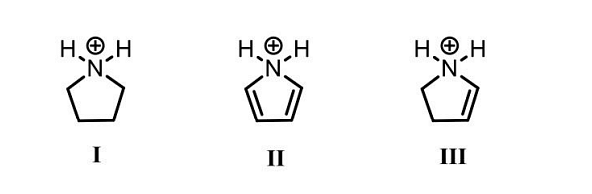
- The molecules A and B are a pair of___