Question:
Which of the following features the best bone apposition?
Which of the following features the best bone apposition?
Show Hint
Compare direct membrane ossification (no cartilage step) with endochondral ossification (cartilage first).
Updated On: Jul 8, 2026
- Chondroblastic activity in endochondrium
- Osteoblastic activity in membrane
- Periosteal changes
- Enchondral ossification
Show Solution

Verified By Collegedunia
The Correct Option is B
Solution and Explanation
Step 1: Understanding the Question:
"Bone apposition" means new bone being laid down directly on an existing surface by bone-forming cells, without an in-between cartilage step. We need the option that best fits this direct, surface-laying process.
Step 2: Key Formula or Approach:
There are two main ways new bone forms. Intramembranous ossification: osteoblasts inside a fibrous membrane lay down bone matrix directly. Endochondral ossification: a cartilage model is built first and is then replaced by bone. Direct osteoblast work on a membrane is the purer, faster form of apposition.
Step 3: Detailed Explanation:
In osteoblastic activity in membrane (intramembranous ossification), osteoblasts differentiate straight from mesenchymal cells inside a connective tissue membrane and deposit bone matrix directly, with no cartilage precursor. This is the most direct and efficient form of bone apposition and is how flat bones, such as those of the skull, and the outer (periosteal) surface of long bones grow in width.
Chondroblastic activity in endochondrium describes cartilage cells laying down cartilage matrix, not bone. This is the first step of endochondral ossification, not apposition of bone itself.
Periosteal changes is too broad and vague. It can include inflammation, new bone formation, or thickening from many different causes (infection, trauma, tumor), so it does not specifically describe the cleanest form of bone apposition.
Enchondral (endochondral) ossification builds bone through an intermediate cartilage model that later calcifies and is replaced by bone. This is slower and indirect compared to the straight osteoblastic laying down of bone in membrane.
Step 4: Final Answer:
Direct osteoblastic activity within a membrane gives the most direct and best bone apposition, since bone is formed straight away without a cartilage intermediate.
\[ \boxed{\text{Osteoblastic activity in membrane}} \]
"Bone apposition" means new bone being laid down directly on an existing surface by bone-forming cells, without an in-between cartilage step. We need the option that best fits this direct, surface-laying process.
Step 2: Key Formula or Approach:
There are two main ways new bone forms. Intramembranous ossification: osteoblasts inside a fibrous membrane lay down bone matrix directly. Endochondral ossification: a cartilage model is built first and is then replaced by bone. Direct osteoblast work on a membrane is the purer, faster form of apposition.
Step 3: Detailed Explanation:
In osteoblastic activity in membrane (intramembranous ossification), osteoblasts differentiate straight from mesenchymal cells inside a connective tissue membrane and deposit bone matrix directly, with no cartilage precursor. This is the most direct and efficient form of bone apposition and is how flat bones, such as those of the skull, and the outer (periosteal) surface of long bones grow in width.
Chondroblastic activity in endochondrium describes cartilage cells laying down cartilage matrix, not bone. This is the first step of endochondral ossification, not apposition of bone itself.
Periosteal changes is too broad and vague. It can include inflammation, new bone formation, or thickening from many different causes (infection, trauma, tumor), so it does not specifically describe the cleanest form of bone apposition.
Enchondral (endochondral) ossification builds bone through an intermediate cartilage model that later calcifies and is replaced by bone. This is slower and indirect compared to the straight osteoblastic laying down of bone in membrane.
Step 4: Final Answer:
Direct osteoblastic activity within a membrane gives the most direct and best bone apposition, since bone is formed straight away without a cartilage intermediate.
\[ \boxed{\text{Osteoblastic activity in membrane}} \]
Was this answer helpful?
0
0
Top NEET PG Anatomy Questions
- A defect in which of the following forms the structure marked below?

- A student had his jaw locked while yawning. Which of the following muscles is attached to the articular disc of the temporomandibular joint?
- The given histology image is of ?

- A defect in which of the following aortic arches causes the defect shown in the image?
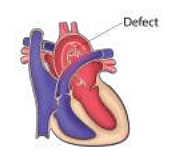
- Which of the following structures develops from the structure marked 4?
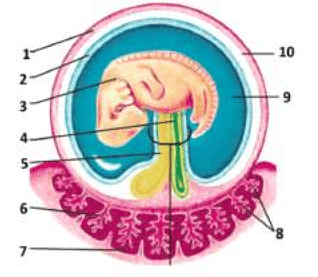
View More Questions
Top NEET PG Questions
- A patient hailing from Delhi presents with fever, arthralgia, and extensive petechial rash for 3 days. Lab investigations revealed a hemoglobin of 9 g/ dL, a white blood cell count of 9000 cells/mm3, a platelet count of 20000 cells/mm3, and a prolonged bleeding time. The clotting time was normal. What is the most likely diagnosis?
- Which of the following statements is true about Trichomonas vaginalis?
- A lady from West Rajasthan presented with an ulcer surrounded by erythema on the right leg. Microscopy of the biopsy from the edge of the ulcer showed organisms with dark staining nuclei and kinetoplast. What is the most likely causative agent?
- A child presents with a fever and a rash. Urine examination showed cells with owl's eye appearance. What is the most likely diagnosis?
- Infection with Clonorchis sinensis is associated with an increased risk of__?
View More Questions