Question:
What is the treatment of choice for hyperparathyroidism?
What is the treatment of choice for hyperparathyroidism?
Show Hint
In four-gland parathyroid hyperplasia, all 4 glands are removed and a small piece is autotransplanted (often to the forearm).
Updated On: Jul 8, 2026
- Removal of the hyperplastic gland
- Removal of all 4 glands
- Radical parathyroidectomy
- 3 and 1/2 parathyroidectomy
Show Solution

Verified By Collegedunia
The Correct Option is B
Solution and Explanation
Step 1: Split the causes of hyperparathyroidism.
Primary hyperparathyroidism is caused by an overactive parathyroid gland or glands. About 85% of cases come from a single adenoma in one gland, but a meaningful minority come from hyperplasia, where all four glands are enlarged and overactive together, as seen in some familial syndromes and in secondary or tertiary hyperparathyroidism from long-standing kidney disease.
Step 2: Focus on the four-gland hyperplasia scenario.
When all four glands are diseased, removing just one gland leaves three overactive glands behind, so the disease keeps going. The surgery has to deal with all four glands, not just one.
Step 3: Explain what removal of all 4 glands means in practice.
The standard operation for four-gland hyperplasia is a total parathyroidectomy, where all four enlarged glands are taken out of the neck, and then a small piece of parathyroid tissue is immediately reimplanted, usually into a forearm muscle. This autotransplant keeps a source of parathyroid hormone that can be adjusted or removed later if needed, while clearing the neck completely of diseased tissue.
Step 4: Compare with the other options.
Removing only the hyperplastic gland would miss the other enlarged glands and fail to cure the patient when hyperplasia is bilateral and multi-gland. Radical parathyroidectomy is not a standard recognized operation name for this condition. A subtotal, three and a half gland parathyroidectomy (leaving a remnant in the neck) is an alternative approach some surgeons use, but it carries a higher chance the disease recurs in the remaining neck tissue, and reoperating in a scarred neck is riskier than trimming a small forearm graft if hyperplasia comes back after a full four-gland clearance with autotransplant.
Step 5: Final conclusion.
For parathyroid hyperplasia, the preferred approach is to clear the neck completely.
\[ \boxed{\text{Removal of all 4 glands (with autotransplantation)}} \]
Primary hyperparathyroidism is caused by an overactive parathyroid gland or glands. About 85% of cases come from a single adenoma in one gland, but a meaningful minority come from hyperplasia, where all four glands are enlarged and overactive together, as seen in some familial syndromes and in secondary or tertiary hyperparathyroidism from long-standing kidney disease.
Step 2: Focus on the four-gland hyperplasia scenario.
When all four glands are diseased, removing just one gland leaves three overactive glands behind, so the disease keeps going. The surgery has to deal with all four glands, not just one.
Step 3: Explain what removal of all 4 glands means in practice.
The standard operation for four-gland hyperplasia is a total parathyroidectomy, where all four enlarged glands are taken out of the neck, and then a small piece of parathyroid tissue is immediately reimplanted, usually into a forearm muscle. This autotransplant keeps a source of parathyroid hormone that can be adjusted or removed later if needed, while clearing the neck completely of diseased tissue.
Step 4: Compare with the other options.
Removing only the hyperplastic gland would miss the other enlarged glands and fail to cure the patient when hyperplasia is bilateral and multi-gland. Radical parathyroidectomy is not a standard recognized operation name for this condition. A subtotal, three and a half gland parathyroidectomy (leaving a remnant in the neck) is an alternative approach some surgeons use, but it carries a higher chance the disease recurs in the remaining neck tissue, and reoperating in a scarred neck is riskier than trimming a small forearm graft if hyperplasia comes back after a full four-gland clearance with autotransplant.
Step 5: Final conclusion.
For parathyroid hyperplasia, the preferred approach is to clear the neck completely.
\[ \boxed{\text{Removal of all 4 glands (with autotransplantation)}} \]
Was this answer helpful?
0
0
Top NEET PG Surgery Questions
- A 55-year-old male presented with verrucous carcinoma around the glans of the penis. Examination reveals that the inguinal lymph nodes are not enlarged. What is the appropriate management for this patient?
- Identify the procedure being performed in the image given below.
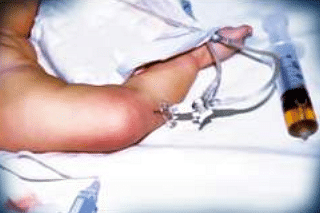
- A diabetic patient presents with sudden-onset perineal pain. On examination, foul-smelling discharge, and necrotic tissue as seen in the image is noted. Which of the following is true about the given condition?
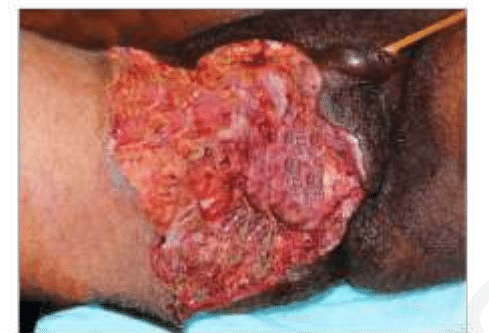
- Which of the following is the most common complication following ligation of the first vessel during abdominoperineal resection for rectal carcinoma?(APR Abdominoperineal resection)
- A patient presents to the clinic with the lesion given in the image. He had a traumatic injury to the chest one year ago. What is the most likely diagnosis?
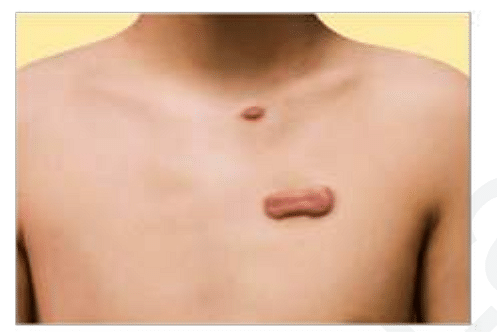
View More Questions
Top NEET PG Questions
- A patient hailing from Delhi presents with fever, arthralgia, and extensive petechial rash for 3 days. Lab investigations revealed a hemoglobin of 9 g/ dL, a white blood cell count of 9000 cells/mm3, a platelet count of 20000 cells/mm3, and a prolonged bleeding time. The clotting time was normal. What is the most likely diagnosis?
- Which of the following statements is true about Trichomonas vaginalis?
- A lady from West Rajasthan presented with an ulcer surrounded by erythema on the right leg. Microscopy of the biopsy from the edge of the ulcer showed organisms with dark staining nuclei and kinetoplast. What is the most likely causative agent?
- A child presents with a fever and a rash. Urine examination showed cells with owl's eye appearance. What is the most likely diagnosis?
- Infection with Clonorchis sinensis is associated with an increased risk of__?
View More Questions