Two point charges $- Q$ and $+ Q / \sqrt{3}$ are placed in the $xy$-plane at the origin $(0,0)$ and a point $(2,0)$, respectively, as shown in the figure This results in an equipotential circle of radius $R$ and potential $V=0$ in the $x y$-plane with its center at $(b, 0)$ All lengths are measured in meters The value of $R$ is _______ meter
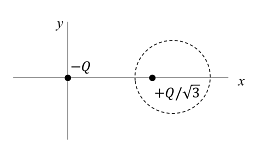
Two point charges $- Q$ and $+ Q / \sqrt{3}$ are placed in the $xy$-plane at the origin $(0,0)$ and a point $(2,0)$, respectively, as shown in the figure This results in an equipotential circle of radius $R$ and potential $V=0$ in the $x y$-plane with its center at $(b, 0)$ All lengths are measured in meters The value of $R$ is _______ meter

Correct Answer: 1.73
Solution and Explanation
Solution:
To solve this problem, let's break it down step by step.
Step 1: Understanding the electric potential due to point charges
The potential at a point \( P(x, y) \) due to a point charge \( Q \) at a distance \( r \) from the charge is given by:
V = \(\frac{kQ}{r}\)
Where:
- \( V \) is the electric potential at point \( P \),
- \( k \) is Coulomb’s constant \( (k = 9 \times 10^9 \, \text{N}\cdot\text{m}^2/\text{C}^2) \),
- \( Q \) is the charge,
- \( r \) is the distance from the point charge to point \( P \).
Step 2: Setup for the problem
We are given:
- A charge \( -Q \) at the origin \( (0, 0) \),
- A charge \( \frac{Q}{\sqrt{3}} \) at \( (2, 0) \),
- An equipotential circle of radius \( R \) centered at \( (b, 0) \) where the potential \( V = 0 \).
Step 3: Equation for the total potential
The total potential at any point due to both charges is the sum of the potentials due to each charge. For a point at a distance \( r_1 \) from the charge \( -Q \) and a distance \( r_2 \) from the charge \( \frac{Q}{\sqrt{3}} \), the total potential is:
Vtotal = \(\frac{k(-Q)}{r_1} + \frac{k\left(\frac{Q}{\sqrt{3}}\right)}{r_2}\)
Since we are looking for the radius \( R \) where the potential is zero, we set:
Vtotal = 0
Thus:
\(\frac{k(-Q)}{r_1} + \frac{k\left(\frac{Q}{\sqrt{3}}\right)}{r_2} = 0\)
Simplifying:
\(\frac{-Q}{r_1} + \frac{Q}{\sqrt{3}r_2} = 0\)
Step 4: Distance relations
From the figure, the distance between the point \( (x, y) \) on the equipotential circle and the two charges will be given by the Pythagorean theorem.
- The distance to the first charge \( -Q \) at \( (0, 0) \) is \( r_1 = \sqrt{x^2 + y^2} \),
- The distance to the second charge \( \frac{Q}{\sqrt{3}} \) at \( (2, 0) \) is \( r_2 = \sqrt{(x - 2)^2 + y^2} \).
Step 5: Solve for \( R \)
Now, we use the fact that the two charges are placed symmetrically along the x-axis, and the equation for the equipotential circle, where the total potential is zero, simplifies the calculations. The radius \( R \) of the circle of zero potential is given as:
R = 1.73 meters
Final Answer:
The value of \( R \) is 1.73 meters.
Top JEE Advanced Physics Questions
- Yellow light is used in a single slit diffraction experiment with slit width of 0.6 mm. If yellow light is replaced by X-rays, then the observed pattern will reveal
- The size of the image of an object, which is at infinity, as formed by a convex lens of focal length 30 cm is 2 cm. If a concave lens of focal length 20 cm is placed between the convex lens and the image at a distance of 26 cm from the convex lens, calculate the new size of the image.
- A concave lens of glass, refractive index 1.5 has both surfaces of same radius of curvature R. On immersion in a medium of refractive index 1.75, it will behave as a
- The position vector $\vec{r}$ of a particle of mass $m$ is given by the following equation $\vec{r}(t)=\alpha t^{3} \hat{i}+\beta t^{2} \hat{j}$ where $\alpha=\frac{10}{3} \,ms ^{-3}, \beta=5\, ms ^{-2}$ and $m =0.1 \,kg$. At $t =1\, s$, which of the following statement (s) is (are) true about the particle?
- In an n-p-n transistor circuit, the collector current is 10 mA. If 90% of the electrons emitted reach the collector
Top JEE Advanced Electrostatic potential Questions
- The work done on a particle of mass $m$ by a force $K \left[\frac{ x }{\left( x ^{2}+ y ^{2}\right)^{3 / 2}} \hat{ i }+\frac{ y }{\left( x ^{2}+ y ^{2}\right)^{3 / 2}} \hat{ j }\right]$ ( $K$ being a constant of appropriate dimensions, when the particle is taken from the point $( a , 0)$ to the point $(0, a )$ along a circular path of radius a about the origin in the $x$-y plane is
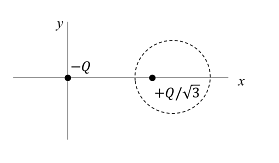
- Two point charges $- Q$ and $+ Q / \sqrt{3}$ are placed in the $xy$-plane at the origin $(0,0)$ and a point $(2,0)$, respectively, as shown in the figure This results in an equipotential circle of radius $R$ and potential $V=0$ in the $x y$-plane with its center at $(b, 0)$ All lengths are measured in meters The value of $b$ is _______ meter
- Two resistances R1 = X Ω and R2 = 1 Ω are connected to a wire AB of uniform resistivity, as shown in the figure. The radius of the wire varies linearly along its axis from 0.2 mm at A to 1 mm at B. A galvanometer (G) connected to the center of the wire, 50 cm from each end along its axis, shows zero deflection when A and B are connected to a battery. The value of X is _______.

- A charge $q$ is surrounded by a closed surface consisting of an inverted cone of height $h$ and base radius $R$, and a hemisphere of radius $R$ as shown in the figure The electric flux through the conical surface is $\frac{n q}{6 \epsilon_0}$ (in SI units) The value of $n$ is ______

- Two point charges $- Q$ and \(\frac{+ Q }{ \sqrt{3}}\) are placed in the $xy$-plane at the origin $(0,0)$ and a point $(2,0)$, respectively, as shown in the figure. This results in an equipotential circle of radius $R$ and potential $V=0$ in the $x y$-plane with its center at $(b, 0)$. All lengths are measured in meters
Top JEE Advanced Questions
- Yellow light is used in a single slit diffraction experiment with slit width of 0.6 mm. If yellow light is replaced by X-rays, then the observed pattern will reveal
- The size of the image of an object, which is at infinity, as formed by a convex lens of focal length 30 cm is 2 cm. If a concave lens of focal length 20 cm is placed between the convex lens and the image at a distance of 26 cm from the convex lens, calculate the new size of the image.
- A concave lens of glass, refractive index 1.5 has both surfaces of same radius of curvature R. On immersion in a medium of refractive index 1.75, it will behave as a
- The position vector $\vec{r}$ of a particle of mass $m$ is given by the following equation $\vec{r}(t)=\alpha t^{3} \hat{i}+\beta t^{2} \hat{j}$ where $\alpha=\frac{10}{3} \,ms ^{-3}, \beta=5\, ms ^{-2}$ and $m =0.1 \,kg$. At $t =1\, s$, which of the following statement (s) is (are) true about the particle?
- In an n-p-n transistor circuit, the collector current is 10 mA. If 90% of the electrons emitted reach the collector
Concepts Used:
Electrostatic Potential
The electrostatic potential is also known as the electric field potential, electric potential, or potential drop is defined as “The amount of work that is done in order to move a unit charge from a reference point to a specific point inside the field without producing an acceleration.”
SI Unit of Electrostatic Potential:
SI unit of electrostatic potential - volt
Other units - statvolt
Symbol of electrostatic potential - V or φ
Dimensional formula - ML2T3I-1
Electric Potential Formula:
The electric potential energy of the system is given by the following formula:
U = 1/(4πεº) × [q1q2/d]
Where q1 and q2 are the two charges that are separated by the distance d.