Two iron solid discs of negligible thickness have radii $R_1$ and $R_2$ and moment of inertia $I_1$ and $I_2$, respectively. For $R_2 = 2R_1$, the ratio of $I_1$ and $I_2$ would be $1/x$, where $x =$ _____.
Show Hint

Correct Answer: 16
Solution and Explanation
The moment of inertia of a solid disc about an axis passing through its center and perpendicular to its plane is given by $I = \frac{1}{2}MR^2$, where $M$ is the mass of the disc and $R$ is its radius.
Since both discs are made of iron and have negligible thickness, their mass depends on their area. For a disc, $\text{Area} = \pi R^2$. Thus the mass is proportional to $R^2$: $M \propto R^2$.
Substituting this proportionality into the moment of inertia formula: $I = \frac{1}{2}MR^2 \implies I \propto R^2 \times R^2 \implies I \propto R^4$.
Therefore, $\frac{I_2}{I_1} = \left(\frac{R_2}{R_1}\right)^4$. Given $R_2 = 2R_1$, we have $\frac{I_2}{I_1} = \left(\frac{2R_1}{R_1}\right)^4 = 2^4 = 16$.
Hence, $\frac{I_1}{I_2} = \frac{1}{16}$. Comparing with the given form $\frac{I_1}{I_2} = \frac{1}{x}$, we obtain $x = 16$.
Top JEE Main Physics Questions
- Two masses $m$ and $\frac{m}{2}$ are connected at the two ends of a massless rigid rod of length $l$. The rod is suspended by a thin wire of torsional constant $k$ at the centre of mass of the rod-mass system(see figure). Because of torsional constant $k$, the restoring torque is $\tau =k\theta$ for angular displacement $\theta$. If the rod is rota ted by $\theta_0$ and released, the tension in it when it passes through its mean position will be:
A black body is at a temperature of 2880 K. The energy of radiation emitted by this body with wavelength between 499 nm and 500 nm is U1, between 999 nm and 1000 nm is U2 and between 1499 nm and 1500 nm is U3. The Wien's constant, b = 2.88×10⁶ nm-K. Then,
- $I _{ CM }$ is the moment of inertia of a circular disc about an axis (CM) passing through its center and perpendicular to the plane of disc $I_{A B}$ is it's moment of inertia about an axis $AB$ perpendicular to plane and parallel to axis $CM$ at a distance $\frac{2}{3} R$ from center Where $R$ is the radius of the dise The ratio of $I _{ AB }$ and $I _{ CM }$ is $x: 9$ The value of $x$ is______

- A nucleus disintegrates into two smaller parts, which have their velocities in the ratio $3: 2$ The ratio of their nuclear sizes will be $\left(\frac{x}{3}\right)^{\frac{1}{3}}$ The value of ' $x$ ' is:-
- A particle starts with an initial velocity of 10.0 m/s along x-direction and accelerates uniformly at the rate of 2.0 m/s$^2$. The time taken by the particle to reach the velocity of 60.0 m/s is
Top JEE Main Rotational motion Questions
- Given below are two statements: One is labelled as Assertion A and the other is labelled as Reason R
Assertion (A):- fan spins even after switch is off
Reason (R):- Fan in rotation has rotational inertia.
In the light of the above statements, choose the correct answer from the options given belows - A massless rod has a point mass attached to one end while the other end is hinged. The rod is released from the position shown. The speed of the mass at the bottom most point is $(R = 14 m, g = 10 m/s^2)$
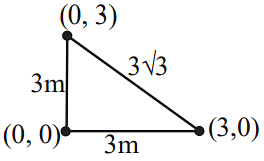
- Three identical spheres each of mass M are placed at the corners of a right angled triangle with mutually perpendicular sides equal to 3 m each. Taking point of intersection of mutually perpendicular sides as origin, the magnitude of position vector of centre of mass of the system will be √x m. The value of x is _______ .
- Consider a disc of mass 5 kg, radius 2 m, rotating with angular velocity of 10 rad/s about an axis perpendicular to the plane of rotation. An identical disc is kept gently over the rotating disc along the same axis. The energy dissipated so that both the discs continue to rotate together without slipping is \( \_\_\_\_ \) J.

- A ring and a solid sphere roll down the same inclined plane without slipping. They start from rest. The radii of both bodies are identical and the ratio of their kinetic energies is \( \frac{7}{x} \) where \( x \) is \(\_\_\_\_\_\_\_\).
Top JEE Main Questions
- Two masses $m$ and $\frac{m}{2}$ are connected at the two ends of a massless rigid rod of length $l$. The rod is suspended by a thin wire of torsional constant $k$ at the centre of mass of the rod-mass system(see figure). Because of torsional constant $k$, the restoring torque is $\tau =k\theta$ for angular displacement $\theta$. If the rod is rota ted by $\theta_0$ and released, the tension in it when it passes through its mean position will be:
What will be the equilibrium constant of the given reaction carried out in a \(5 \,L\) vessel and having equilibrium amounts of \(A_2\) and \(A\) as \(0.5\) mole and \(2 \times 10^{-6}\) mole respectively?
The reaction : \(A_2 \rightleftharpoons 2A\)- The value of is
- The number of terms of an is even. The sum of the odd terms is and of the even terms is . The last term exceeds the first by . Then the number of terms in the series is ______.
A black body is at a temperature of 2880 K. The energy of radiation emitted by this body with wavelength between 499 nm and 500 nm is U1, between 999 nm and 1000 nm is U2 and between 1499 nm and 1500 nm is U3. The Wien's constant, b = 2.88×10⁶ nm-K. Then,