Question:
The table lists the unit selling price of five products P, Q, R, S, and T. On a particular day, 250 items were sold with the average selling price of Rs. 60. The following observations were made:
(i) The quantity of S sold was twice that of T.
(ii) The quantity of R sold was thrice that of T.
(iii) The quantity of Q sold was four times that of T.
Product P Q R S T Unit selling price (Rs.) 100 50 40 60 60
What is the quantity of product P sold on that day?
The table lists the unit selling price of five products P, Q, R, S, and T. On a particular day, 250 items were sold with the average selling price of Rs. 60. The following observations were made:
(i) The quantity of S sold was twice that of T.
(ii) The quantity of R sold was thrice that of T.
(iii) The quantity of Q sold was four times that of T.
What is the quantity of product P sold on that day?
(i) The quantity of S sold was twice that of T.
(ii) The quantity of R sold was thrice that of T.
(iii) The quantity of Q sold was four times that of T.
| Product | P | Q | R | S | T |
|---|---|---|---|---|---|
| Unit selling price (Rs.) | 100 | 50 | 40 | 60 | 60 |
What is the quantity of product P sold on that day?
Show Hint
Write the quantities of Q, R, S in terms of T, then use both the total item count (250) and the total revenue (250 x 60) to form two equations in P's quantity and T.
Updated On: Jul 22, 2026
- 40
- 50
- 60
- 70
Show Solution

Verified By Collegedunia
The Correct Option is B
Solution and Explanation
Step 1: Set up variables for each product's quantity.
Let the quantity of T sold be \(t\). From the observations,
Quantity of S \(= 2t\), Quantity of R \(= 3t\), Quantity of Q \(= 4t\).
Let the quantity of P sold be \(p\), which is what we need to find.
Step 2: Write the total-items equation.
The total number of items sold that day is \(250\), so
\[ p + 4t + 3t + 2t + t = 250 \]
\[ p + 10t = 250 \quad \text{...(1)} \]
Step 3: Write the total-revenue equation.
The average selling price was Rs. \(60\) over \(250\) items, so the total revenue that day was
\[ 250 \times 60 = 15000 \]
Revenue is quantity times unit price, added across all five products:
\[ 100p + 50(4t) + 40(3t) + 60(2t) + 60(t) = 15000 \]
\[ 100p + 200t + 120t + 120t + 60t = 15000 \]
\[ 100p + 500t = 15000 \quad \text{...(2)} \]
Step 4: Solve the two equations together.
From equation (1), \(p = 250-10t\). Substitute this into equation (2):
\[ 100(250-10t) + 500t = 15000 \]
\[ 25000 - 1000t + 500t = 15000 \]
\[ 25000 - 500t = 15000 \]
\[ 500t = 10000 \implies t = 20 \]
Step 5: Find \(p\).
\[ p = 250 - 10(20) = 250-200 = 50 \]
So the quantity of product P sold that day is \(50\).
Step 6: Quick check.
With \(t=20\): Q\(=80\), R\(=60\), S\(=40\), T\(=20\), P\(=50\), total \(=50+80+60+40+20=250\), correct. Revenue \(=100(50)+50(80)+40(60)+60(40)+60(20)=5000+4000+2400+2400+1200=15000\), matching Rs. \(60\) average over \(250\) items.
Step 7: Final Answer.
\[ \boxed{p = 50} \]
Let the quantity of T sold be \(t\). From the observations,
Quantity of S \(= 2t\), Quantity of R \(= 3t\), Quantity of Q \(= 4t\).
Let the quantity of P sold be \(p\), which is what we need to find.
Step 2: Write the total-items equation.
The total number of items sold that day is \(250\), so
\[ p + 4t + 3t + 2t + t = 250 \]
\[ p + 10t = 250 \quad \text{...(1)} \]
Step 3: Write the total-revenue equation.
The average selling price was Rs. \(60\) over \(250\) items, so the total revenue that day was
\[ 250 \times 60 = 15000 \]
Revenue is quantity times unit price, added across all five products:
\[ 100p + 50(4t) + 40(3t) + 60(2t) + 60(t) = 15000 \]
\[ 100p + 200t + 120t + 120t + 60t = 15000 \]
\[ 100p + 500t = 15000 \quad \text{...(2)} \]
Step 4: Solve the two equations together.
From equation (1), \(p = 250-10t\). Substitute this into equation (2):
\[ 100(250-10t) + 500t = 15000 \]
\[ 25000 - 1000t + 500t = 15000 \]
\[ 25000 - 500t = 15000 \]
\[ 500t = 10000 \implies t = 20 \]
Step 5: Find \(p\).
\[ p = 250 - 10(20) = 250-200 = 50 \]
So the quantity of product P sold that day is \(50\).
Step 6: Quick check.
With \(t=20\): Q\(=80\), R\(=60\), S\(=40\), T\(=20\), P\(=50\), total \(=50+80+60+40+20=250\), correct. Revenue \(=100(50)+50(80)+40(60)+60(40)+60(20)=5000+4000+2400+2400+1200=15000\), matching Rs. \(60\) average over \(250\) items.
Step 7: Final Answer.
\[ \boxed{p = 50} \]
Was this answer helpful?
0
0
Top GATE CE General Aptitude Questions
- Find the value of x
3, 7, 15, x, 63, 127, 255 - What is the relationship between P & Q?
\(\left(\frac{P}{Q}\right)^{\frac{P}{Q}} = P^{\frac{P}{Q}-1}\) - If ‘→' denotes increasing order of intensity, then the meaning of the words [smile → giggle → laugh] is analogous to [disapprove → ________→ chide]. Which one of the given options is appropriate to fill the blank?
- Find the odd one out in the set: {19, 37, 21, 17, 23, 29, 31, 11}
- In the following series, identify the number that needs to be changed to form the Fibonacci series. 1, 1, 2, 3, 6, 8, 13, 21,...
View More Questions
Top GATE CE Data Interpretation Questions
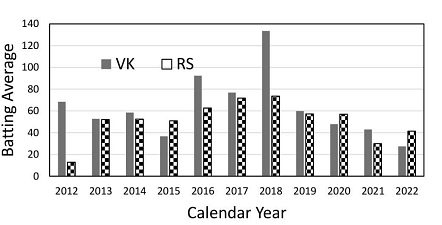
- The bar chart gives the batting averages of VK and RS for 11 calendar years from 2012 to 2022. Considering that 2015 and 2019 are world cup years, which one of the following options is true?
- A planar rectangular paper has two V-shaped pieces attached as shown below.
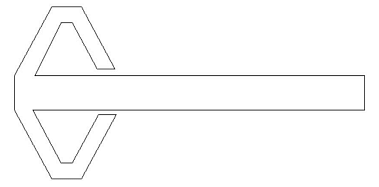
This piece of paper is folded to make the following closed three-dimensional object.
The number of folds required to form the above object is
Top GATE CE Questions
- If \(1+\frac{1}{2}+\frac{1}{3}+\frac{1}{4}+\frac{1}{5}+\frac{1}{6}+\frac{1}{7}+\frac{1}{8}+\frac{1}{9}....\frac{1}{29} =\frac{N}{29!}\) Find the remainder when N is divided by 19.
- What will be the relative density?
M = 0.5 percentage of air voids
γmin = 1.3 gm/cc
γmax = 1.8 gm/cc - Find RL of R?
RL of P [BM = 200.000Point Staff Readings
Back sideStaff Readings
Fore sideRemarks P -2.050 - 200.000 Q 1.050 0.95 Change Point R - -1.655 - - What will the angle of the failure plane from horizontal for sand be?
σ3=300
σ1=300+100=400 - Which of the following having negative skamptam Pore water coefficient?
View More Questions