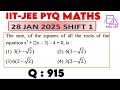
The sum of the squares of all the roots of the equation \( x^2 + [2x - 3] - 4 = 0 \) is:
Show Hint
- \(3(2 - \sqrt{2})\)
- \(6(2 - \sqrt{2})\)
- \(3(3 - \sqrt{2})\)
\(6(2 - \sqrt{2})\)

The Correct Option is D
Solution and Explanation
We are given the equation: \[ x^2 + |2x - 3| - 4 = 0 \]
Case 1: \( x \geq \frac{3}{2} \)
The absolute value simplifies to: \[ x^2 + 2x - 3 - 4 = 0 \] Simplified equation: \[ x^2 + 2x - 7 = 0 \] Solution: \[ x = 2\sqrt{2} - 1 \]
Case 2: \( x < \frac{3}{2} \)
The absolute value becomes: \[ x^2 + 3 - 2x - 4 = 0 \] Simplified equation: \[ x^2 - 2x - 1 = 0 \] Solution: \[ x = 1 - \sqrt{2} \]
Sum of Squares Calculation:
\[ \left( 2\sqrt{2} - 1 \right)^2 + \left( 1 - \sqrt{2} \right)^2 \] Expansion: \[ = 8 - 4\sqrt{2} + 1 + 1 - 2\sqrt{2} + 2 \] Simplification: \[ = 12 - 6\sqrt{2} = 6(2 - \sqrt{2}) \]
Final Answer:
The sum of squares of the solutions is \(6(2 - \sqrt{2})\).
Learn with videos:
Top JEE Main Mathematics Questions
- The value of is
- The number of terms of an is even. The sum of the odd terms is and of the even terms is . The last term exceeds the first by . Then the number of terms in the series is ______.
- If , then the general value of is:
- The general solution of
- If the constant term in the binomial expansion of $\left(\frac{x^{\frac{3}{2}}}{2}-\frac{4}{x^l}\right)^9$ is $-84$ and the coefficient of $x^{-3 l}$ is $2^\alpha \beta$, where $\beta<0$ is an odd number, then $|\alpha l-\beta|$ is equal to_____
Top JEE Main Quadratic Equations Questions
Let p and q be two real numbers such that p + q = 3 and p4 + q4 = 369. Then
\((\frac{1}{p} + \frac{1}{q} )^{-2}\)
is equal to _______.- Given \(x^2 - 70x + \lambda = 0\) with positive integral roots a and B where one of the root is less than 10, and \( \frac{\lambda}2 \times i \frac{\lambda}3\) are not integers, then find value of \(\frac{\sqrt{α-1} +\sqrt{β-1}}{|α-β|}\)
- If\[\int \frac{\sin^{\frac{2}{3}} x + \cos^{\frac{2}{3}} x}{\sqrt{\sin^{\frac{1}{3}} x \cos^{\frac{1}{3}} x \sin(x - \theta)}} \, dx = A \sqrt{\cos \theta \tan x - \sin \theta} + B \sqrt{\cos \theta \cot x + \sin(x - \theta)} + C,\]where \( C \) is the integration constant, then \( AB \) is equal to ______.
- For \( 0<c<b<a \), let \( (a + b - 2c)x^2 + (b + c - 2a)x + (c + a - 2b) = 0 \) and \( \alpha \neq 1 \) be one of its roots. Then, among the two statements
(I) If \( \alpha \in (-1, 0) \), then \( b \) cannot be the geometric mean of \( a \) and \( c \)
(II) If \( \alpha \in (0, 1) \), then \( b \) may be the geometric mean of \( a \) and \( c \) - Let \( S \) be the set of positive integral values of \( a \) for which \[ \frac{a x^2 + 2(a + 1)x + 9a + 4}{x^2 - 8x + 32} < 0, \quad \forall x \in \mathbb{R}. \] Then, the number of elements in \( S \) is:
Top JEE Main Questions
- In a hydrogen like atom, when an electron jumps from the $M$ - shell to the $L$ - shell, the wavelength of emitted radiation is $\lambda$. If an electron jumps from $N$-shell to the $L$-shell, the wavelength of emitted radiation will be :
- Two masses $m$ and $\frac{m}{2}$ are connected at the two ends of a massless rigid rod of length $l$. The rod is suspended by a thin wire of torsional constant $k$ at the centre of mass of the rod-mass system(see figure). Because of torsional constant $k$, the restoring torque is $\tau =k\theta$ for angular displacement $\theta$. If the rod is rota ted by $\theta_0$ and released, the tension in it when it passes through its mean position will be:
What will be the equilibrium constant of the given reaction carried out in a \(5 \,L\) vessel and having equilibrium amounts of \(A_2\) and \(A\) as \(0.5\) mole and \(2 \times 10^{-6}\) mole respectively?
The reaction : \(A_2 \rightleftharpoons 2A\)- The value of is
- The number of terms of an is even. The sum of the odd terms is and of the even terms is . The last term exceeds the first by . Then the number of terms in the series is ______.