The sum of bridging carbonyls in W(CO)6 and Mn2(CO)10 is_____.
Show Hint
For determining bridging carbonyls:
• Examine the geometry and bonding of the complex.
• Bridging carbonyls are shared between two metal centers, while terminal carbonyls are bonded to a single metal atom.

Correct Answer: 0
Solution and Explanation
1. Bridging Carbonyls in W(CO)6:
- Tungsten hexacarbonyl (W(CO)6) has an octahedral geometry, and all carbonyl ligands are terminal.
- Number of bridging carbonyls: 0.
2. Bridging Carbonyls in Mn2(CO)10:
- Manganese decacarbonyl (Mn2(CO)10) has a metal-metal bond with all carbonyls being terminal in its structure.
- Number of bridging carbonyls: 0.
3. Total Bridging Carbonyls:
- Sum = 0 + 0 = 0.
Top JEE Main Chemistry Questions
What will be the equilibrium constant of the given reaction carried out in a \(5 \,L\) vessel and having equilibrium amounts of \(A_2\) and \(A\) as \(0.5\) mole and \(2 \times 10^{-6}\) mole respectively?
The reaction : \(A_2 \rightleftharpoons 2A\)- At equilibrium the concentrations of and in a sealed vessel at . What will be for the reaction
- Find out the major products from the following reactions

Cobalt chloride when dissolved in water forms pink colored complex $X$ which has octahedral geometry. This solution on treating with cone $HCl$ forms deep blue complex, $\underline{Y}$ which has a $\underline{Z}$ geometry $X, Y$ and $Z$, respectively, are
- The correct order of atomic radii is:
Top JEE Main Hydrocarbons Questions
- A \(10\) \(mL\) hydrocarbon \((C_2H_4)\) on combustion give \(40\) \(mL\) \(CO_2\) and \(50\) \(mL\) \(H_20\). Calculate the value of \(x+y\)
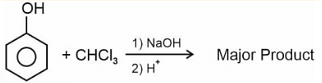
The major product in the above reaction is- 3-Methylhex-2-ene on reaction with HBr in presence of peroxide forms an addition product (A). The number of possible stereoisomers for 'A' is ______.
- Cyclohexene
 is _________ type of an organic compound.
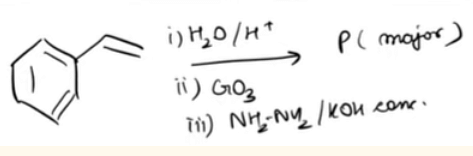
 - Find product P of the following reaction-
Top JEE Main Questions
- In a hydrogen like atom, when an electron jumps from the $M$ - shell to the $L$ - shell, the wavelength of emitted radiation is $\lambda$. If an electron jumps from $N$-shell to the $L$-shell, the wavelength of emitted radiation will be :
- Two masses $m$ and $\frac{m}{2}$ are connected at the two ends of a massless rigid rod of length $l$. The rod is suspended by a thin wire of torsional constant $k$ at the centre of mass of the rod-mass system(see figure). Because of torsional constant $k$, the restoring torque is $\tau =k\theta$ for angular displacement $\theta$. If the rod is rota ted by $\theta_0$ and released, the tension in it when it passes through its mean position will be:
What will be the equilibrium constant of the given reaction carried out in a \(5 \,L\) vessel and having equilibrium amounts of \(A_2\) and \(A\) as \(0.5\) mole and \(2 \times 10^{-6}\) mole respectively?
The reaction : \(A_2 \rightleftharpoons 2A\)- The value of is
- The number of terms of an is even. The sum of the odd terms is and of the even terms is . The last term exceeds the first by . Then the number of terms in the series is ______.