The structure of \(\mathrm{B_4H_{10}}\) is given below. Its styx number is:
Show Hint
Count total H (10) minus one terminal H per boron (4) to get 6 extra H's split between bridges (s) and \(\mathrm{BH_2}\) groups (x); read the one B-B bond as y and check t=0 from the open butterfly skeleton.
Step 1: Recall what styx counts.
Lipscomb's topological (styx) notation describes an electron-deficient borane using four numbers: \(s\) = number of 3-centre-2-electron \(\mathrm{B-H-B}\) bridge bonds, \(t\) = number of 3-centre-2-electron \(\mathrm{B-B-B}\) bonds, \(y\) = number of ordinary 2-centre-2-electron \(\mathrm{B-B}\) bonds, and \(x\) = number of \(\mathrm{BH_2}\) groups (borons carrying an extra terminal hydrogen beyond the one every boron already has).
Step 2: Work out \(p\) and \(q\) for \(\mathrm{B_4H_{10}}\).
Here \(p=4\) borons. Total hydrogens \(=10\), and since every boron already carries one terminal \(\mathrm{B-H}\) bond by default, the extra hydrogens are \(q=10-4=6\).
Step 3: Read the connectivity off the given structure.
The structure shows two central (bridgehead) boron atoms directly bonded to each other by a normal 2-centre bond, each carrying one terminal H. Each central boron is also linked to each of the two wingtip borons by a bridging hydrogen, giving 4 bridging \(\mathrm{B-H-B}\) bonds. Each wingtip boron carries two terminal hydrogens (a \(\mathrm{BH_2}\) group). This gives \(s=4\), \(t=0\) (no 3-centre \(\mathrm{B-B-B}\) bonds), \(y=1\) (the one direct \(\mathrm{B-B}\) bond between the bridgeheads), \(x=2\) (the two \(\mathrm{BH_2}\) wingtip borons).


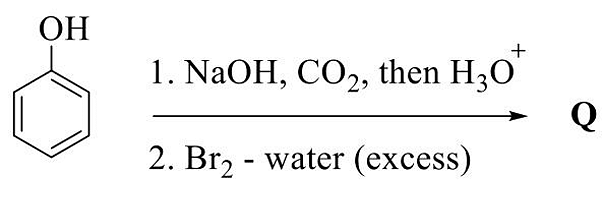
 what is the final product
 intensity ratio of final product