Question:
The standard enthalpy of the reaction,
\[
\text{C (graphite)} + \text{H}_2\text{O (g)} \rightarrow \text{CO (g)} + \text{H}_2\text{ (g)} \text{ is found to be } +131.3 \, \text{kJ mol}^{-1}
\]
and the \( \Delta_f H^\circ \) value for CO (g) is -110.5 kJ mol−1.
The value of \( \Delta_f H^\circ \) (in kJ mol−1) for H2O (g) is:
The standard enthalpy of the reaction,
\[
\text{C (graphite)} + \text{H}_2\text{O (g)} \rightarrow \text{CO (g)} + \text{H}_2\text{ (g)} \text{ is found to be } +131.3 \, \text{kJ mol}^{-1}
\]
and the \( \Delta_f H^\circ \) value for CO (g) is -110.5 kJ mol−1.
The value of \( \Delta_f H^\circ \) (in kJ mol−1) for H2O (g) is:
The value of \( \Delta_f H^\circ \) (in kJ mol−1) for H2O (g) is:
Show Hint
To solve enthalpy problems, use Hess's law and the standard enthalpies of formation to calculate the enthalpy change of the reaction.
Updated On: May 5, 2025
- +241.8
- 0.0
- -241.8
- +20.8
Show Solution

Verified By Collegedunia
The Correct Option is C
Solution and Explanation
The standard enthalpy change for a reaction can be calculated using the following equation:
\[ \Delta_r H^\circ = \sum (\Delta_f H^\circ { products}) - \sum (\Delta_f H^\circ { reactants}) \] From the problem statement, we know the standard enthalpy change for the reaction is \( +131.3 \, {kJ mol}^{-1} \). The given values are:
- \( \Delta_f H^\circ ({CO (g)}) = -110.5 \, {kJ mol}^{-1} \)
- \( \Delta_f H^\circ ({H}_2 ({g})) = 0.0 \, {kJ mol}^{-1} \) (since \( {H}_2 \) is in its standard state)
Substituting the values into the equation:
\[ 131.3 = \left[ (-110.5) + (0.0) \right] - \left[ \Delta_f H^\circ ({C(graphite)}) + \Delta_f H^\circ ({H}_2{O (g)}) \right] \] Since the standard enthalpy of formation of graphite is zero:
\[ 131.3 = (-110.5) - \Delta_f H^\circ ({H}_2{O (g)}) \] Solving for \( \Delta_f H^\circ ({H}_2{O (g)}) \):
\[ \Delta_f H^\circ ({H}_2{O (g)}) = -241.8 \, {kJ mol}^{-1} \] Thus, the value of \( \Delta_f H^\circ \) for {H}_2{O} (g) is \( -241.8 \, {kJ mol}^{-1} \).
\[ \Delta_r H^\circ = \sum (\Delta_f H^\circ { products}) - \sum (\Delta_f H^\circ { reactants}) \] From the problem statement, we know the standard enthalpy change for the reaction is \( +131.3 \, {kJ mol}^{-1} \). The given values are:
- \( \Delta_f H^\circ ({CO (g)}) = -110.5 \, {kJ mol}^{-1} \)
- \( \Delta_f H^\circ ({H}_2 ({g})) = 0.0 \, {kJ mol}^{-1} \) (since \( {H}_2 \) is in its standard state)
Substituting the values into the equation:
\[ 131.3 = \left[ (-110.5) + (0.0) \right] - \left[ \Delta_f H^\circ ({C(graphite)}) + \Delta_f H^\circ ({H}_2{O (g)}) \right] \] Since the standard enthalpy of formation of graphite is zero:
\[ 131.3 = (-110.5) - \Delta_f H^\circ ({H}_2{O (g)}) \] Solving for \( \Delta_f H^\circ ({H}_2{O (g)}) \):
\[ \Delta_f H^\circ ({H}_2{O (g)}) = -241.8 \, {kJ mol}^{-1} \] Thus, the value of \( \Delta_f H^\circ \) for {H}_2{O} (g) is \( -241.8 \, {kJ mol}^{-1} \).
Was this answer helpful?
0
0
Top GATE XL Chemistry Questions
- The CORRECT order of electronegativity is
- Which one of the following is the CORRECT representation of the variation of the Gibbs free energy (G) of a substance with temperature (T) at constant pressure?
- Among the following, the structure representing histidine is
- The CORRECT order of acidity of the following compounds is
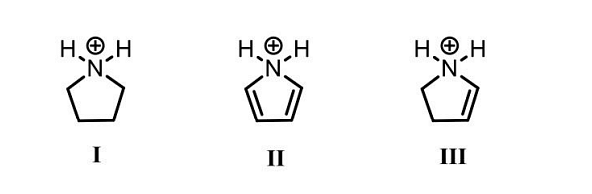
- The molecules A and B are a pair of___
View More Questions
Top GATE XL Thermodynamics Questions
Top GATE XL Questions
- The CORRECT order of electronegativity is
- Which one of the following is the CORRECT representation of the variation of the Gibbs free energy (G) of a substance with temperature (T) at constant pressure?
- Among the following, the structure representing histidine is
- The CORRECT order of acidity of the following compounds is
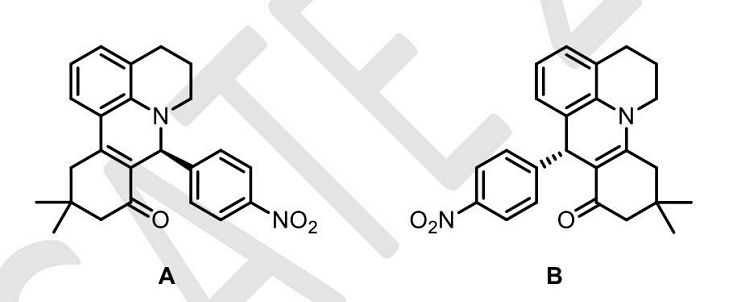
- The molecules A and B are a pair of___
View More Questions