The set(s) of reagents that will effect the following conversion is(are)
Show Hint
Look for a one-carbon Wittig-type homologation (Ph3P=CHOMe/H3O+) or a sulfonium-ylide epoxidation followed by a BF3-catalyzed Meinwald (1,2-hydride shift) rearrangement.
Step 1: Identify the transformation.
The starting ketone is a cyclic ketone (the ring carbon carries \(=\mathrm{O}\)); the product has the SAME ring skeleton but that carbon is now a plain \(\mathrm{CH}\) carrying an exocyclic \(-\mathrm{CHO}\) group. So the net change is: ring \(\mathrm{C{=}O}\) becomes ring \(\mathrm{CH{-}CHO}\), which is a one-carbon homologation of a ketone to an aldehyde (one extra carbon is inserted between the ring and the carbonyl oxygen). We need to pick which reagent set(s) accomplish exactly this.
Step 2: Check option (A), the Wittig homologation.
\(\mathrm{Ph_3P{=}CHOMe}\) is a stabilized methoxymethylene Wittig ylide. It reacts with the ketone carbonyl to replace \(\mathrm{C{=}O}\) with \(\mathrm{C{=}CH\text{-}OMe}\), a vinyl (enol) ether, at the same ring carbon.
Hydrolysis with aqueous acid (\(\mathrm{H_3O^+}\)) then hydrolyzes this enol ether: the \(\mathrm{C{=}CH\text{-}OMe}\) double bond is protonated, water adds, and methanol is lost, unmasking an aldehyde. Because the vinyl ether carbon was directly attached to the ring carbon, hydrolysis delivers the ring carbon as \(\mathrm{CH}\) bearing a \(\mathrm{-CHO}\) group.
This is exactly the target product, so (A) works: this Wittig-then-hydrolysis sequence is the standard one-carbon homologation of a ketone to an aldehyde.
Step 3: Check option (D), the sulfonium ylide / Meinwald rearrangement route.
\(\mathrm{Me_3SI}\) (trimethylsulfoxonium iodide) with \(\mathrm{NaH}\) generates the Corey-Chaykovsky ylide \(\mathrm{Me_2S(O){=}CH_2}\). This ylide adds to the ketone carbonyl and displaces \(\mathrm{Me_2SO}\) to give a spiro-epoxide, methylenating the carbonyl carbon (the ring carbon that was \(\mathrm{C{=}O}\) is now part of a three-membered epoxide ring with an extra \(\mathrm{CH_2}\)).
Treating this spiro-epoxide with the Lewis acid \(\mathrm{BF_3\cdot OEt_2}\) opens the epoxide (Meinwald rearrangement): the ring carbon-oxygen bond that regenerates the more stable, more substituted carbocation breaks, and a 1,2-hydride shift from the adjacent epoxide carbon delivers the oxygen as a carbonyl on the exocyclic carbon, i.e. the ring carbon ends up as \(\mathrm{CH}\) bearing \(\mathrm{-CHO}\).
This again gives the same one-carbon homologated aldehyde, so (D) also works.
Step 4: Rule out option (B).
\(\mathrm{TsNHNH_2}\) converts the ketone to its tosylhydrazone. Treating this with 2 equivalents of \(^{n}\mathrm{BuLi}\) is the Shapiro reaction: it eliminates \(\mathrm{N_2}\) and \(\mathrm{Ts^-}\) to generate a VINYLLITHIUM at the former carbonyl carbon, with a new ring \(\mathrm{C{=}C}\) double bond to the adjacent ring carbon. Quenching this vinyllithium with \(\mathrm{DMF}\) installs a formyl group ON that alkene carbon, giving an \(\alpha,\beta\)-unsaturated aldehyde (an enal), which has one MORE degree of unsaturation than the target (the target ring is fully saturated at that position, with a simple \(\mathrm{CH{-}CHO}\), not a ring alkene). So (B) gives the wrong (unsaturated) product.
Step 5: Rule out option (C).
Lithiated 1,3-dithiane is an acyl-anion equivalent, but adding it to a ketone carbonyl gives simple nucleophilic addition, installing a tertiary alcohol bearing the dithiane group on that carbon, not a homologated chain. Hydrolysis of the dithiane with \(\mathrm{HgSO_4}\)/dil. \(\mathrm{H_2SO_4}\) would then unmask a carbonyl on the dithiane carbon, giving an \(\alpha\)-hydroxy ketone type product, which does not match the simple \(\mathrm{CH{-}CHO}\) target. So (C) is wrong.
Final Answer:
Only the Wittig homologation (A) and the sulfonium-ylide/Meinwald rearrangement route (D) deliver the one-carbon homologated aldehyde shown. \[ \boxed{\text{(A) and (D)}} \]


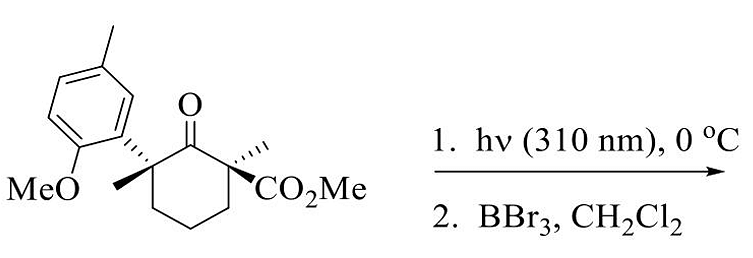
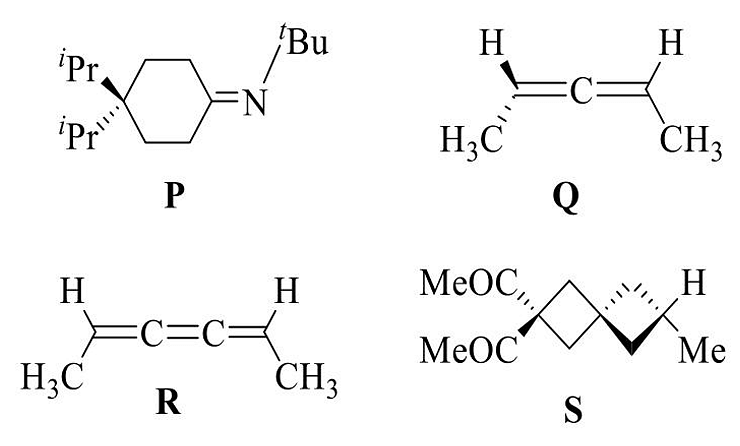
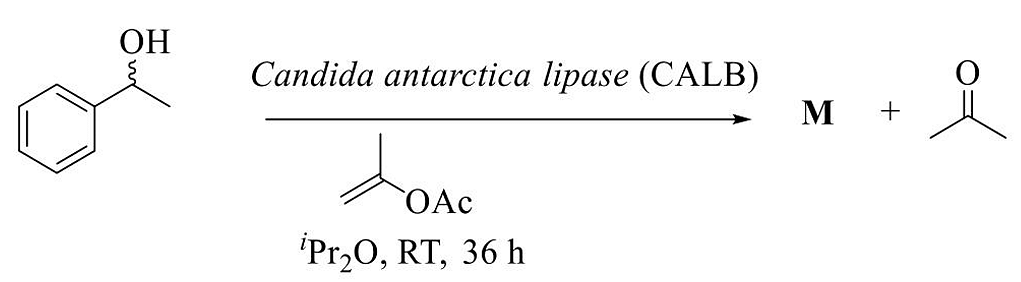
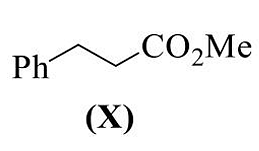
 what is the final product
 intensity ratio of final product