The reagent(s) that will effect the following transformation is(are) (\(\mathrm{MEM} = \) methoxyethoxymethyl)
Show Hint
MEM is an acetal-type protecting group; look for a mild Lewis acid or Bronsted acid in a protic solvent, not a hydrogenolysis or fluoride reagent (those remove different protecting groups).
Step 1: Understanding the Question.
The starting material is an alcohol protected as its MEM ether (a \(\mathrm{-O-CH_2-O-CH_2CH_2-OCH_3}\) acetal-type group attached to the alcohol oxygen), and the product is the free primary alcohol. So we need reagent(s) that selectively remove a MEM protecting group without touching anything else in the molecule.
Step 2: Key idea, how a MEM ether is removed.
A MEM ether is essentially a mixed acetal (formaldehyde acetal of the substrate alcohol and 2-methoxyethanol). It is cleaved by activating that acetal center, either with a Lewis acid that coordinates to one of the acetal oxygens and helps expel the alkoxide, or with a mild Bronsted acid catalyst in a protic solvent that protonates an acetal oxygen and does the same job, in both cases regenerating the free alcohol plus formaldehyde and 2-methoxyethanol as byproducts.
Step 3: Evaluate option (A), \(Pd/C, H_2\).
This is a hydrogenolysis condition, used to cleave benzylic C-O bonds (as in a benzyl ether) or to reduce alkenes/alkynes. The MEM acetal has no benzylic C-O bond and no unsaturation to hydrogenate, so \(Pd/C, H_2\) does nothing to it. Wrong.
Step 4: Evaluate option (B), \(ZnBr_2\).
\(ZnBr_2\) is a classic mild Lewis acid used specifically to cleave MEM ethers (in a solvent like \(CH_2Cl_2\)). It coordinates to the acetal oxygen, weakens the \(C-O\) bond to the alcohol oxygen, and lets the free alcohol leave as the MEM group is expelled as an oxocarbenium species that is trapped and destroyed. This is a textbook MEM deprotection reagent. Correct.
Step 5: Evaluate option (C), PPTS, \(^tBuOH\).
Pyridinium \(p\)-toluenesulfonate is a very mild proton source. In a protic solvent such as \(^tBuOH\) under reflux, catalytic PPTS protonates the acetal oxygen of the MEM group and promotes its hydrolysis/solvolysis back to the free alcohol, a standard mild-acid method for removing MEM (and THP) ethers. Correct.
Step 6: Evaluate option (D), \(^nBu_4NF\) (TBAF).
Fluoride is a specific reagent for cleaving silicon-oxygen bonds in silyl ethers (\(TMS\), \(TBS\), \(TIPS\)), because fluoride has an extremely strong affinity for silicon. The MEM group has no silicon in it, so TBAF does not touch it. Wrong.
Final Answer:
The reagents that remove the MEM group and reveal the free alcohol are \(ZnBr_2\) and PPTS/\(^tBuOH\).
\[ \boxed{\text{(B) and (C)}} \]


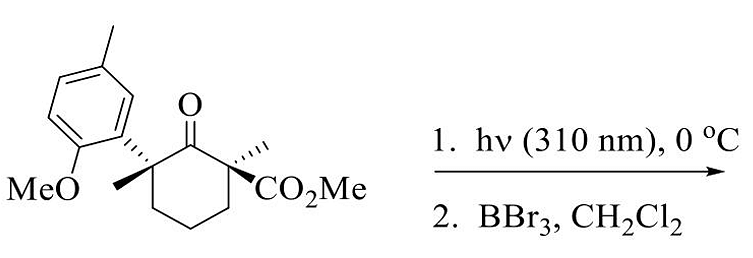
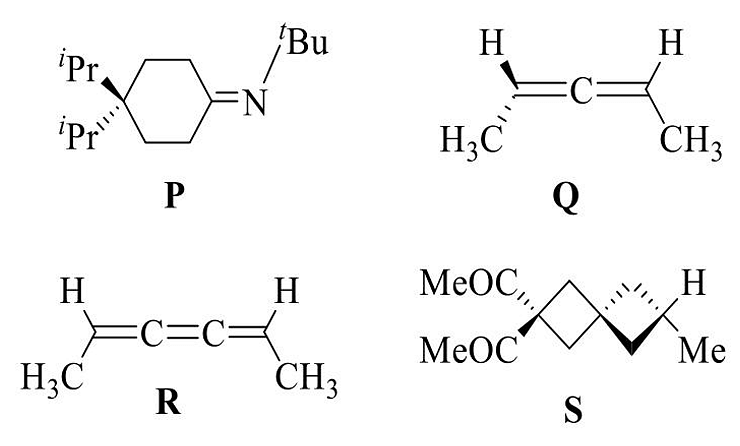
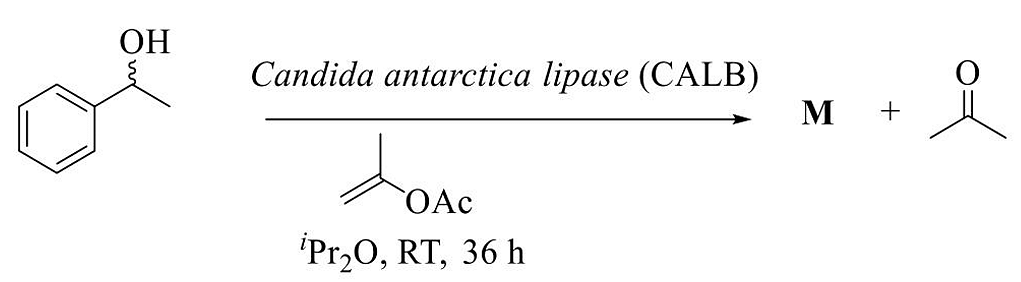
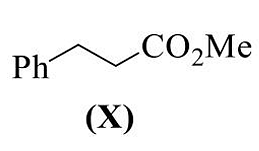
 what is the final product
 intensity ratio of final product