Question:
The reaction(s) that produce(s) 2-methylindole as the major product is(are)
The reaction(s) that produce(s) 2-methylindole as the major product is(are)
Show Hint
Count the ring size each route builds first (six-membered = quinoline, not indole), then check what group actually ends up at indole C2.
Updated On: Aug 10, 2026


Show Solution

Verified By Collegedunia
The Correct Option is B, D
Solution and Explanation
Step 1: Recognize this as a "spot the named indole synthesis" question.
Each option draws a classic named synthesis. We need the one(s) that specifically build the INDOLE ring (a five-membered pyrrole fused to benzene) with a methyl group landing at C2, not some other heterocycle or a differently substituted indole.
Step 2: Check option (A), actually a quinoline synthesis, not an indole synthesis.
2-Nitrobenzaldehyde and acetone under \(\mathrm{NaOH}\) undergo an aldol (Claisen-Schmidt) condensation to give the enone \(\mathrm{Ar\text{-}CH{=}CH\text{-}CO\text{-}CH_3}\) (\(\mathrm{Ar}=\) 2-nitrophenyl). Reducing the nitro group with \(\mathrm{Sn/HCl}\) generates an ortho-amino group, which then condenses intramolecularly with the ketone carbon three atoms further down the chain. Counting atoms around that ring closure gives a SIX-membered ring fused to benzene, i.e. this is the Friedlander-type synthesis of quinaldine (2-methylquinoline), not an indole. So (A) does not give 2-methylindole.
Step 3: Check option (B), the Cadogan (Sundberg) reductive cyclization.
The substrate is an ortho-nitro-\(\beta\)-methylstyrene, \(\mathrm{Ar(NO_2)\text{-}CH{=}CH\text{-}CH_3}\). Heating with the trivalent phosphite \(\mathrm{P(OEt)_3}\) deoxygenates the nitro group to a nitrene at nitrogen; this nitrene undergoes intramolecular cyclization onto the adjacent alkene (with loss of \(\mathrm{P(OEt)_3{=}O}\)), closing the five-membered pyrrole ring directly. The carbon that carried the methyl group becomes indole C2 (next to nitrogen), so this gives 2-methylindole directly, in one pot. So (B) works.
Step 4: Check option (C), the classical Reissert synthesis of an indole-2-CARBOXYLATE, not 2-methylindole.
2-Nitrotoluene's benzylic \(\mathrm{CH_3}\) (activated by the ortho nitro group) is deprotonated by \(\mathrm{NaOEt}\) and undergoes a Claisen condensation with diethyl oxalate, installing a \(\mathrm{-CH_2COCOOEt}\) side chain. Reducing the nitro group with \(\mathrm{Zn/AcOH}\) triggers reductive cyclization to give ethyl indole-2-carboxylate, an ester at C2, not a methyl group. So (C) gives the wrong substituent at C2 and is not the answer.
Step 5: Check option (D), the Gassman indole synthesis.
N-Chloroaniline reacts with the \(\beta\)-keto sulfide \(\mathrm{MeS\text{-}CH_2\text{-}CO\text{-}CH_3}\): the sulfide attacks the electrophilic N-Cl nitrogen, and base (\(\mathrm{Et_3N}\), heat) promotes a \([2,3]\)-sigmatropic rearrangement onto the ortho position of the ring, followed by cyclization, to give a 3-(methylthio)-2-methylindole intermediate (the "\(\mathrm{Me}\)" from the ketone lands at C2, and the sulfide sulfur ends up at C3). \(\mathrm{Raney\text{-}Ni}\) then desulfurizes, removing the C3 \(\mathrm{-SMe}\) group and leaving plain 2-methylindole. So (D) works.
Final Answer:
Only the Cadogan-type reductive cyclization (B) and the Gassman synthesis (D) deliver 2-methylindole; (A) gives a quinoline and (C) gives an indole-2-carboxylate. \[ \boxed{\text{(B) and (D)}} \]
Each option draws a classic named synthesis. We need the one(s) that specifically build the INDOLE ring (a five-membered pyrrole fused to benzene) with a methyl group landing at C2, not some other heterocycle or a differently substituted indole.
Step 2: Check option (A), actually a quinoline synthesis, not an indole synthesis.
2-Nitrobenzaldehyde and acetone under \(\mathrm{NaOH}\) undergo an aldol (Claisen-Schmidt) condensation to give the enone \(\mathrm{Ar\text{-}CH{=}CH\text{-}CO\text{-}CH_3}\) (\(\mathrm{Ar}=\) 2-nitrophenyl). Reducing the nitro group with \(\mathrm{Sn/HCl}\) generates an ortho-amino group, which then condenses intramolecularly with the ketone carbon three atoms further down the chain. Counting atoms around that ring closure gives a SIX-membered ring fused to benzene, i.e. this is the Friedlander-type synthesis of quinaldine (2-methylquinoline), not an indole. So (A) does not give 2-methylindole.
Step 3: Check option (B), the Cadogan (Sundberg) reductive cyclization.
The substrate is an ortho-nitro-\(\beta\)-methylstyrene, \(\mathrm{Ar(NO_2)\text{-}CH{=}CH\text{-}CH_3}\). Heating with the trivalent phosphite \(\mathrm{P(OEt)_3}\) deoxygenates the nitro group to a nitrene at nitrogen; this nitrene undergoes intramolecular cyclization onto the adjacent alkene (with loss of \(\mathrm{P(OEt)_3{=}O}\)), closing the five-membered pyrrole ring directly. The carbon that carried the methyl group becomes indole C2 (next to nitrogen), so this gives 2-methylindole directly, in one pot. So (B) works.
Step 4: Check option (C), the classical Reissert synthesis of an indole-2-CARBOXYLATE, not 2-methylindole.
2-Nitrotoluene's benzylic \(\mathrm{CH_3}\) (activated by the ortho nitro group) is deprotonated by \(\mathrm{NaOEt}\) and undergoes a Claisen condensation with diethyl oxalate, installing a \(\mathrm{-CH_2COCOOEt}\) side chain. Reducing the nitro group with \(\mathrm{Zn/AcOH}\) triggers reductive cyclization to give ethyl indole-2-carboxylate, an ester at C2, not a methyl group. So (C) gives the wrong substituent at C2 and is not the answer.
Step 5: Check option (D), the Gassman indole synthesis.
N-Chloroaniline reacts with the \(\beta\)-keto sulfide \(\mathrm{MeS\text{-}CH_2\text{-}CO\text{-}CH_3}\): the sulfide attacks the electrophilic N-Cl nitrogen, and base (\(\mathrm{Et_3N}\), heat) promotes a \([2,3]\)-sigmatropic rearrangement onto the ortho position of the ring, followed by cyclization, to give a 3-(methylthio)-2-methylindole intermediate (the "\(\mathrm{Me}\)" from the ketone lands at C2, and the sulfide sulfur ends up at C3). \(\mathrm{Raney\text{-}Ni}\) then desulfurizes, removing the C3 \(\mathrm{-SMe}\) group and leaving plain 2-methylindole. So (D) works.
Final Answer:
Only the Cadogan-type reductive cyclization (B) and the Gassman synthesis (D) deliver 2-methylindole; (A) gives a quinoline and (C) gives an indole-2-carboxylate. \[ \boxed{\text{(B) and (D)}} \]
Was this answer helpful?
0
0
Top GATE CY Organic Chemistry Questions
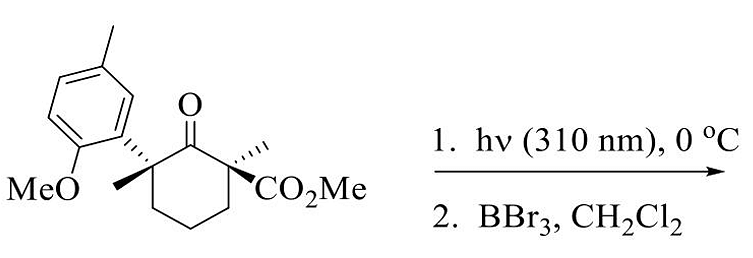
- The major product in the following reaction sequence is
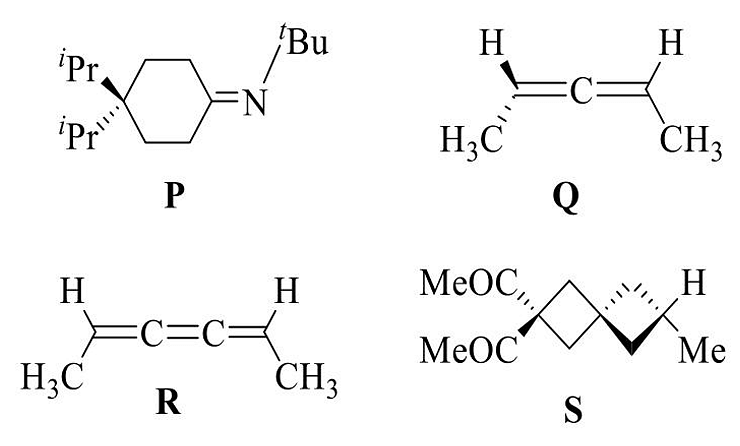
- Among the following, the chiral compound is
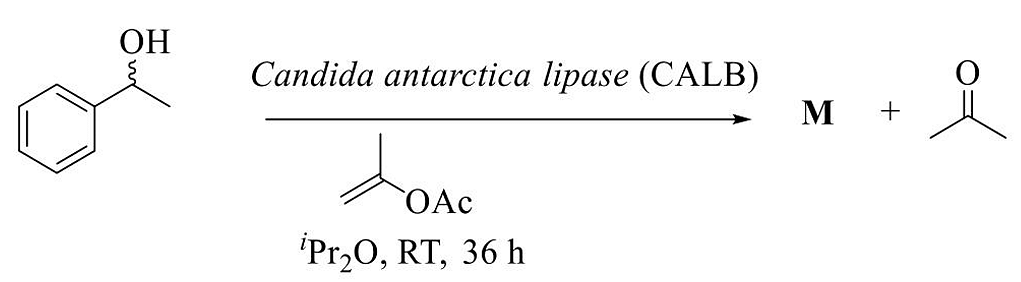
- The product M in the following reaction is
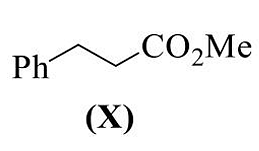
- The reaction(s) that yield(s) X as the major product is (are)
- The reaction(s) that yield(s) 2-methylquinoline as the major product is (are)
View More Questions
Top GATE CY Questions
- Ψ(x) = \(\sqrt{\frac{32}{L^3}}\)[sin(\(\frac{\pi x}{L}\)).cos(\(\frac{\pi x}{L}\)).sin(\(\frac{2\pi y}{L}\)).sin(\(\frac{\pi z}{L}\))]Find the value of E221: E111.
 what is the final product
- Which are optically active?
 intensity ratio of final product
- Which among the following is true?
View More Questions