The plane which bisects the line segment joining the points (-3,-3,4) and (3,7,6) at right angles, passes through which one of the following points ?
- (4, -1,7)
- (4,1,-2)
- (-2,3,5)
- (2,1,3)

The Correct Option is B
Solution and Explanation
Top JEE Main Mathematics Questions
- The value of is
- The number of terms of an is even. The sum of the odd terms is and of the even terms is . The last term exceeds the first by . Then the number of terms in the series is ______.
- If , then the general value of is:
- The general solution of
- If the constant term in the binomial expansion of $\left(\frac{x^{\frac{3}{2}}}{2}-\frac{4}{x^l}\right)^9$ is $-84$ and the coefficient of $x^{-3 l}$ is $2^\alpha \beta$, where $\beta<0$ is an odd number, then $|\alpha l-\beta|$ is equal to_____
Top JEE Main Distance of a Point from a Plane Questions
- Let the image of the point P(1, 2, 6) in the plane passing through the points A(1, 2, 0), B(1, 4, 1) and C(0, 5, 1) be Q (α, β, γ). Then (α2 + β2 + γ2) is equal to
- An equation of a plane parallel to the plane \(x-2y+2z-5=0\) and at a unit distance from the origin is?
- The square of the distance of the point \(\left( \frac{15}{7}, \frac{32}{7}, 7 \right)\) from the line \(\frac{x+1}{3} = \frac{y+3}{5} = \frac{z+5}{7}\) in the direction of the vector \(\mathbf{i} + 4\mathbf{j} + 7\mathbf{k}\) is:
- Let d be the distance between the foot of perpendiculars of the point P(1, 2, –1) and Q(2, –1, 3) on the plane –x + y + z = 1. Then d2 is equal to ____.
Top JEE Main Questions
- Two masses $m$ and $\frac{m}{2}$ are connected at the two ends of a massless rigid rod of length $l$. The rod is suspended by a thin wire of torsional constant $k$ at the centre of mass of the rod-mass system(see figure). Because of torsional constant $k$, the restoring torque is $\tau =k\theta$ for angular displacement $\theta$. If the rod is rota ted by $\theta_0$ and released, the tension in it when it passes through its mean position will be:
What will be the equilibrium constant of the given reaction carried out in a \(5 \,L\) vessel and having equilibrium amounts of \(A_2\) and \(A\) as \(0.5\) mole and \(2 \times 10^{-6}\) mole respectively?
The reaction : \(A_2 \rightleftharpoons 2A\)- The value of is
- The number of terms of an is even. The sum of the odd terms is and of the even terms is . The last term exceeds the first by . Then the number of terms in the series is ______.
A black body is at a temperature of 2880 K. The energy of radiation emitted by this body with wavelength between 499 nm and 500 nm is U1, between 999 nm and 1000 nm is U2 and between 1499 nm and 1500 nm is U3. The Wien's constant, b = 2.88×10⁶ nm-K. Then,
Concepts Used:
Distance of a Point from a Plane
The shortest perpendicular distance from the point to the given plane is the distance between point and plane. In simple terms, the shortest distance from a point to a plane is the length of the perpendicular parallel to the normal vector dropped from the particular point to the particular plane. Let's see the formula for the distance between point and plane.
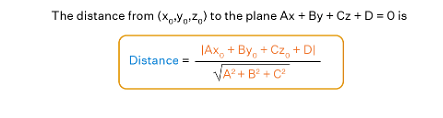
Read More: Distance Between Two Points