The paramagnetic species among the following is/are (Given: Atomic numbers of Cr = 24; Fe = 26; Ni = 28):
Show Hint
- ([Fe(CN)_6]^{3-})
- ([Ni(OH_2)_6]^{2+})
- ([Ni(CN)_4]^{2-})
- ([Cr(CN)_6]^{3-})

The Correct Option is A
Solution and Explanation
Paramagnetism arises due to the presence of unpaired electrons in a species. To determine whether a complex is paramagnetic, we evaluate the electronic configuration of the central metal ion and the effect of the ligands on its d-orbitals.
Step 2: Analyzing the given options.- Option (A): \([\text{Fe}(\text{CN})_6]^{3-}\)
Iron in this complex is in the +3 oxidation state (\(\text{Fe}^{3+}\), \(3d^5\)). Cyanide (\(\text{CN}^-\)) is a strong field ligand, leading to a low-spin complex with one unpaired electron. Therefore, this species is paramagnetic.
- Option (B): \([\text{Ni}(\text{OH}_2)_6]^{2+}\)
Nickel in this complex is in the +2 oxidation state (\(\text{Ni}^{2+}\), \(3d^8\)). Water (\(\text{H}_2\text{O}\)) is a weak field ligand, leading to a high-spin complex with two unpaired electrons. Therefore, this species is paramagnetic.
- Option (C): \([\text{Ni}(\text{CN})_4]^{2-}\)
Nickel in this complex is in the +2 oxidation state (\(\text{Ni}^{2+}\), \(3d^8\)). Cyanide (\(\text{CN}^-\)) is a strong field ligand, leading to a low-spin complex with all electrons paired. Therefore, this species is diamagnetic.
- Option (D): \([\text{Cr}(\text{CN})_6]^{3-}\)
Chromium in this complex is in the +3 oxidation state (\(\text{Cr}^{3+}\), \(3d^3\)). Cyanide (\(\text{CN}^-\)) is a strong field ligand, leading to a low-spin complex with three unpaired electrons. Therefore, this species is paramagnetic.
The paramagnetic species are \([\text{Fe}(\text{CN})_6]^{3-}\), \([\text{Ni}(\text{OH}_2)_6]^{2+}\), and \([\text{Cr}(\text{CN})_6]^{3-}\), corresponding to options (A), (B), and (D).
Top GATE XL Chemistry Questions
- The CORRECT order of electronegativity is
- Which one of the following is the CORRECT representation of the variation of the Gibbs free energy (G) of a substance with temperature (T) at constant pressure?
- Among the following, the structure representing histidine is
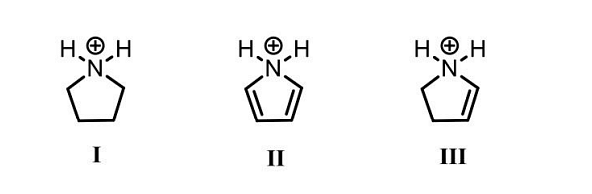
- The CORRECT order of acidity of the following compounds is
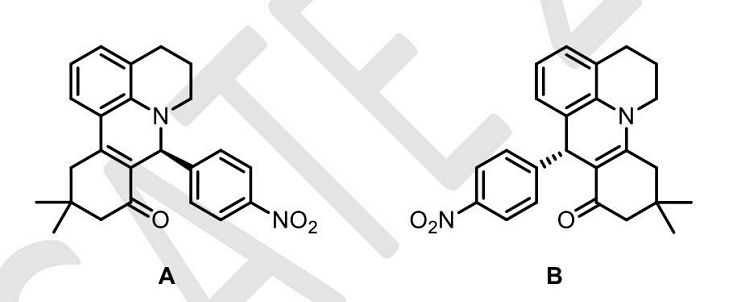
- The molecules A and B are a pair of___
Top GATE XL Order of reaction Questions
- The initial rate of a reaction triples when the concentration of a reactant, A, is doubled. The order of the reaction with respect to A is _______(rounded off to 2 decimal places).
- The initial rate of a reaction triples when the concentration of a reactant, A, is doubled. The order of the reaction with respect to A is _______(rounded off to 2 decimal places).
- The CORRECT order of electronegativity is:
The CORRECT order of acidity of the following compounds is:

The CORRECT option(s) of ( Y ) for the following reaction is/are:

Top GATE XL Questions
- The CORRECT order of electronegativity is
- Which one of the following is the CORRECT representation of the variation of the Gibbs free energy (G) of a substance with temperature (T) at constant pressure?
- Among the following, the structure representing histidine is
- The CORRECT order of acidity of the following compounds is
- The molecules A and B are a pair of___