Question:
The pair(s) of lanthanide ions whose ground state term symbols have same spin multiplicity \((2S+1)\) and orbital angular momentum \((L)\), but different spin-orbit coupling \((J)\) is(are)
(Given: Atomic number: \(\mathrm{Nd}=60\); \(\mathrm{Pm}=61\); \(\mathrm{Ho}=67\); \(\mathrm{Er}=68\))
The pair(s) of lanthanide ions whose ground state term symbols have same spin multiplicity \((2S+1)\) and orbital angular momentum \((L)\), but different spin-orbit coupling \((J)\) is(are)
(Given: Atomic number: \(\mathrm{Nd}=60\); \(\mathrm{Pm}=61\); \(\mathrm{Ho}=67\); \(\mathrm{Er}=68\))
(Given: Atomic number: \(\mathrm{Nd}=60\); \(\mathrm{Pm}=61\); \(\mathrm{Ho}=67\); \(\mathrm{Er}=68\))
Show Hint
Get the 4f electron count from \(n=Z-57\), apply Hund's rules for \(S\) and \(L\), then use the less/more-than-half-filled rule for \(J\); ions whose electron counts add up to 14 (hole partners) share the same \(S,L\).
Updated On: Aug 10, 2026
- \(\mathrm{Pm^{3+}}\) and \(\mathrm{Ho^{3+}}\)
- \(\mathrm{Nd^{3+}}\) and \(\mathrm{Er^{3+}}\)
- \(\mathrm{Pm^{3+}}\) and \(\mathrm{Nd^{3+}}\)
- \(\mathrm{Ho^{3+}}\) and \(\mathrm{Er^{3+}}\)
Show Solution

Verified By Collegedunia
The Correct Option is A, B
Solution and Explanation
Step 1: Find the 4f electron count of each ion.
For a lanthanide, \(\mathrm{Ln^{3+}}\) has configuration \([\mathrm{Xe}]4f^n\) with \(n=Z-57\), since \(\mathrm{La^{3+}}\) (\(Z=57\)) is \(4f^0\).
\(\mathrm{Nd^{3+}}\) (\(Z=60\)): \(n=3\), so \(4f^3\). \(\mathrm{Pm^{3+}}\) (\(Z=61\)): \(n=4\), so \(4f^4\). \(\mathrm{Ho^{3+}}\) (\(Z=67\)): \(n=10\), so \(4f^{10}\). \(\mathrm{Er^{3+}}\) (\(Z=68\)): \(n=11\), so \(4f^{11}\).
Step 2: Apply Hund's rules to get \(S\) and \(L\).
The 7 f orbitals have \(m_l=3,2,1,0,-1,-2,-3\); electrons fill singly first.
\(4f^3\): singly fills \(m_l=3,2,1\); \(S=3/2\) so \(2S+1=4\); \(M_L=6\) so \(L=6\) (an I term).
\(4f^4\): singly fills \(m_l=3,2,1,0\); \(S=2\) so \(2S+1=5\); \(M_L=6\) so \(L=6\) (an I term).
\(4f^{10}=4f^{14-4}\) has 4 holes, so it has the same \(S,L\) as \(4f^4\): \(2S+1=5\), \(L=6\).
\(4f^{11}=4f^{14-3}\) has 3 holes, so it has the same \(S,L\) as \(4f^3\): \(2S+1=4\), \(L=6\).
Step 3: Get \(J\) with the more/less-than-half-filled rule (half filled at \(4f^7\)).
\(4f^3\) (\(\mathrm{Nd^{3+}}\), less than half filled): \(J=L-S=6-1.5=9/2\), term \({}^4I_{9/2}\).
\(4f^4\) (\(\mathrm{Pm^{3+}}\), less than half filled): \(J=L-S=6-2=4\), term \({}^5I_4\).
\(4f^{10}\) (\(\mathrm{Ho^{3+}}\), more than half filled): \(J=L+S=6+2=8\), term \({}^5I_8\).
\(4f^{11}\) (\(\mathrm{Er^{3+}}\), more than half filled): \(J=L+S=6+1.5=15/2\), term \({}^4I_{15/2}\).
Step 4: Compare the pairs.
\(\mathrm{Pm^{3+}}\) (\({}^5I_4\)) and \(\mathrm{Ho^{3+}}\) (\({}^5I_8\)) share \(2S+1=5\) and \(L=6\), but have different \(J\) (4 vs 8): option (A) fits.
\(\mathrm{Nd^{3+}}\) (\({}^4I_{9/2}\)) and \(\mathrm{Er^{3+}}\) (\({}^4I_{15/2}\)) share \(2S+1=4\) and \(L=6\), but have different \(J\) (9/2 vs 15/2): option (B) fits.
\(\mathrm{Pm^{3+}}\) (\(2S+1=5\)) and \(\mathrm{Nd^{3+}}\) (\(2S+1=4\)) do not match: option (C) fails.
\(\mathrm{Ho^{3+}}\) (\(2S+1=5\)) and \(\mathrm{Er^{3+}}\) (\(2S+1=4\)) do not match: option (D) fails.
Final Answer:
Only \(\mathrm{Pm^{3+}}\)/\(\mathrm{Ho^{3+}}\) and \(\mathrm{Nd^{3+}}\)/\(\mathrm{Er^{3+}}\) share the same \(2S+1\) and \(L\) while differing in \(J\).
\[ \boxed{\text{(A) and (B)}} \]
For a lanthanide, \(\mathrm{Ln^{3+}}\) has configuration \([\mathrm{Xe}]4f^n\) with \(n=Z-57\), since \(\mathrm{La^{3+}}\) (\(Z=57\)) is \(4f^0\).
\(\mathrm{Nd^{3+}}\) (\(Z=60\)): \(n=3\), so \(4f^3\). \(\mathrm{Pm^{3+}}\) (\(Z=61\)): \(n=4\), so \(4f^4\). \(\mathrm{Ho^{3+}}\) (\(Z=67\)): \(n=10\), so \(4f^{10}\). \(\mathrm{Er^{3+}}\) (\(Z=68\)): \(n=11\), so \(4f^{11}\).
Step 2: Apply Hund's rules to get \(S\) and \(L\).
The 7 f orbitals have \(m_l=3,2,1,0,-1,-2,-3\); electrons fill singly first.
\(4f^3\): singly fills \(m_l=3,2,1\); \(S=3/2\) so \(2S+1=4\); \(M_L=6\) so \(L=6\) (an I term).
\(4f^4\): singly fills \(m_l=3,2,1,0\); \(S=2\) so \(2S+1=5\); \(M_L=6\) so \(L=6\) (an I term).
\(4f^{10}=4f^{14-4}\) has 4 holes, so it has the same \(S,L\) as \(4f^4\): \(2S+1=5\), \(L=6\).
\(4f^{11}=4f^{14-3}\) has 3 holes, so it has the same \(S,L\) as \(4f^3\): \(2S+1=4\), \(L=6\).
Step 3: Get \(J\) with the more/less-than-half-filled rule (half filled at \(4f^7\)).
\(4f^3\) (\(\mathrm{Nd^{3+}}\), less than half filled): \(J=L-S=6-1.5=9/2\), term \({}^4I_{9/2}\).
\(4f^4\) (\(\mathrm{Pm^{3+}}\), less than half filled): \(J=L-S=6-2=4\), term \({}^5I_4\).
\(4f^{10}\) (\(\mathrm{Ho^{3+}}\), more than half filled): \(J=L+S=6+2=8\), term \({}^5I_8\).
\(4f^{11}\) (\(\mathrm{Er^{3+}}\), more than half filled): \(J=L+S=6+1.5=15/2\), term \({}^4I_{15/2}\).
Step 4: Compare the pairs.
\(\mathrm{Pm^{3+}}\) (\({}^5I_4\)) and \(\mathrm{Ho^{3+}}\) (\({}^5I_8\)) share \(2S+1=5\) and \(L=6\), but have different \(J\) (4 vs 8): option (A) fits.
\(\mathrm{Nd^{3+}}\) (\({}^4I_{9/2}\)) and \(\mathrm{Er^{3+}}\) (\({}^4I_{15/2}\)) share \(2S+1=4\) and \(L=6\), but have different \(J\) (9/2 vs 15/2): option (B) fits.
\(\mathrm{Pm^{3+}}\) (\(2S+1=5\)) and \(\mathrm{Nd^{3+}}\) (\(2S+1=4\)) do not match: option (C) fails.
\(\mathrm{Ho^{3+}}\) (\(2S+1=5\)) and \(\mathrm{Er^{3+}}\) (\(2S+1=4\)) do not match: option (D) fails.
Final Answer:
Only \(\mathrm{Pm^{3+}}\)/\(\mathrm{Ho^{3+}}\) and \(\mathrm{Nd^{3+}}\)/\(\mathrm{Er^{3+}}\) share the same \(2S+1\) and \(L\) while differing in \(J\).
\[ \boxed{\text{(A) and (B)}} \]
Was this answer helpful?
0
0
Top GATE CY Inorganic Chemistry Questions
- Which are optically active?
- Among the following, the compound with the lowest CO stretching frequency is
- The ground state of [Cr(H2O)6]2+ is
- The reaction of XeF2 with HN(SO2F)2 at 273 K in CF2Cl2 solvent yields
- The major product in the given reaction sequence is Q. The mass spectrum of Q shows
([M] = molecular ion peak)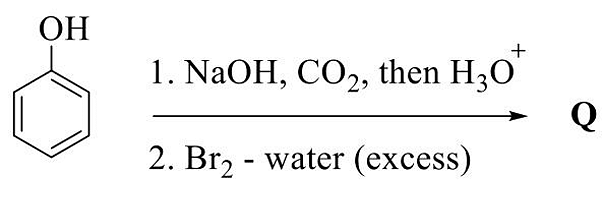
View More Questions
Top GATE CY Lanthanoids and Actinides Questions


Top GATE CY Questions
- Ψ(x) = \(\sqrt{\frac{32}{L^3}}\)[sin(\(\frac{\pi x}{L}\)).cos(\(\frac{\pi x}{L}\)).sin(\(\frac{2\pi y}{L}\)).sin(\(\frac{\pi z}{L}\))]Find the value of E221: E111.
 what is the final product
- Which are optically active?
 intensity ratio of final product
- Which among the following is true?
View More Questions