Question:
The pair of complex ions that exhibits the slowest outer-sphere electron-exchange reaction at 25 \(^{\circ}\mathrm{C}\) is:
The pair of complex ions that exhibits the slowest outer-sphere electron-exchange reaction at 25 \(^{\circ}\mathrm{C}\) is:
Show Hint
Outer-sphere self-exchange rate drops when the metal-ligand bond length (and spin state) changes a lot between the two oxidation states; check which pair has the biggest jump in \(e_g\) electron occupancy.
Updated On: Aug 10, 2026
- \(\mathrm{[Co(NH_3)_6]^{3+}}\) and \(\mathrm{[Co(NH_3)_6]^{2+}}\)
- \(\mathrm{[Fe(H_2O)_6]^{3+}}\) and \(\mathrm{[Fe(H_2O)_6]^{2+}}\)
- \(\mathrm{[Ru(NH_3)_6]^{3+}}\) and \(\mathrm{[Ru(NH_3)_6]^{2+}}\)
- \(\mathrm{[Mn(CN)_6]^{3-}}\) and \(\mathrm{[Mn(CN)_6]^{4-}}\)
Show Solution

Verified By Collegedunia
The Correct Option is A
Solution and Explanation
Step 1: Recall what controls outer-sphere self-exchange rate.
Marcus theory says the rate of an outer-sphere electron-transfer self-exchange (same metal, two oxidation states) depends on the reorganization energy \(\lambda\): the energy needed to distort the metal-ligand bond lengths and angles of both partners to a common geometry before the electron jumps, since electron transfer is much faster than nuclear motion (Franck-Condon principle). A larger \(\lambda\) means a higher barrier and a slower rate.
Step 2: Identify what makes \(\lambda\) large.
\(\lambda\) is large when the metal-ligand bond length changes a lot between the two oxidation states, and it gets even larger if the spin state also changes, since electrons must then reorganize between orbitals of very different bonding character.
Step 3: Analyze the cobalt ammine pair.
\(\mathrm{[Co(NH_3)_6]^{3+}}\) is \(\mathrm{Co(III)}\), \(d^6\), low spin, \(t_{2g}^6e_g^0\). \(\mathrm{[Co(NH_3)_6]^{2+}}\) is \(\mathrm{Co(II)}\), \(d^7\), high spin, \(t_{2g}^5e_g^2\), with two electrons now in the strongly \(\sigma^*\)-antibonding \(e_g\) set. Populating \(e_g\) stretches the \(\mathrm{Co-N}\) bonds by a large amount, and the spin state itself changes, so \(\lambda\) becomes very large.
Step 4: Compare with the other pairs.
\(\mathrm{[Fe(H_2O)_6]^{3+/2+}}\) are both high spin with a smaller bond-length change and no spin-state change. \(\mathrm{[Ru(NH_3)_6]^{3+/2+}}\) are both low spin (the heavier 4d metal has a stronger field), with only a tiny bond-length change, giving one of the fastest known outer-sphere rates. \(\mathrm{[Mn(CN)_6]^{3-/4-}}\) are both low spin with strong-field \(\mathrm{CN^-}\), also a small bond-length change.
Step 5: Conclude.
The cobalt ammine pair has by far the largest reorganization energy (large bond-length change plus a spin-state change), so it has the slowest self-exchange rate. This is a classic example: \(\mathrm{[Co(NH_3)_6]^{3+/2+}}\) self-exchange is famously slow, around \(10^{-6}\ \mathrm{M^{-1}s^{-1}}\), against \(\mathrm{[Ru(NH_3)_6]^{3+/2+}}\) at around \(10^{2}\text{-}10^{3}\ \mathrm{M^{-1}s^{-1}}\).
Final Answer:
The slowest pair is \(\mathrm{[Co(NH_3)_6]^{3+}}\) and \(\mathrm{[Co(NH_3)_6]^{2+}}\), option (A). \[ \boxed{\text{(A)}} \]
Marcus theory says the rate of an outer-sphere electron-transfer self-exchange (same metal, two oxidation states) depends on the reorganization energy \(\lambda\): the energy needed to distort the metal-ligand bond lengths and angles of both partners to a common geometry before the electron jumps, since electron transfer is much faster than nuclear motion (Franck-Condon principle). A larger \(\lambda\) means a higher barrier and a slower rate.
Step 2: Identify what makes \(\lambda\) large.
\(\lambda\) is large when the metal-ligand bond length changes a lot between the two oxidation states, and it gets even larger if the spin state also changes, since electrons must then reorganize between orbitals of very different bonding character.
Step 3: Analyze the cobalt ammine pair.
\(\mathrm{[Co(NH_3)_6]^{3+}}\) is \(\mathrm{Co(III)}\), \(d^6\), low spin, \(t_{2g}^6e_g^0\). \(\mathrm{[Co(NH_3)_6]^{2+}}\) is \(\mathrm{Co(II)}\), \(d^7\), high spin, \(t_{2g}^5e_g^2\), with two electrons now in the strongly \(\sigma^*\)-antibonding \(e_g\) set. Populating \(e_g\) stretches the \(\mathrm{Co-N}\) bonds by a large amount, and the spin state itself changes, so \(\lambda\) becomes very large.
Step 4: Compare with the other pairs.
\(\mathrm{[Fe(H_2O)_6]^{3+/2+}}\) are both high spin with a smaller bond-length change and no spin-state change. \(\mathrm{[Ru(NH_3)_6]^{3+/2+}}\) are both low spin (the heavier 4d metal has a stronger field), with only a tiny bond-length change, giving one of the fastest known outer-sphere rates. \(\mathrm{[Mn(CN)_6]^{3-/4-}}\) are both low spin with strong-field \(\mathrm{CN^-}\), also a small bond-length change.
Step 5: Conclude.
The cobalt ammine pair has by far the largest reorganization energy (large bond-length change plus a spin-state change), so it has the slowest self-exchange rate. This is a classic example: \(\mathrm{[Co(NH_3)_6]^{3+/2+}}\) self-exchange is famously slow, around \(10^{-6}\ \mathrm{M^{-1}s^{-1}}\), against \(\mathrm{[Ru(NH_3)_6]^{3+/2+}}\) at around \(10^{2}\text{-}10^{3}\ \mathrm{M^{-1}s^{-1}}\).
Final Answer:
The slowest pair is \(\mathrm{[Co(NH_3)_6]^{3+}}\) and \(\mathrm{[Co(NH_3)_6]^{2+}}\), option (A). \[ \boxed{\text{(A)}} \]
Was this answer helpful?
0
0
Top GATE CY Inorganic Chemistry Questions
- Which are optically active?
- Among the following, the compound with the lowest CO stretching frequency is
- The ground state of [Cr(H2O)6]2+ is
- The reaction of XeF2 with HN(SO2F)2 at 273 K in CF2Cl2 solvent yields
- The major product in the given reaction sequence is Q. The mass spectrum of Q shows
([M] = molecular ion peak)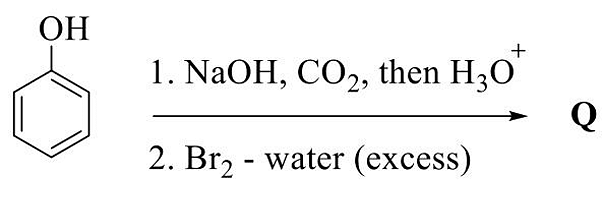
View More Questions
Top GATE CY Coordination chemistry Questions
- Which are optically active?
- Among the following, the compound with the lowest CO stretching frequency is
- The ground state of [Cr(H2O)6]2+ is
- The complex(es) with distorted octahedral structure is (are)
- The heptacity of allyl and Cp and the ligation mode of NO in the thermodynamically stable complexes
[(ηx-allyl)Ru(CO)2(NO)] and [(ηy-Cp)Ru(CO)2(NO)],
respectively, are
(The heptacity of allyl and Cp are denoted by ηx and ηy, respectively.)
View More Questions
Top GATE CY Questions
- Ψ(x) = \(\sqrt{\frac{32}{L^3}}\)[sin(\(\frac{\pi x}{L}\)).cos(\(\frac{\pi x}{L}\)).sin(\(\frac{2\pi y}{L}\)).sin(\(\frac{\pi z}{L}\))]Find the value of E221: E111.
 what is the final product
- Which are optically active?
 intensity ratio of final product
- Which among the following is true?
View More Questions