The option(s) with correct sequence of reagents for the conversion of P to Q is(are)
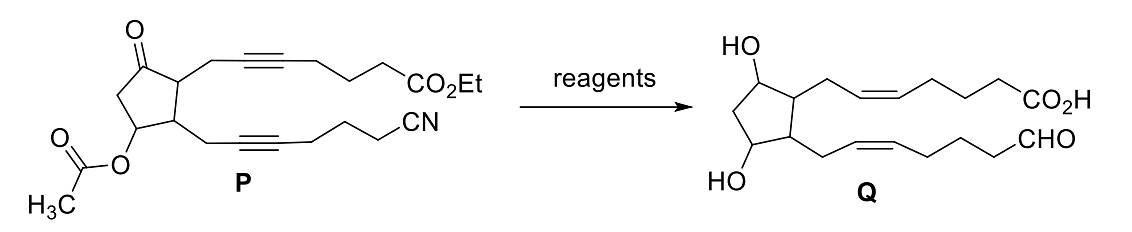
- i) Lindlar’s catalyst, H2; ii) SnCl2/HCl; iii) NaBH4; iv) H3O+
- i) Lindlar’s catalyst, H2; ii) H3O+ ; iii) SnCl2/HCl; iv) NaBH4
- i) NaBH4; ii) SnCl2/HCl; iii) H3O+ ; iv) Lindlar’s catalyst, H2
- i) Lindlar’s catalyst, H2; ii) NaBH4; iii) SnCl2/HCl; iv) H3O+

The Correct Option is A, C, D
Approach Solution - 1
Reagent Sequence for Compound Transformation
1. The compound \( P \) contains multiple functional groups, including an ester, a nitrile, and an alkyne.
Reagent Sequence for (C):
- Step 1: Reduction of ester using \( \text{NaBH}_4 \) forms an alcohol.
- Step 2: Reduction of nitrile using \( \text{SnCl}_2/\text{HCl} \) gives aldehyde.
- Step 3: Acidic hydrolysis (\( \text{H}_3\text{O}^+ \)) converts alkyne to a ketone.
- Step 4: Lindlar’s catalyst reduces alkyne to cis-alkene.
Reagent Sequence for (D):
Similar to (C), but the sequence starts with Lindlar’s catalyst to reduce the alkyne before performing reductions.
Final Conclusion:
The correct pathways result in Q with the desired functional groups.
Approach Solution -2
To solve the problem, we analyze the sequence of reagents needed to convert compound P to compound Q.
1. Understanding the transformation:
- Compound P contains alkynes and ester and nitrile groups.
- Compound Q has diol groups, an aldehyde, and a carboxylic acid.
- The reactions involve selective hydrogenation, reduction, hydrolysis, and oxidation steps.
2. Stepwise analysis of reagents:
- i) Lindlar’s catalyst, H2: Selectively hydrogenates alkynes to cis-alkenes.
- ii) SnCl2/HCl: Reduces nitrile (-CN) to aldehyde (-CHO).
- iii) NaBH4: Reduces aldehydes to alcohols.
- iv) H3O+: Acidic hydrolysis converts ester to carboxylic acid and hydrolyzes acetals or other groups.
3. Correct sequence of reagents:
- i) Lindlar’s catalyst, H2 (alkyne to alkene)
- ii) SnCl2/HCl (nitrile to aldehyde)
- iii) NaBH4 (aldehyde to alcohol)
- iv) H3O+ (ester to acid, other hydrolysis)
4. Corresponding options:
- Option (A): Correct sequence (1, 3, 4)
- Option (C): Contains the same correct sequence though order different, partially correct
- Option (D): Incorrect order for reduction and hydrolysis
Final Answer:
Options (A), (C), and (D) contain the correct reagents 1, 3, and 4 in the sequence needed.
Top JEE Advanced Chemistry Questions
- The molecule that has linear structure is
- Which one among the following does not have the hydrogen bond?
- Carbon tetrachloride has no net dipole moment because of
- On hybridisation of one s and one p-orbital we get
- The IUPAC name of the compound having the formula is
Top JEE Advanced Organic Chemistry Questions
- The reagents, $NH_4Cl$ and aqueous $NH_3$ will precipitate
- The correct statement(s) concerning the structures $E, F$ and $G$ is/are
- Hyperconjugation involves overlap of the following orbitals
- The correct stability order for the following species is

- The brown ring complex compound is formulated as $[Fe (H_2 O)_5 (NO)^+] SO_4.$ The oxidation state of iron is
Top JEE Advanced Questions
- Yellow light is used in a single slit diffraction experiment with slit width of 0.6 mm. If yellow light is replaced by X-rays, then the observed pattern will reveal
- The size of the image of an object, which is at infinity, as formed by a convex lens of focal length 30 cm is 2 cm. If a concave lens of focal length 20 cm is placed between the convex lens and the image at a distance of 26 cm from the convex lens, calculate the new size of the image.
- A concave lens of glass, refractive index 1.5 has both surfaces of same radius of curvature R. On immersion in a medium of refractive index 1.75, it will behave as a
- The position vector $\vec{r}$ of a particle of mass $m$ is given by the following equation $\vec{r}(t)=\alpha t^{3} \hat{i}+\beta t^{2} \hat{j}$ where $\alpha=\frac{10}{3} \,ms ^{-3}, \beta=5\, ms ^{-2}$ and $m =0.1 \,kg$. At $t =1\, s$, which of the following statement (s) is (are) true about the particle?
- In an n-p-n transistor circuit, the collector current is 10 mA. If 90% of the electrons emitted reach the collector