To differentiate between types of isomers, always compare:
1. Connectivity of atoms for constitutional isomers.
2. Mirror image relation for enantiomers.
3. Bond rotations for conformational isomers.
4. Stereochemistry for diastereomers.
Step 1: Understanding the types of isomerism.
1. Enantiomers: Molecules that are non-superimposable mirror images of each other.
2. Diastereomers: Stereoisomers that are not mirror images of each other.
3. Conformational isomers: Isomers that differ by rotation about a single bond.
4. Constitutional isomers: Molecules with the same molecular formula but different connectivity of atoms. Step 2: Analyzing molecules A and B.
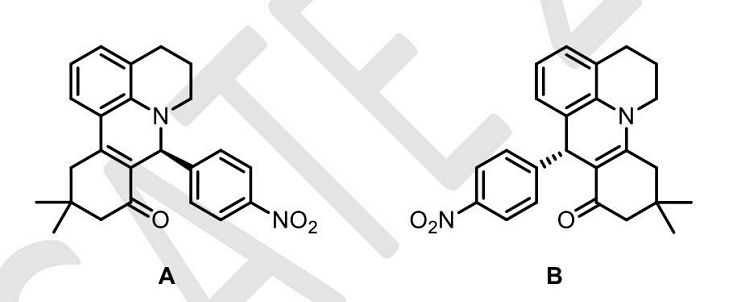
The given molecules A and B have the same molecular formula. However, the connectivity of atoms differs between the two structures. For example, the positions of the functional groups (like the ( {NO}_2 ) group) and the bonds differ between the two molecules.
This difference in connectivity indicates that the two molecules are constitutional isomers. Step 3: Conclusion.
The correct classification of molecules A and B is that they are constitutional isomers.