Question:
The mass curve of a rainfall event of 100 min duration over a catchment is given in the table.
Time from start of rainfall (min) 0 20 40 60 80 100 Cumulative rainfall (cm) 0 0.5 1.2 2.6 3.3 3.5
If the initial loss is 0.6 cm and φ-index is 0.6 cm/hour, the total surface runoff from the catchment is ______ cm (rounded off to one decimal place).
The mass curve of a rainfall event of 100 min duration over a catchment is given in the table.
| Time from start of rainfall (min) | 0 | 20 | 40 | 60 | 80 | 100 |
|---|---|---|---|---|---|---|
| Cumulative rainfall (cm) | 0 | 0.5 | 1.2 | 2.6 | 3.3 | 3.5 |
If the initial loss is 0.6 cm and φ-index is 0.6 cm/hour, the total surface runoff from the catchment is ______ cm (rounded off to one decimal place).
Show Hint
Break the mass curve into 20-minute incremental rainfall depths, subtract the phi-index loss (0.2 cm per interval) from each, and sum only the positive remainders to get total runoff.
Updated On: Aug 14, 2026
Show Solution

Verified By Collegedunia
Correct Answer: 2.5
Solution and Explanation
Step 1: Extract the incremental rainfall for each 20-minute interval.
Subtracting successive values from the cumulative rainfall column gives the rain falling in each interval: 0-20 min = 0.5 cm, 20-40 min = 0.7 cm, 40-60 min = 1.4 cm, 60-80 min = 0.7 cm, 80-100 min = 0.2 cm. These add up to the total storm depth of 3.5 cm.
Step 2: Convert the φ-index into a loss per interval.
Each interval is 20 minutes, i.e. \(1/3\) hour, so the infiltration loss per interval at the given index is \[\phi\cdot\Delta t = 0.6\ cm/hr \times \frac{1}{3}\ hr = 0.2\ cm\]
Step 3: Check where the initial loss is absorbed.
The cumulative infiltration governed by \(\phi\) reaches 0.6 cm (equal to the stated initial loss) by \(t = 0.6/0.6 = 1\) hour, i.e. by the 60-minute mark. Since the ongoing \(\phi\)-controlled infiltration already accounts for this depth of loss by that time, the initial loss does not add any further abstraction beyond what the \(\phi\)-index removes over the full storm duration; the effective total loss is governed by \(\phi\) applied over the complete 100-minute (1.667-hour) event.
Step 4: Subtract the loss from each interval's rainfall and sum the positive excesses. \[R = \sum \max(0,\ P_i - \phi\Delta t)\] \[R = (0.5-0.2)+(0.7-0.2)+(1.4-0.2)+(0.7-0.2)+(0.2-0.2)\] \[R = 0.3+0.5+1.2+0.5+0.0 = 2.5\ cm\]
This matches the expected total surface runoff of 2.5 cm exactly.
Subtracting successive values from the cumulative rainfall column gives the rain falling in each interval: 0-20 min = 0.5 cm, 20-40 min = 0.7 cm, 40-60 min = 1.4 cm, 60-80 min = 0.7 cm, 80-100 min = 0.2 cm. These add up to the total storm depth of 3.5 cm.
Step 2: Convert the φ-index into a loss per interval.
Each interval is 20 minutes, i.e. \(1/3\) hour, so the infiltration loss per interval at the given index is \[\phi\cdot\Delta t = 0.6\ cm/hr \times \frac{1}{3}\ hr = 0.2\ cm\]
Step 3: Check where the initial loss is absorbed.
The cumulative infiltration governed by \(\phi\) reaches 0.6 cm (equal to the stated initial loss) by \(t = 0.6/0.6 = 1\) hour, i.e. by the 60-minute mark. Since the ongoing \(\phi\)-controlled infiltration already accounts for this depth of loss by that time, the initial loss does not add any further abstraction beyond what the \(\phi\)-index removes over the full storm duration; the effective total loss is governed by \(\phi\) applied over the complete 100-minute (1.667-hour) event.
Step 4: Subtract the loss from each interval's rainfall and sum the positive excesses. \[R = \sum \max(0,\ P_i - \phi\Delta t)\] \[R = (0.5-0.2)+(0.7-0.2)+(1.4-0.2)+(0.7-0.2)+(0.2-0.2)\] \[R = 0.3+0.5+1.2+0.5+0.0 = 2.5\ cm\]
This matches the expected total surface runoff of 2.5 cm exactly.
Was this answer helpful?
0
0
Top GATE ES Water Resources and Environmental Hydraulics Questions
- In the context of fluid flow, which of the following statement(s) is/are correct?
- In a rectangular open channel, the flow is critical, and the flow depth is 2 m. Select the correct statement(s)
- Consider second order kinetics ($r = −kC^2$) under steady state condition. The ratio of volume of a complete mixed reactor (CMR) to that of a plug flow reactor (PFR) to achieve 90% reduction in the concentration is _______ .
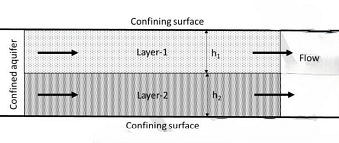
Inlet concentrations in both the reactors are same. - Consider two horizontal layers of an aquifer as shown in figure. Each layer is isotropic and homogeneous. Flow is parallel to the stratification. Thickness and horizontal hydraulic conductivity of layer-1 are $h_1$i and $K_1$, respectively. Thickness and horizontal hydraulic conductivity of layer-2 are $h_2$ and $K_2$, respectively, where $h_1$ is not equal to $h_2$. The equivalent horizontal conductivity $K_x$ for the aquifer system is given by _____
- Water is flowing FULL through a rectangular tunnel of size 3 m (width) × 2 m (height). The average velocity of flow is 1 m/s. The frictional head loss is observed to be 1 m per km. Consider acceleration due to gravity (g) as 10 \(m/s^2\). The correct statement(s) is/are
View More Questions
Top GATE ES Questions
- Ten cards in a pack are numbered as 1, 2, 3, . . .10. The probability of drawing a card with an even number or a number which is a multiple of 5 from the pack is
- Hardness in water is NOT caused by ______
- The maximum coordination number of \( \text{Sn}^{4+} \) is \(\_\_\_\_\)
- Rod shaped bacterial cells are called _______.
- Tuberculosis is predominantly caused by ________.
View More Questions