The major product formed in the following reaction is:
Show Hint
Ask which carbon sits anti to the leaving \(\mathrm{OH}\): here it is a gem-dimethyl carbon that can form a stable tertiary cation, so the oxime fragments (C-C cleavage to a nitrile) instead of doing a normal 1,2-migration, and the resulting cation is captured by the nearby aromatic ring.
Step 1: Identify the substrate and the reaction type.
The starting material is the oxime of a benzo-fused seven-membered ring ketone, a 2,2-dimethyl-1-benzosuberone oxime: the ring carbon bearing \(\mathrm{{=}N{-}OH}\) is fused directly to the aromatic ring, and the very next ring carbon carries two methyl groups, a quaternary, gem-dimethyl carbon. Treating an oxime with \(\mathrm{H_2SO_4}\) is the classic setup for a Beckmann rearrangement, in which the \(\mathrm{OH}\) is protonated and leaves as water while the group anti (trans) to it migrates from carbon to nitrogen.
Step 2: Decide which group is anti to the leaving \(\mathrm{OH}\).
The drawn oxime geometry places the aryl-fused ring carbon syn to the \(\mathrm{OH}\), so the group anti to the leaving \(\mathrm{OH}\) is the ring bond to the gem-dimethyl carbon. In a normal Beckmann rearrangement, this gem-dimethyl carbon, with its bonding electrons, would migrate onto nitrogen to give a ring-expanded lactam.
Step 3: Recognize why fragmentation wins over simple migration.
The gem-dimethyl carbon is flanked by two methyl groups, so if it ionizes instead of migrating as a unit, it forms a tertiary carbocation, far more stable than the incipient charge in a normal 1,2-shift. When the group anti to the leaving \(\mathrm{OH}\) can form a well-stabilized cation, the oxime undergoes Beckmann fragmentation instead of Beckmann rearrangement: the \(\mathrm{C_1{-}C_2}\) bond (oxime carbon to gem-dimethyl carbon) breaks completely. The oxime carbon keeps its bond to the aromatic ring and becomes a nitrile carbon (\(\mathrm{Ar{-}C{\equiv}N}\)), while the gem-dimethyl carbon is released as a tertiary carbocation still tethered to the rest of the chain (three \(\mathrm{CH_2}\) groups) and to the other aromatic ring-fusion carbon.
Step 4: Ring closure by intramolecular Friedel-Crafts alkylation.
The tethered tertiary carbocation is attacked intramolecularly by the electron-rich benzene ring, an intramolecular Friedel-Crafts alkylation, forming a new carbon-carbon bond and closing a new six-membered ring fused to the aromatic ring. The overall result is ring contraction from a seven-membered to a six-membered carbocycle: a tetrahydronaphthalene skeleton carrying the nitrile group on the aromatic ring, near the original point of attachment, and the two methyl groups on the newly formed quaternary ring carbon, positioned across the new ring from the nitrile-bearing carbon. This matches option (C).
Why the other options are wrong:
Options (A) and (B) are both simple Beckmann rearrangement (ring-expanded, seven-membered lactam) products, differing only in whether the carbonyl or the NH ends up next to the aromatic ring. Neither forms here, because the tertiary-cation-forming fragmentation pathway is much faster than ordinary 1,2-alkyl migration for this gem-dimethyl substrate.
Option (D) has the correct nitrile-plus-ring-contraction skeleton, but places the gem-dimethyl group on the ring carbon immediately next to the nitrile-bearing aromatic carbon, which does not match the connectivity produced by the fragmentation and Friedel-Crafts closure traced in Step 4, the gem-dimethyl carbon ends up bonded to the far ring-fusion carbon, not the near one.
Final Answer:
The major product is the ring-contracted nitrile shown in option (C).
\[ \boxed{\text{(C)}} \]


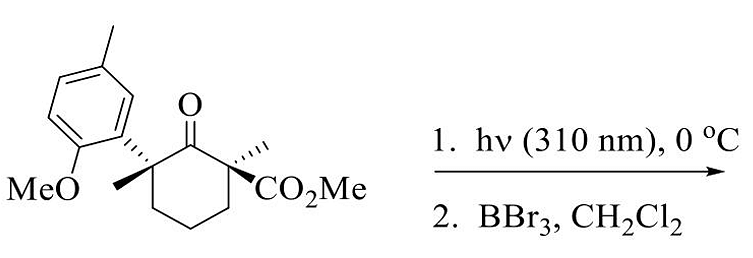
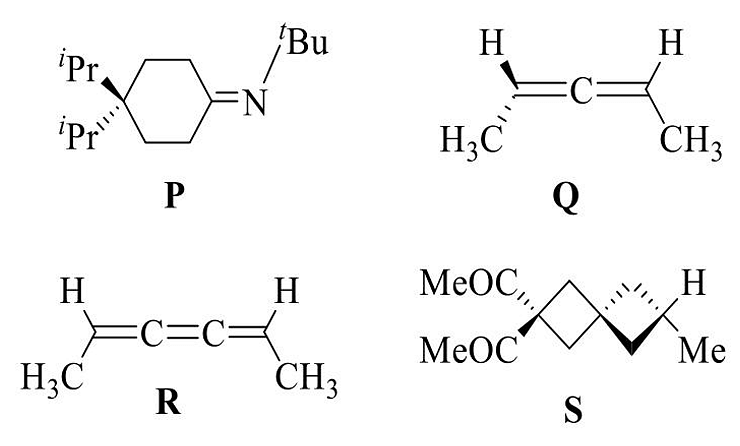
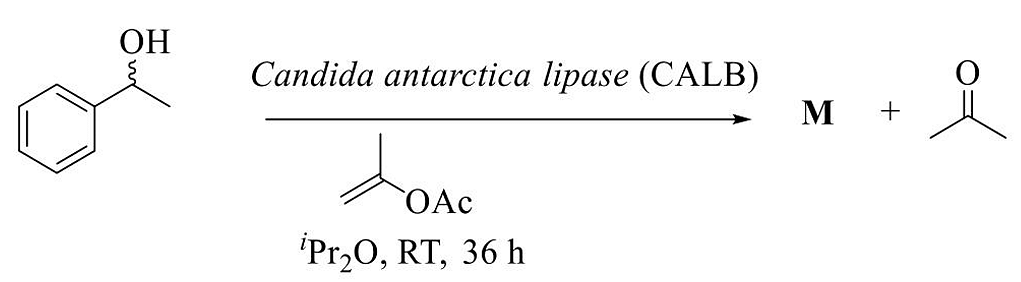
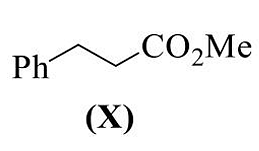
 what is the final product
 intensity ratio of final product