Question:
The ideal management for squamous cell carcinoma of the middle one-third of the lower lip (1 x 1 cm in size), without lymph node involvement, would be:
The ideal management for squamous cell carcinoma of the middle one-third of the lower lip (1 x 1 cm in size), without lymph node involvement, would be:
Show Hint
Think about the size threshold below which surgery alone is enough.
Updated On: Jul 16, 2026
- Chemoradiotherapy
- Local resection followed by radiotherapy
- Excision with primary repair
- Primary irradiation
Show Solution

Verified By Collegedunia
The Correct Option is C
Solution and Explanation
Step 1: Understanding the Question:
The question presents a small (1 x 1 cm), node-negative squamous cell carcinoma of the lower lip and asks for the ideal management, testing how tumor size and stage should guide the choice of treatment.
Step 2: Key Concept or Approach:
Lip cancer staging directly drives treatment choice. Small (under 2 cm), superficial, node-negative lesions are best treated with surgery alone, because cure rates approach 90-95%, the lip can usually be closed primarily (wedge or V-excision) with a good cosmetic and functional result, and this avoids the morbidity of radiotherapy such as mucositis, xerostomia, and skin changes. Radiotherapy is generally reserved for larger lesions, cases where surgery would badly compromise lip competence, patients unfit for surgery, or as an adjuvant when margins or nodes turn out positive.
Step 3: Working Through the Options:
Chemoradiotherapy is overtreatment for a tiny node-negative lesion; it is reserved for advanced or unresectable disease. Local resection followed by radiotherapy adds unnecessary adjuvant radiotherapy after what should be a clean small excision, increasing toxicity without added benefit. Primary irradiation alone is a valid option for lip cancer, but it is generally chosen when surgery would cause unacceptable cosmetic or functional loss for larger lesions, which does not apply to a 1 cm tumor where excision gives an excellent result. Excision with primary repair achieves complete removal with clear margins, cures the disease, and preserves lip function and appearance, making it ideal for this small lesion.
Step 4: Conclusion:
The ideal management is excision with primary repair.
The question presents a small (1 x 1 cm), node-negative squamous cell carcinoma of the lower lip and asks for the ideal management, testing how tumor size and stage should guide the choice of treatment.
Step 2: Key Concept or Approach:
Lip cancer staging directly drives treatment choice. Small (under 2 cm), superficial, node-negative lesions are best treated with surgery alone, because cure rates approach 90-95%, the lip can usually be closed primarily (wedge or V-excision) with a good cosmetic and functional result, and this avoids the morbidity of radiotherapy such as mucositis, xerostomia, and skin changes. Radiotherapy is generally reserved for larger lesions, cases where surgery would badly compromise lip competence, patients unfit for surgery, or as an adjuvant when margins or nodes turn out positive.
Step 3: Working Through the Options:
Chemoradiotherapy is overtreatment for a tiny node-negative lesion; it is reserved for advanced or unresectable disease. Local resection followed by radiotherapy adds unnecessary adjuvant radiotherapy after what should be a clean small excision, increasing toxicity without added benefit. Primary irradiation alone is a valid option for lip cancer, but it is generally chosen when surgery would cause unacceptable cosmetic or functional loss for larger lesions, which does not apply to a 1 cm tumor where excision gives an excellent result. Excision with primary repair achieves complete removal with clear margins, cures the disease, and preserves lip function and appearance, making it ideal for this small lesion.
Step 4: Conclusion:
The ideal management is excision with primary repair.
Was this answer helpful?
0
0
Top NEET PG Surgery Questions
- A 55-year-old male presented with verrucous carcinoma around the glans of the penis. Examination reveals that the inguinal lymph nodes are not enlarged. What is the appropriate management for this patient?
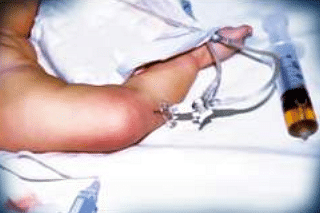
- Identify the procedure being performed in the image given below.
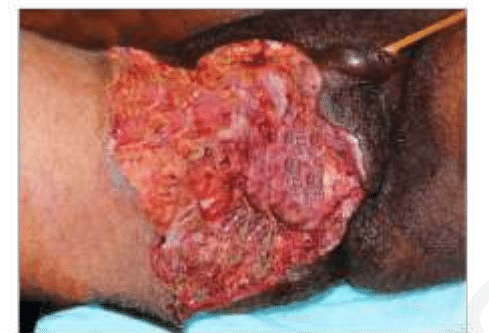
- A diabetic patient presents with sudden-onset perineal pain. On examination, foul-smelling discharge, and necrotic tissue as seen in the image is noted. Which of the following is true about the given condition?
- Which of the following is the most common complication following ligation of the first vessel during abdominoperineal resection for rectal carcinoma?(APR Abdominoperineal resection)
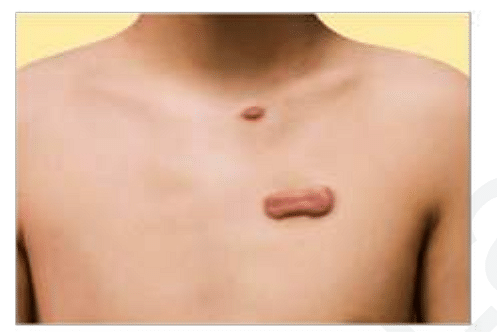
- A patient presents to the clinic with the lesion given in the image. He had a traumatic injury to the chest one year ago. What is the most likely diagnosis?
View More Questions
Top NEET PG Questions
- A patient hailing from Delhi presents with fever, arthralgia, and extensive petechial rash for 3 days. Lab investigations revealed a hemoglobin of 9 g/ dL, a white blood cell count of 9000 cells/mm3, a platelet count of 20000 cells/mm3, and a prolonged bleeding time. The clotting time was normal. What is the most likely diagnosis?
- Which of the following statements is true about Trichomonas vaginalis?
- A lady from West Rajasthan presented with an ulcer surrounded by erythema on the right leg. Microscopy of the biopsy from the edge of the ulcer showed organisms with dark staining nuclei and kinetoplast. What is the most likely causative agent?
- A child presents with a fever and a rash. Urine examination showed cells with owl's eye appearance. What is the most likely diagnosis?
- Infection with Clonorchis sinensis is associated with an increased risk of__?
View More Questions