Question:
The Hamiltonian for a quantum particle of mass \(m\) is given below, where \(\omega < \Omega\). The Schrodinger equation for this system can be solved exactly using the orthogonal transformation \(x = \dfrac{x_1 - x_2}{\sqrt2}\) and \(y = \dfrac{x_1+x_2}{\sqrt2}\).
\[ H = -\dfrac{\hbar^2}{2m}\left[\dfrac{\partial^2}{\partial x^2} + \dfrac{\partial^2}{\partial y^2}\right] + \dfrac12 m\Omega^2(x^2+y^2) + m\omega^2 xy \]The ground state energy of this system is
The Hamiltonian for a quantum particle of mass \(m\) is given below, where \(\omega < \Omega\). The Schrodinger equation for this system can be solved exactly using the orthogonal transformation \(x = \dfrac{x_1 - x_2}{\sqrt2}\) and \(y = \dfrac{x_1+x_2}{\sqrt2}\).
\[ H = -\dfrac{\hbar^2}{2m}\left[\dfrac{\partial^2}{\partial x^2} + \dfrac{\partial^2}{\partial y^2}\right] + \dfrac12 m\Omega^2(x^2+y^2) + m\omega^2 xy \]The ground state energy of this system is
\[ H = -\dfrac{\hbar^2}{2m}\left[\dfrac{\partial^2}{\partial x^2} + \dfrac{\partial^2}{\partial y^2}\right] + \dfrac12 m\Omega^2(x^2+y^2) + m\omega^2 xy \]The ground state energy of this system is
Show Hint
Rewrite \(x^2+y^2\) and \(xy\) in terms of \(x_1,x_2\) using the given rotation, then group terms to see two separate uncoupled oscillators.
Updated On: Aug 17, 2026
- \(\dfrac{\hbar}{2}\Big[\sqrt{\Omega^2-\omega^2} + \sqrt{\Omega^2+\omega^2}\Big]\)
- \(\hbar\Big[\sqrt{\Omega^2-\omega^2} + \sqrt{\Omega^2+\omega^2}\Big]\)
- \(\dfrac{\hbar}{2}\Big[\sqrt{\Omega^2+\Omega\omega} + \sqrt{\Omega^2-\Omega\omega}\Big]\)
- \(\hbar\Big[\sqrt{\Omega^2+\Omega\omega} - \sqrt{\Omega^2-\Omega\omega}\Big]\)
Show Solution

Verified By Collegedunia
The Correct Option is A
Solution and Explanation
Step 1: Understand the coupling in the Hamiltonian.
The Hamiltonian describes a particle moving in two dimensions with an isotropic potential \(\tfrac12 m\Omega^2(x^2+y^2)\) plus an extra cross term \(m\omega^2 xy\) that mixes \(x\) and \(y\). Because of this cross term, \(x\) and \(y\) are not independent oscillators as written, so we cannot just read off two separate frequencies yet. The question tells us that rotating to a new pair of coordinates \(x_1, x_2\) removes the mixing.
Step 2: Rewrite the potential in the new coordinates.
We are given \(x = \dfrac{x_1-x_2}{\sqrt2}\) and \(y = \dfrac{x_1+x_2}{\sqrt2}\). First find \(x^2+y^2\):
\[ x^2+y^2 = \frac{(x_1-x_2)^2 + (x_1+x_2)^2}{2} = \frac{2x_1^2+2x_2^2}{2} = x_1^2+x_2^2 \]
This is expected because a rotation of coordinates never changes the total distance from the origin. Next find \(xy\):
\[ xy = \frac{(x_1-x_2)(x_1+x_2)}{2} = \frac{x_1^2-x_2^2}{2} \]
Step 3: Rewrite the kinetic term.
A rotation between two coordinate pairs is an orthogonal transformation, and the sum of second derivatives (the Laplacian) is unchanged by any orthogonal (rotation) transformation. So
\[ \frac{\partial^2}{\partial x^2}+\frac{\partial^2}{\partial y^2} = \frac{\partial^2}{\partial x_1^2}+\frac{\partial^2}{\partial x_2^2} \]
Step 4: Assemble the Hamiltonian in the new coordinates.
\[ H = -\frac{\hbar^2}{2m}\left[\frac{\partial^2}{\partial x_1^2}+\frac{\partial^2}{\partial x_2^2}\right] + \frac12 m\Omega^2(x_1^2+x_2^2) + m\omega^2\left(\frac{x_1^2-x_2^2}{2}\right) \]
Group the \(x_1\) terms and the \(x_2\) terms separately:
\[ H = \left[-\frac{\hbar^2}{2m}\frac{\partial^2}{\partial x_1^2} + \frac12 m(\Omega^2+\omega^2)x_1^2\right] + \left[-\frac{\hbar^2}{2m}\frac{\partial^2}{\partial x_2^2} + \frac12 m(\Omega^2-\omega^2)x_2^2\right] \]
This is now exactly two independent, uncoupled simple harmonic oscillators.
Step 5: Read off the two frequencies and the ground state energy.
A one-dimensional oscillator \(-\tfrac{\hbar^2}{2m}\tfrac{\partial^2}{\partial x^2}+\tfrac12 m\omega_0^2 x^2\) has frequency \(\omega_0\) and ground state energy \(\tfrac12\hbar\omega_0\). Comparing, the two frequencies here are \(\omega_1 = \sqrt{\Omega^2+\omega^2}\) (from the \(x_1\) oscillator) and \(\omega_2 = \sqrt{\Omega^2-\omega^2}\) (from the \(x_2\) oscillator); the condition \(\omega < \Omega\) given in the question keeps \(\omega_2\) real. The total ground state energy of two independent oscillators just adds:
\[ E_0 = \frac12\hbar\omega_1 + \frac12\hbar\omega_2 = \frac{\hbar}{2}\Big[\sqrt{\Omega^2+\omega^2}+\sqrt{\Omega^2-\omega^2}\Big] \]
Step 6: Why the other options are wrong.
Option (B) has the right square-root terms but is missing the \(\tfrac12\) factor that comes from adding two ground state energies of \(\tfrac12\hbar\omega\) each. Options (C) and (D) mix up the frequencies with \(\Omega\omega\) products under the square root instead of \(\omega^2\), which does not come from this cross term at all.
Final Answer:
The ground state energy is \(\dfrac{\hbar}{2}\big[\sqrt{\Omega^2-\omega^2}+\sqrt{\Omega^2+\omega^2}\big]\), option (A).\[ \boxed{E_0 = \frac{\hbar}{2}\left[\sqrt{\Omega^2-\omega^2}+\sqrt{\Omega^2+\omega^2}\right]} \]
The Hamiltonian describes a particle moving in two dimensions with an isotropic potential \(\tfrac12 m\Omega^2(x^2+y^2)\) plus an extra cross term \(m\omega^2 xy\) that mixes \(x\) and \(y\). Because of this cross term, \(x\) and \(y\) are not independent oscillators as written, so we cannot just read off two separate frequencies yet. The question tells us that rotating to a new pair of coordinates \(x_1, x_2\) removes the mixing.
Step 2: Rewrite the potential in the new coordinates.
We are given \(x = \dfrac{x_1-x_2}{\sqrt2}\) and \(y = \dfrac{x_1+x_2}{\sqrt2}\). First find \(x^2+y^2\):
\[ x^2+y^2 = \frac{(x_1-x_2)^2 + (x_1+x_2)^2}{2} = \frac{2x_1^2+2x_2^2}{2} = x_1^2+x_2^2 \]
This is expected because a rotation of coordinates never changes the total distance from the origin. Next find \(xy\):
\[ xy = \frac{(x_1-x_2)(x_1+x_2)}{2} = \frac{x_1^2-x_2^2}{2} \]
Step 3: Rewrite the kinetic term.
A rotation between two coordinate pairs is an orthogonal transformation, and the sum of second derivatives (the Laplacian) is unchanged by any orthogonal (rotation) transformation. So
\[ \frac{\partial^2}{\partial x^2}+\frac{\partial^2}{\partial y^2} = \frac{\partial^2}{\partial x_1^2}+\frac{\partial^2}{\partial x_2^2} \]
Step 4: Assemble the Hamiltonian in the new coordinates.
\[ H = -\frac{\hbar^2}{2m}\left[\frac{\partial^2}{\partial x_1^2}+\frac{\partial^2}{\partial x_2^2}\right] + \frac12 m\Omega^2(x_1^2+x_2^2) + m\omega^2\left(\frac{x_1^2-x_2^2}{2}\right) \]
Group the \(x_1\) terms and the \(x_2\) terms separately:
\[ H = \left[-\frac{\hbar^2}{2m}\frac{\partial^2}{\partial x_1^2} + \frac12 m(\Omega^2+\omega^2)x_1^2\right] + \left[-\frac{\hbar^2}{2m}\frac{\partial^2}{\partial x_2^2} + \frac12 m(\Omega^2-\omega^2)x_2^2\right] \]
This is now exactly two independent, uncoupled simple harmonic oscillators.
Step 5: Read off the two frequencies and the ground state energy.
A one-dimensional oscillator \(-\tfrac{\hbar^2}{2m}\tfrac{\partial^2}{\partial x^2}+\tfrac12 m\omega_0^2 x^2\) has frequency \(\omega_0\) and ground state energy \(\tfrac12\hbar\omega_0\). Comparing, the two frequencies here are \(\omega_1 = \sqrt{\Omega^2+\omega^2}\) (from the \(x_1\) oscillator) and \(\omega_2 = \sqrt{\Omega^2-\omega^2}\) (from the \(x_2\) oscillator); the condition \(\omega < \Omega\) given in the question keeps \(\omega_2\) real. The total ground state energy of two independent oscillators just adds:
\[ E_0 = \frac12\hbar\omega_1 + \frac12\hbar\omega_2 = \frac{\hbar}{2}\Big[\sqrt{\Omega^2+\omega^2}+\sqrt{\Omega^2-\omega^2}\Big] \]
Step 6: Why the other options are wrong.
Option (B) has the right square-root terms but is missing the \(\tfrac12\) factor that comes from adding two ground state energies of \(\tfrac12\hbar\omega\) each. Options (C) and (D) mix up the frequencies with \(\Omega\omega\) products under the square root instead of \(\omega^2\), which does not come from this cross term at all.
Final Answer:
The ground state energy is \(\dfrac{\hbar}{2}\big[\sqrt{\Omega^2-\omega^2}+\sqrt{\Omega^2+\omega^2}\big]\), option (A).\[ \boxed{E_0 = \frac{\hbar}{2}\left[\sqrt{\Omega^2-\omega^2}+\sqrt{\Omega^2+\omega^2}\right]} \]
Was this answer helpful?
0
0
Top GATE PH Physics Questions
- An infinite one-dimensional lattice extends along the x-axis. At each lattice site, there exists an ion with spin 1/2. The spin can point either in the +z or -z direction only. Let \( S_P \), \( S_F \), and \( S_A \) denote the entropies of paramagnetic, ferromagnetic, and antiferromagnetic configurations, respectively. Which of the following relations is/are true?
- Two point charges of charge \( +q \) each are placed a distance \( 2d \) apart. A grounded solid conducting sphere of radius \( a \) is placed midway between them. Assume \( a^2 \ll d^2 \). Which of the following statements is/are true?
- A particle of mass $m$ is moving in the potential
\[ V(x) = \begin{cases} V_0 + \frac{1}{2} m \omega_{0P}^2 x^2 & \quad \text{if } x > 0 \\ \infty & \quad \text{if } x \leq 0 \end{cases} \]
Figures P, Q, R, and S show different combinations of the values of $ \omega_0 $ and $ V_0 $. - Decays of mesons and baryons can be categorized as weak, strong and electromagnetic decays depending upon the interactions involved in the processes. Which of the following option is/are true?
- The temperature \( T \) dependence of magnetic susceptibility \( \chi \) (Column I) of certain magnetic materials (Column II) are given below. Which of the following options is/are correct?
Column I Column II (1) 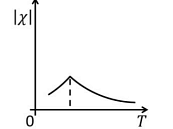
(P) Diamagnetic (2) 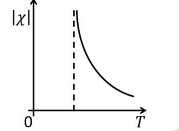
(Q) Paramagnetic (3) 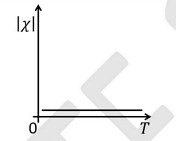
(R) Ferromagnetic (4) 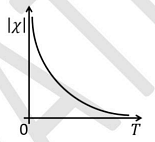
(S) Antiferromagnetic
View More Questions
Top GATE PH Quantum Mechanics Questions
- A particle of mass \( m \) is in a potential \( V(x) = \frac{1}{2} m \omega^2 x^2 \) for \( x > 0 \), and \( V(x) = \infty \) for \( x \leq 0 \), where \( \omega \) is the angular frequency. The ratio of the energies corresponding to the lowest energy level to the next higher level is:
- A particle is scattered from a potential \( V_{\vec{r}} = g \delta^3(\vec{r}) \), where \( g \) is a positive constant. Using the first Born approximation, the angular \((\theta, \phi)\) dependence of the differential scattering cross section \( \frac{d\sigma}{d\Omega} \) is:
- Which of the following option(s) is/are correct for photons?
Two projectile protons \( P_1 \) and \( P_2 \), both with spin up (along the \( +z \)-direction), are scattered from another fixed target proton \( T \) with spin up at rest in the \( xy \)-plane, as shown in the figure. They scatter one at a time. The nuclear interaction potential between both the projectiles and the target proton is \( \hat{\lambda} \vec{L} \cdot \vec{S} \), where \( \vec{L} \) is the orbital angular momentum of the system with respect to the target, \( \vec{S} \) is the spin angular momentum of the system, and \( \lambda \) is a negative constant in appropriate units. Which one of the following is correct?

- Let \( |m\rangle \) and \( |n\rangle \) denote the energy eigenstates of a one-dimensional simple harmonic oscillator. The position and momentum operators are \( \hat{X} \) and \( \hat{P} \), respectively. The matrix element \( \langle m | \hat{P}\hat{X} | n \rangle \) is non-zero when:
View More Questions
Top GATE PH Questions
- If \( F_1(Q, q) = Qq \) is the generating function of a canonical transformation from \((p, q)\) to \((P, Q)\), then which one of the following relations is correct?
- When an unpolarized plane electromagnetic wave in a dielectric medium with refractive index \( n_1 \) is incident on a plane interface separating it from another dielectric medium with refractive index \( n_2 \) (where \( n_2 > n_1 \)), and the angle of incidence is \(\tan^{-1} \left( \frac{n_2}{n_1} \right) \), the following statement is true:
- The wavefunction of a particle in an infinite one-dimensional potential well at time \( t \) is
\[ \Psi(x, t) = \sqrt{\frac{2}{3}} e^{-iE_1 t/\hbar}\psi_1(x) + \frac{1}{\sqrt{6}} e^{i\pi/6} e^{-iE_2 t/\hbar} \psi_2(x) + \frac{1}{\sqrt{6}} e^{i\pi/4} e^{-iE_3 t/\hbar} \psi_3(x) \]where \(\psi_1\), \(\psi_2\), and \(\psi_3\) are the normalized ground state, the normalized first excited state, and the normalized second excited state, respectively. \(E_1\), \(E_2\), and \(E_3\) are the eigen-energies corresponding to \(\psi_1\), \(\psi_2\), and \(\psi_3\), respectively. The expectation value of energy of the particle in state \(\Psi(x,t)\) is - If a thermodynamical system is adiabatically isolated and experiences a change in volume under an externally applied constant pressure, then the thermodynamical potential minimized at equilibrium is the
- The mean distance between the two atoms of an HD molecule is \( r \), where H and D denote hydrogen and deuterium, respectively. The mass of the hydrogen atom is \( m_H \). The energy difference between the two lowest lying rotational states of HD in multiples of \(\frac{h^2}{m_H r^2}\) is:
View More Questions