Question:
The four cardinal movements, flexion, internal rotation, extension, and restitution with external rotation, constitute part of the normal mechanism of labor. The chronological order in which they occur is
The four cardinal movements, flexion, internal rotation, extension, and restitution with external rotation, constitute part of the normal mechanism of labor. The chronological order in which they occur is
Show Hint
Walk through how the head has to turn and tilt as it moves down and out of the birth canal.
Updated On: Jul 7, 2026
- Flexion, internal rotation, extension, restitution and external rotation
- Internal rotation, flexion, extension, restitution and external rotation
- Flexion, extension, restitution and external rotation, internal rotation
- Internal rotation, extension, restitution and external rotation, flexion
Show Solution

Verified By Collegedunia
The Correct Option is A
Solution and Explanation
Step 1: Recall the full list of cardinal movements of labor.
The normal mechanism of labor for a baby in the vertex position follows a set sequence, engagement, descent, flexion, internal rotation, extension, restitution and external rotation, and finally expulsion. Engagement, descent, and expulsion are not among the four movements listed in this question, so we focus on the middle four.
Step 2: Explain why flexion comes first among the four.
As the head descends and meets resistance from the pelvic floor and cervix, the chin tucks toward the chest. This flexion presents the smallest diameter of the head, the suboccipitobregmatic diameter, to the pelvis, making further descent easier.
Step 3: Explain why internal rotation comes next.
After flexion, the well flexed head reaches the level of the ischial spines and rotates so the occiput turns toward the front, or occasionally the back, aligning the head's longest diameter with the widest diameter of the pelvic outlet.
Step 4: Explain why extension follows.
Once the head is at the vulva, it extends as it passes under the pubic arch, since the birth canal now curves forward and the head must straighten out to be born.
Step 5: Explain why restitution and external rotation come last.
Once the head is delivered, it untwists back to its natural relationship with the shoulders (restitution) and then rotates further as the shoulders themselves rotate internally to pass through the pelvis (external rotation). This is the final step of the four before the shoulders and body are delivered.
Step 6: Confirm the order.
Putting these together gives flexion, then internal rotation, then extension, then restitution and external rotation, matching sequence 1, 2, 3, 4.
Final Answer:
The chronological order is flexion, internal rotation, extension, and restitution with external rotation.
\[ \boxed{1,2,3,4} \]
The normal mechanism of labor for a baby in the vertex position follows a set sequence, engagement, descent, flexion, internal rotation, extension, restitution and external rotation, and finally expulsion. Engagement, descent, and expulsion are not among the four movements listed in this question, so we focus on the middle four.
Step 2: Explain why flexion comes first among the four.
As the head descends and meets resistance from the pelvic floor and cervix, the chin tucks toward the chest. This flexion presents the smallest diameter of the head, the suboccipitobregmatic diameter, to the pelvis, making further descent easier.
Step 3: Explain why internal rotation comes next.
After flexion, the well flexed head reaches the level of the ischial spines and rotates so the occiput turns toward the front, or occasionally the back, aligning the head's longest diameter with the widest diameter of the pelvic outlet.
Step 4: Explain why extension follows.
Once the head is at the vulva, it extends as it passes under the pubic arch, since the birth canal now curves forward and the head must straighten out to be born.
Step 5: Explain why restitution and external rotation come last.
Once the head is delivered, it untwists back to its natural relationship with the shoulders (restitution) and then rotates further as the shoulders themselves rotate internally to pass through the pelvis (external rotation). This is the final step of the four before the shoulders and body are delivered.
Step 6: Confirm the order.
Putting these together gives flexion, then internal rotation, then extension, then restitution and external rotation, matching sequence 1, 2, 3, 4.
Final Answer:
The chronological order is flexion, internal rotation, extension, and restitution with external rotation.
\[ \boxed{1,2,3,4} \]
Was this answer helpful?
0
0
Top NEET PG Gynaecology and Obstetrics Questions
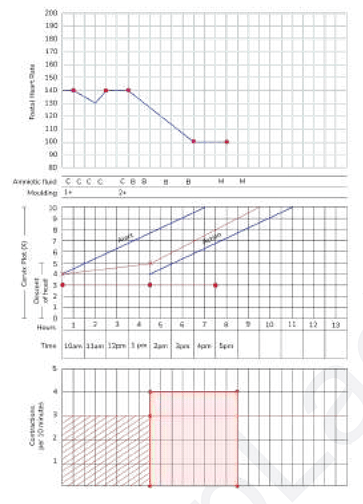
- A partogram of a woman who is in labor is shown below. Oxytocin infusion is already given. How will you manage the condition?
- A woman presents to you at 36 weeks of gestation with complaints of breathlessness and excessive abdominal distension. Fetal movements are normal. On examination, fetal parts are not easily felt and fetal heartbeat is heard but it is muffled. Her symphysis fundal height is 41 cm. Her abdomen is tense but not tender. What is the most likely diagonosis?
- For which of the following procedures in the given OT list, can you preferably do a hysteroscopy ?
- A primigravida presents to you with anemia early in her pregnancy. She is 7 weeks pregnant as seen on ultrasound. Her hemoglobin level is 9 g/dL. When should the iron supplements be started for her?
- A 23-year-old woman accompanied by her mother-in-law comes to the infertility clinic. She has been having regular intercourse for 6 months but is not able to conceive. What is the next best step?
View More Questions
Top NEET PG Questions
- A patient hailing from Delhi presents with fever, arthralgia, and extensive petechial rash for 3 days. Lab investigations revealed a hemoglobin of 9 g/ dL, a white blood cell count of 9000 cells/mm3, a platelet count of 20000 cells/mm3, and a prolonged bleeding time. The clotting time was normal. What is the most likely diagnosis?
- Which of the following statements is true about Trichomonas vaginalis?
- A lady from West Rajasthan presented with an ulcer surrounded by erythema on the right leg. Microscopy of the biopsy from the edge of the ulcer showed organisms with dark staining nuclei and kinetoplast. What is the most likely causative agent?
- A child presents with a fever and a rash. Urine examination showed cells with owl's eye appearance. What is the most likely diagnosis?
- Infection with Clonorchis sinensis is associated with an increased risk of__?
View More Questions