The effect of lanthanoid contraction in the lanthanoid series of elements by and large means :
- decrease in both atomic and ionic radii
- increase in atomic radii and decrease in ionic radii
- increase in both atomic and ionic radii
- decrease in atomic radii and increase in ionic radii

The Correct Option is A
Solution and Explanation
The question pertains to the lanthanoid contraction, an important concept in the periodic trends of the lanthanide series of elements. Let’s break down the concept to understand the correct answer.
Explanation:
-
Definition of Lanthanoid Contraction: It refers to the gradual reduction in the atomic and ionic radii of the lanthanide series elements, from lanthanum (La) to lutetium (Lu), as the atomic number increases.
-
Cause: This contraction is primarily due to the poor shielding effect of the 4f electrons. The 4f electrons do not shield the nuclear charge effectively, resulting in a greater effective nuclear charge. This causes the electrons to be pulled closer to the nucleus.
-
Effect on Atomic and Ionic Radii: Because of this increased effective nuclear charge:
- Both atomic and ionic radii decrease as we move across the lanthanide series.
-
Conclusion: The correct option that aligns with this concept is "decrease in both atomic and ionic radii".
Justification:
Let's examine the given options:
- Decrease in both atomic and ionic radii: This is the correct explanation for the lanthanoid contraction as discussed.
- Increase in atomic radii and decrease in ionic radii: This is incorrect as both radii decrease.
- Increase in both atomic and ionic radii: Incorrect; neither radii increase due to the effective nuclear charge.
- Decrease in atomic radii and increase in ionic radii: Incorrect as both radii decrease.
Conclusion:
The effect of lanthanoid contraction is the decrease in both atomic and ionic radii. This is due to inefficient shielding by 4f electrons, thereby causing a stronger pull by the nucleus on the valence electrons.
Top JEE Main Chemistry Questions
What will be the equilibrium constant of the given reaction carried out in a \(5 \,L\) vessel and having equilibrium amounts of \(A_2\) and \(A\) as \(0.5\) mole and \(2 \times 10^{-6}\) mole respectively?
The reaction : \(A_2 \rightleftharpoons 2A\)- At equilibrium the concentrations of and in a sealed vessel at . What will be for the reaction
- Find out the major products from the following reactions

Cobalt chloride when dissolved in water forms pink colored complex $X$ which has octahedral geometry. This solution on treating with cone $HCl$ forms deep blue complex, $\underline{Y}$ which has a $\underline{Z}$ geometry $X, Y$ and $Z$, respectively, are
- The correct order of atomic radii is:
Top JEE Main The Lanthanoids Questions
Top JEE Main Questions
- Two masses $m$ and $\frac{m}{2}$ are connected at the two ends of a massless rigid rod of length $l$. The rod is suspended by a thin wire of torsional constant $k$ at the centre of mass of the rod-mass system(see figure). Because of torsional constant $k$, the restoring torque is $\tau =k\theta$ for angular displacement $\theta$. If the rod is rota ted by $\theta_0$ and released, the tension in it when it passes through its mean position will be:
What will be the equilibrium constant of the given reaction carried out in a \(5 \,L\) vessel and having equilibrium amounts of \(A_2\) and \(A\) as \(0.5\) mole and \(2 \times 10^{-6}\) mole respectively?
The reaction : \(A_2 \rightleftharpoons 2A\)- The value of is
- The number of terms of an is even. The sum of the odd terms is and of the even terms is . The last term exceeds the first by . Then the number of terms in the series is ______.
A black body is at a temperature of 2880 K. The energy of radiation emitted by this body with wavelength between 499 nm and 500 nm is U1, between 999 nm and 1000 nm is U2 and between 1499 nm and 1500 nm is U3. The Wien's constant, b = 2.88×10⁶ nm-K. Then,
Concepts Used:
Lanthanoids
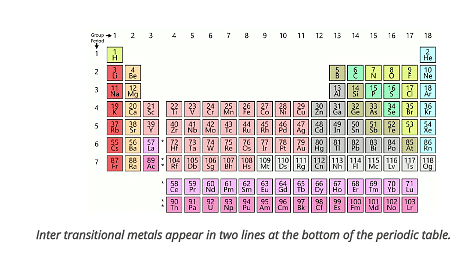
Lanthanoids are at the top of these two-row, while actinoids are at the bottom row.
Properties of Lanthanoids
Lanthanoids are inclusive of 14 elements, with atomic numbers 58-71:
- Cerium - Xe 4f1 5d1 6s2
- Praseodymium - Xe 4f3 6s2
- Neodymium - Xe 4f4 6s2
- Promethium - Xe 4f5 6s2
- Samarium - Xe 4f6 6s2
- Europium - Xe 4f7 6s2
- Gadolinium - Xe 4f7 5d1 6s2
- Terbium - Xe 4f9 6s2
- Dysprosium - Xe 4f10 6s2
- Holmium - Xe 4f11 6s2
- Erbium - Xe 4f12 6s2
- Thulium - Xe 4f13 6s2
- Ytterbium - Xe 4f14 6s2
- Lutetium - Xe 4f14 5d1 6s2
These elements are also called rare earth elements. They are found naturally on the earth, and they're all radioactively stable except promethium, which is radioactive. A trend is one of the interesting properties of the lanthanoid elements, called lanthanide contraction.