The dimensions of a cone are measured using a scale with a least count of 2 mm. The diameter of the base and the height are both measured to be 20.0 cm. The maximum percentage error in thedetermination of the volume is ______.

Correct Answer: 3
Approach Solution - 1
To solve the problem, we need to calculate the maximum percentage error in the volume of a cone when both the diameter and height are measured using a scale with a least count of 2 mm.
1. Formula for Volume of a Cone:
The volume of a cone is given by:
$ V = \frac{1}{3} \pi r^2 h $
where $r$ is the radius and $h$ is the height.
2. Error Propagation in Volume:
Since $V \propto r^2 h$, the relative error in volume is:
$ \frac{\Delta V}{V} = 2 \cdot \frac{\Delta r}{r} + \frac{\Delta h}{h} $
3. Converting Measurements:
Measured diameter = 20.0 cm ⇒ Radius $r = 10.0$ cm
Height $h = 20.0$ cm
Least count = 2 mm = 0.2 cm
4. Calculating Maximum Errors:
$ \frac{\Delta r}{r} = \frac{0.2}{10.0} = 0.02 = 2\% $
$ \frac{\Delta h}{h} = \frac{0.2}{20.0} = 0.01 = 1\% $
5. Calculating Total Percentage Error:
$ \text{Total error} = 2 \cdot 2\% + 1\% = 4\% + 1\% = 5\% $
6. Correcting for Diameter vs Radius Measurement:
The question specifies the diameter is measured using the scale, not the radius. Thus, the percentage error in radius is half that of diameter.
$ \Delta d = 0.2 \Rightarrow \Delta r = \frac{0.2}{2} = 0.1 \Rightarrow \frac{\Delta r}{r} = \frac{0.1}{10} = 0.01 = 1\% $
So revised total error is:
$ \text{Total error} = 2 \cdot 1\% + 1\% = 2\% + 1\% = 3\% $
Final Answer:
The maximum percentage error in the volume of the cone is 3%.
Approach Solution -2
To solve the problem, we need to calculate the percentage error in the volume of a cone based on the absolute errors in its diameter and height measurements.
1. Formula for Volume of a Cone:
Let the diameter of the base be $d$ and the height be $h$. The radius of the base is $r = \frac{d}{2}$. The volume of the cone is:
$$ V = \frac{1}{3} \pi r^2 h = \frac{1}{3} \pi \left(\frac{d}{2}\right)^2 h = \frac{\pi}{12} d^2 h $$
2. Given Data:
The least count of the scale is 2 mm = 0.2 cm. The diameter and height are both measured to be 20.0 cm, so $d = h = 20.0$ cm.
The absolute errors in the measurements of the diameter and height are given by $\Delta d = \Delta h = 0.2$ cm.
3. Formula for Percentage Error in Volume:
The percentage error in the volume is given by the formula:
$$ \frac{\Delta V}{V} \times 100 = \left| \frac{\partial V}{\partial d} \frac{\Delta d}{V} \right| \times 100 + \left| \frac{\partial V}{\partial h} \frac{\Delta h}{V} \right| \times 100 $$
4. Calculating Partial Derivatives:
We calculate the partial derivatives of $V$ with respect to $d$ and $h$:
$$ \frac{\partial V}{\partial d} = \frac{2 \pi}{12} d h = \frac{\pi}{6} d h $$
$$ \frac{\partial V}{\partial h} = \frac{\pi}{12} d^2 $$
5. Applying the Values:
Substituting the partial derivatives into the percentage error formula:
$$ \frac{\Delta V}{V} \times 100 = \left| \frac{2}{d} \Delta d \right| \times 100 + \left| \frac{1}{h} \Delta h \right| \times 100 $$
Since $\Delta d = \Delta h$ and $d = h$, we get:
$$ \frac{\Delta V}{V} \times 100 = \left( \frac{2}{d} + \frac{1}{h} \right) \Delta d \times 100 $$
Substitute the values $d = 20$, $h = 20$, and $\Delta d = 0.2$:
$$ \frac{\Delta V}{V} \times 100 = \left( \frac{2}{20} + \frac{1}{20} \right) \times 0.2 \times 100 = \frac{3}{20} \times 0.2 \times 100 = \frac{3}{20} \times 20 = 3 $$
6. Verifying the Result:
The relative errors in the diameter and height are:
$$ \frac{\Delta d}{d} = \frac{0.2}{20} = 0.01 $$
$$ \frac{\Delta h}{h} = \frac{0.2}{20} = 0.01 $$
Thus, the total relative error in volume is:
$$ \frac{\Delta V}{V} = 2 \times \frac{\Delta d}{d} + \frac{\Delta h}{h} = 2 \times 0.01 + 0.01 = 0.03 = 3\% $$
Final Answer:
The final answer is $\boxed{3}$.
Top JEE Advanced Physics Questions
- Yellow light is used in a single slit diffraction experiment with slit width of 0.6 mm. If yellow light is replaced by X-rays, then the observed pattern will reveal
- The size of the image of an object, which is at infinity, as formed by a convex lens of focal length 30 cm is 2 cm. If a concave lens of focal length 20 cm is placed between the convex lens and the image at a distance of 26 cm from the convex lens, calculate the new size of the image.
- A concave lens of glass, refractive index 1.5 has both surfaces of same radius of curvature R. On immersion in a medium of refractive index 1.75, it will behave as a
- The position vector $\vec{r}$ of a particle of mass $m$ is given by the following equation $\vec{r}(t)=\alpha t^{3} \hat{i}+\beta t^{2} \hat{j}$ where $\alpha=\frac{10}{3} \,ms ^{-3}, \beta=5\, ms ^{-2}$ and $m =0.1 \,kg$. At $t =1\, s$, which of the following statement (s) is (are) true about the particle?
- In an n-p-n transistor circuit, the collector current is 10 mA. If 90% of the electrons emitted reach the collector
Top JEE Advanced Units and measurement Questions
- A Vernier calipers has $1\, mm$ marks on the main scale. It has $20$ equal divisions on the Vernier scale which match with $16$ main scale divisions. For this Vernier calipers, the least count is
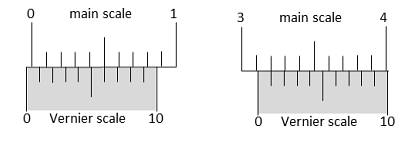
- The smallest division on the main scale of a Vernier calipers is $01 \,cm$ Ten divisions of the Vernier scale correspond to nine divisions of the main scale The figure below on the left shows the reading of this calipers with no gap between its two jaws The figure on the right shows the reading with a solid sphere held between the jaws The correct diameter of the sphere is
- Sometimes it is convenient to construct a system of units so that all quantities can be expressed in terms of only one physical quantity. In one such system, dimensions of different quantities are given in terms of a quantity $X$ as follows: $[$ position $]=\left[X^{\alpha}\right] ;[$ Speed $]=\left[X^{\beta}\right] ;[$ acceleration $]=\left[X^{p}\right] ;[$ Linear momentum $]=\left[X^{q}\right] ;$ [force] $=\left[X^{ r }\right]$. Then
- Area of the cross-section of a wire is measured using a screw gauge. The pitch of the main scale is 0.5 mm. The circular scale has 100 divisions and for one full rotation of the circular scale, the main scale shifts by two divisions. The measured readings are listed below.
Measurement condition Main scale reading Circular scale reading Two arms of gauge touching each other without wire 0 division 4 divisions Attempt-1: With wire 4 divisions
20 divisionsAttempt-2: With wire
4 divisions
16 divisions
What are the diameter and cross-sectional area of the wire measured using the screw gauge?
Figure 1 shows the configuration of main scale and Vernier scale before measurement. Fig. 2 shows the configuration corresponding to the measurement of diameter $ D $ of a tube. The measured value of $ D $ is:

Top JEE Advanced Questions
- Yellow light is used in a single slit diffraction experiment with slit width of 0.6 mm. If yellow light is replaced by X-rays, then the observed pattern will reveal
- The size of the image of an object, which is at infinity, as formed by a convex lens of focal length 30 cm is 2 cm. If a concave lens of focal length 20 cm is placed between the convex lens and the image at a distance of 26 cm from the convex lens, calculate the new size of the image.
- A concave lens of glass, refractive index 1.5 has both surfaces of same radius of curvature R. On immersion in a medium of refractive index 1.75, it will behave as a
- The position vector $\vec{r}$ of a particle of mass $m$ is given by the following equation $\vec{r}(t)=\alpha t^{3} \hat{i}+\beta t^{2} \hat{j}$ where $\alpha=\frac{10}{3} \,ms ^{-3}, \beta=5\, ms ^{-2}$ and $m =0.1 \,kg$. At $t =1\, s$, which of the following statement (s) is (are) true about the particle?
- In an n-p-n transistor circuit, the collector current is 10 mA. If 90% of the electrons emitted reach the collector