Question:
The correct statement(s) about the structure of metal oxides is(are)
The correct statement(s) about the structure of metal oxides is(are)
Show Hint
Recall the ratio of tetrahedral to octahedral holes in a close packed oxide lattice, the classic \(\mathrm{ABO_3}\) perovskite structure, and which cation sits where in inverse-spinel magnetite.
Updated On: Aug 10, 2026
- Spinel has 8 tetrahedral sites and 4 octahedral sites per formula unit
- \(\mathrm{BaTiO_3}\) has a perovskite structure
- In \(\mathrm{Fe_3O_4}\), \(\mathrm{Fe^{2+}}\) occupies both tetrahedral and octahedral sites in the unit cell
- \(\gamma\text{-}\mathrm{Al_2O_3}\) is a defect spinel
Show Solution

Verified By Collegedunia
The Correct Option is A, B, D
Solution and Explanation
Step 1: Check the spinel site count.
A spinel has the general formula \(\mathrm{AB_2O_4}\), and its unit cell contains 8 formula units (\(Z=8\)), built from a cubic close packed array of 32 oxide ions.
A cubic close packed array of \(N\) oxide ions creates \(N\) octahedral holes and \(2N\) tetrahedral holes, so 32 oxide ions create 32 octahedral holes and 64 tetrahedral holes in the full unit cell.
Dividing by the 8 formula units per cell gives 4 octahedral holes and 8 tetrahedral holes available per formula unit of \(\mathrm{AB_2O_4}\).
So statement (A), that spinel has 8 tetrahedral sites and 4 octahedral sites per formula unit, is correct. In a normal spinel only 1 of the 8 tetrahedral holes and 2 of the 4 octahedral holes per formula unit are actually filled by cations, but the statement talks about the sites that exist, not the ones that are occupied.
Step 2: Check the perovskite claim for \(\mathrm{BaTiO_3}\).
\(\mathrm{BaTiO_3}\) is the textbook example of the perovskite structure type \(\mathrm{ABO_3}\): \(\mathrm{Ba^{2+}}\) sits at the cube corners in 12-coordinate holes, \(\mathrm{Ti^{4+}}\) sits at the body centre in an octahedral hole, and \(\mathrm{O^{2-}}\) sits at the face centres.
So statement (B) is correct.
Step 3: Check the site occupancy in \(\mathrm{Fe_3O_4}\).
\(\mathrm{Fe_3O_4}\) (magnetite) is an inverse spinel, written as \(\mathrm{Fe^{3+}[Fe^{2+}Fe^{3+}]O_4}\), where the ions inside the bracket sit on octahedral sites and the \(\mathrm{Fe^{3+}}\) outside the bracket sits on tetrahedral sites.
So \(\mathrm{Fe^{2+}}\) is found only on octahedral sites, while every tetrahedral site is filled by \(\mathrm{Fe^{3+}}\).
Statement (C) claims \(\mathrm{Fe^{2+}}\) occupies both tetrahedral and octahedral sites, which is wrong.
Step 4: Check the \(\gamma\text{-}\mathrm{Al_2O_3}\) claim.
\(\gamma\text{-}\mathrm{Al_2O_3}\) has its oxide ions close packed in the same arrangement as a spinel lattice, but \(\mathrm{Al_2O_3}\) does not carry enough cations to fill a true \(\mathrm{AB_2O_4}\) spinel, so some of the cation sites are left as vacancies.
A spinel lattice with cation vacancies of this kind is exactly what chemists call a defect spinel, so statement (D) is correct.
Final Answer:
Statements (A), (B), and (D) are correct; (C) is wrong because \(\mathrm{Fe^{2+}}\) in magnetite sits only on octahedral sites, not tetrahedral ones.
\[ \boxed{\text{(A), (B), (D)}} \]
A spinel has the general formula \(\mathrm{AB_2O_4}\), and its unit cell contains 8 formula units (\(Z=8\)), built from a cubic close packed array of 32 oxide ions.
A cubic close packed array of \(N\) oxide ions creates \(N\) octahedral holes and \(2N\) tetrahedral holes, so 32 oxide ions create 32 octahedral holes and 64 tetrahedral holes in the full unit cell.
Dividing by the 8 formula units per cell gives 4 octahedral holes and 8 tetrahedral holes available per formula unit of \(\mathrm{AB_2O_4}\).
So statement (A), that spinel has 8 tetrahedral sites and 4 octahedral sites per formula unit, is correct. In a normal spinel only 1 of the 8 tetrahedral holes and 2 of the 4 octahedral holes per formula unit are actually filled by cations, but the statement talks about the sites that exist, not the ones that are occupied.
Step 2: Check the perovskite claim for \(\mathrm{BaTiO_3}\).
\(\mathrm{BaTiO_3}\) is the textbook example of the perovskite structure type \(\mathrm{ABO_3}\): \(\mathrm{Ba^{2+}}\) sits at the cube corners in 12-coordinate holes, \(\mathrm{Ti^{4+}}\) sits at the body centre in an octahedral hole, and \(\mathrm{O^{2-}}\) sits at the face centres.
So statement (B) is correct.
Step 3: Check the site occupancy in \(\mathrm{Fe_3O_4}\).
\(\mathrm{Fe_3O_4}\) (magnetite) is an inverse spinel, written as \(\mathrm{Fe^{3+}[Fe^{2+}Fe^{3+}]O_4}\), where the ions inside the bracket sit on octahedral sites and the \(\mathrm{Fe^{3+}}\) outside the bracket sits on tetrahedral sites.
So \(\mathrm{Fe^{2+}}\) is found only on octahedral sites, while every tetrahedral site is filled by \(\mathrm{Fe^{3+}}\).
Statement (C) claims \(\mathrm{Fe^{2+}}\) occupies both tetrahedral and octahedral sites, which is wrong.
Step 4: Check the \(\gamma\text{-}\mathrm{Al_2O_3}\) claim.
\(\gamma\text{-}\mathrm{Al_2O_3}\) has its oxide ions close packed in the same arrangement as a spinel lattice, but \(\mathrm{Al_2O_3}\) does not carry enough cations to fill a true \(\mathrm{AB_2O_4}\) spinel, so some of the cation sites are left as vacancies.
A spinel lattice with cation vacancies of this kind is exactly what chemists call a defect spinel, so statement (D) is correct.
Final Answer:
Statements (A), (B), and (D) are correct; (C) is wrong because \(\mathrm{Fe^{2+}}\) in magnetite sits only on octahedral sites, not tetrahedral ones.
\[ \boxed{\text{(A), (B), (D)}} \]
Was this answer helpful?
0
0
Top GATE CY Inorganic Chemistry Questions
- Which are optically active?
- Among the following, the compound with the lowest CO stretching frequency is
- The ground state of [Cr(H2O)6]2+ is
- The reaction of XeF2 with HN(SO2F)2 at 273 K in CF2Cl2 solvent yields
- The major product in the given reaction sequence is Q. The mass spectrum of Q shows
([M] = molecular ion peak)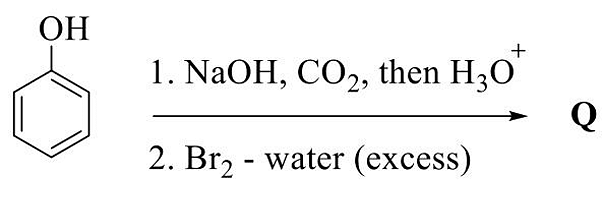
View More Questions
Top GATE CY Solid State Questions
The normal mode(s) of vibration of H\(_2\)O is/are:

- The number of photons emitted per nanosecond by a deuterium lamp (400 nm) having a power of 1 microwatt (rounded off to the nearest integer) is \(\underline{\hspace{2cm}}\).
Given: \( h = 6.626 \times 10^{-34} \, \text{kg m}^2 \text{s}^{-1}, c = 3.0 \times 10^8 \, \text{m s}^{-1} \).
Top GATE CY Questions
- Ψ(x) = \(\sqrt{\frac{32}{L^3}}\)[sin(\(\frac{\pi x}{L}\)).cos(\(\frac{\pi x}{L}\)).sin(\(\frac{2\pi y}{L}\)).sin(\(\frac{\pi z}{L}\))]Find the value of E221: E111.
 what is the final product
- Which are optically active?
 intensity ratio of final product
- Which among the following is true?
View More Questions