Question:
The correct statement(s) about Mossbauer spectroscopy of iron compounds is(are)
The correct statement(s) about Mossbauer spectroscopy of iron compounds is(are)
Show Hint
Recall the source isotope and transition energy for \(^{57}\mathrm{Fe}\) Mossbauer spectroscopy, and remember that isomer shift falls as s-electron density at the nucleus rises while quadrupole splitting grows with an asymmetric ligand field.
Updated On: Aug 10, 2026
- \(^{57}\mathrm{Co}\) is used as a source
- Their Mossbauer spectra are obtained using \(\gamma\)-ray with resonance energy of 14.4 keV
- \(\mathrm{K_2[Fe(CN)_5NO]}\) shows large quadrupole splitting
- Isomer shift of \(\mathrm{FeSO_4 \cdot 7H_2O}\) is smaller than that of \(\mathrm{K_3[Fe(CN)_6]}\)
Show Solution

Verified By Collegedunia
The Correct Option is A, B, C
Solution and Explanation
Step 1: Understand the Mossbauer setup for iron.
Mossbauer spectroscopy of \(^{57}\mathrm{Fe}\) needs a gamma-ray source that decays into the correct excited nuclear state of iron. The parent isotope \(^{57}\mathrm{Co}\) decays by electron capture to an excited state of \(^{57}\mathrm{Fe}\), which then drops to the ground state and gives out a 14.4 keV gamma-ray. This gamma-ray is resonantly absorbed by \(^{57}\mathrm{Fe}\) nuclei in the sample, so \(^{57}\mathrm{Co}\) is the standard source. Statement (A) is correct.
Step 2: Check the resonance energy value.
The nuclear transition used in \(^{57}\mathrm{Fe}\) Mossbauer spectroscopy is the \(3/2 \rightarrow 1/2\) transition of the \(^{57}\mathrm{Fe}\) nucleus, and its energy is fixed at 14.4 keV. This is the standard, well known value quoted for all iron Mossbauer work. Statement (B) is correct.
Step 3: Look at the quadrupole splitting of \(\mathrm{K_2[Fe(CN)_5NO]}\).
Quadrupole splitting comes from an electric field gradient at the iron nucleus, which grows when the electron density around iron is not symmetric. In \(\mathrm{K_2[Fe(CN)_5NO]}\) (the nitroprusside type ion), the strong pi-acceptor NO ligand is very different from the five CN ligands, so the field around iron is heavily distorted along the Fe-NO direction. This asymmetry gives a large electric field gradient, and hence a large quadrupole splitting, one of the biggest seen among iron nitrosyl-cyanide complexes. Statement (C) is correct.
Step 4: Compare isomer shifts of \(\mathrm{FeSO_4 \cdot 7H_2O}\) and \(\mathrm{K_3[Fe(CN)_6]}\).
Isomer shift depends on the s-electron density at the iron nucleus: more s-density gives a smaller (more negative) isomer shift. \(\mathrm{FeSO_4 \cdot 7H_2O}\) has high spin \(\mathrm{Fe^{2+}}\) (\(d^6\)), and its extra d-electrons shield the s-electrons from the nucleus, lowering the s-density there and pushing the isomer shift to a larger, positive value (about 1.2 to 1.4 mm/s). \(\mathrm{K_3[Fe(CN)_6]}\) has low spin \(\mathrm{Fe^{3+}}\) (\(d^5\)), where the strong field CN ligands pair up the electrons and the smaller d-shielding lets s-density at the nucleus stay higher, giving a small isomer shift close to zero (about -0.1 mm/s). So the isomer shift of \(\mathrm{FeSO_4 \cdot 7H_2O}\) is actually larger, not smaller, than that of \(\mathrm{K_3[Fe(CN)_6]}\). Statement (D) is wrong.
Final Answer:
Statements (A), (B) and (C) are correct; (D) is incorrect. \[ \boxed{\text{A, B, C}} \]
Mossbauer spectroscopy of \(^{57}\mathrm{Fe}\) needs a gamma-ray source that decays into the correct excited nuclear state of iron. The parent isotope \(^{57}\mathrm{Co}\) decays by electron capture to an excited state of \(^{57}\mathrm{Fe}\), which then drops to the ground state and gives out a 14.4 keV gamma-ray. This gamma-ray is resonantly absorbed by \(^{57}\mathrm{Fe}\) nuclei in the sample, so \(^{57}\mathrm{Co}\) is the standard source. Statement (A) is correct.
Step 2: Check the resonance energy value.
The nuclear transition used in \(^{57}\mathrm{Fe}\) Mossbauer spectroscopy is the \(3/2 \rightarrow 1/2\) transition of the \(^{57}\mathrm{Fe}\) nucleus, and its energy is fixed at 14.4 keV. This is the standard, well known value quoted for all iron Mossbauer work. Statement (B) is correct.
Step 3: Look at the quadrupole splitting of \(\mathrm{K_2[Fe(CN)_5NO]}\).
Quadrupole splitting comes from an electric field gradient at the iron nucleus, which grows when the electron density around iron is not symmetric. In \(\mathrm{K_2[Fe(CN)_5NO]}\) (the nitroprusside type ion), the strong pi-acceptor NO ligand is very different from the five CN ligands, so the field around iron is heavily distorted along the Fe-NO direction. This asymmetry gives a large electric field gradient, and hence a large quadrupole splitting, one of the biggest seen among iron nitrosyl-cyanide complexes. Statement (C) is correct.
Step 4: Compare isomer shifts of \(\mathrm{FeSO_4 \cdot 7H_2O}\) and \(\mathrm{K_3[Fe(CN)_6]}\).
Isomer shift depends on the s-electron density at the iron nucleus: more s-density gives a smaller (more negative) isomer shift. \(\mathrm{FeSO_4 \cdot 7H_2O}\) has high spin \(\mathrm{Fe^{2+}}\) (\(d^6\)), and its extra d-electrons shield the s-electrons from the nucleus, lowering the s-density there and pushing the isomer shift to a larger, positive value (about 1.2 to 1.4 mm/s). \(\mathrm{K_3[Fe(CN)_6]}\) has low spin \(\mathrm{Fe^{3+}}\) (\(d^5\)), where the strong field CN ligands pair up the electrons and the smaller d-shielding lets s-density at the nucleus stay higher, giving a small isomer shift close to zero (about -0.1 mm/s). So the isomer shift of \(\mathrm{FeSO_4 \cdot 7H_2O}\) is actually larger, not smaller, than that of \(\mathrm{K_3[Fe(CN)_6]}\). Statement (D) is wrong.
Final Answer:
Statements (A), (B) and (C) are correct; (D) is incorrect. \[ \boxed{\text{A, B, C}} \]
Was this answer helpful?
0
0
Top GATE CY Inorganic Chemistry Questions
- Which are optically active?
- Among the following, the compound with the lowest CO stretching frequency is
- The ground state of [Cr(H2O)6]2+ is
- The reaction of XeF2 with HN(SO2F)2 at 273 K in CF2Cl2 solvent yields
- The major product in the given reaction sequence is Q. The mass spectrum of Q shows
([M] = molecular ion peak)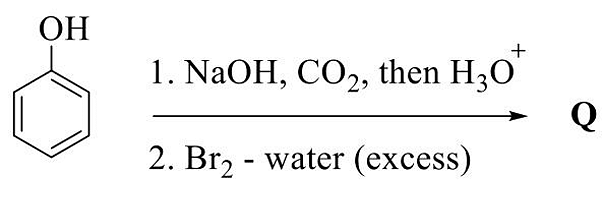
View More Questions
Top GATE CY Mössbauer spectroscopy (Fe and Sn) Questions
Top GATE CY Questions
- Ψ(x) = \(\sqrt{\frac{32}{L^3}}\)[sin(\(\frac{\pi x}{L}\)).cos(\(\frac{\pi x}{L}\)).sin(\(\frac{2\pi y}{L}\)).sin(\(\frac{\pi z}{L}\))]Find the value of E221: E111.
 what is the final product
- Which are optically active?
 intensity ratio of final product
- Which among the following is true?
View More Questions