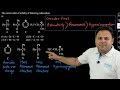
Let's analyze the stability of the given carbocations:
A. Triphenyl carbocation: The positive charge is stabilized by resonance with three phenyl rings.
B. Diphenyl carbocation: The positive charge is stabilized by resonance with two phenyl rings.
C. Tropylium carbocation: This is a cyclic carbocation with 6 π electrons. It is aromatic and highly stable due to resonance and delocalization of charge.
D. Secondary carbocation: This is a relatively simple carbocation stabilized mainly by the inductive effect of alkyl groups.
The stability of carbocations increases with the number of alkyl groups attached to the positively charged carbon. Additionally, resonance stabilization significantly enhances the stability of the carbocation.
Tropylium carbocation (C) is the most stable due to its aromaticity and extensive resonance stabilization.
Triphenyl carbocation (A) is more stable than diphenyl carbocation (B) because it has three phenyl groups that allow for greater resonance stabilization compared to only two in B.
Secondary carbocation (D) is the least stable among the four because it lacks significant resonance stabilization and is only moderately stabilized by inductive effects.
Final Order of Stability: $ C > A > B > D $
Final Answer: The final answer is $ C > A > B > D $.