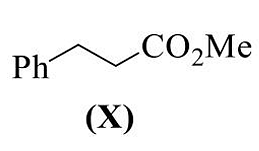
The correct match for the protons labeled in compound \(\mathrm{X}\) in Column M with the corresponding chemical shifts (\(\delta\), ppm) in Column N is
Column M
Column N
P
\(H_a\)
I
7.00 (ddd, \(J\) = 8.4, 7.3, 1.4 Hz, 1H)
Q
\(H_b\)
II
7.17 (dd, \(J\) = 8.4, 1.4 Hz, 1H)
R
\(H_c\)
III
7.59 (ddd, \(J\) = 8.4, 7.3, 1.4 Hz, 1H)
S
\(H_d\)
IV
8.12 (dd, \(J\) = 8.4, 1.4 Hz, 1H)
Show Hint
A proton flanked by ring CH on both sides gives ddd (three J's); one flanked on only one side gives dd (two J's). Substituent effects then fix which is more upfield or downfield: OH shields ortho/para, NO2 deshields ortho/para.
Step 1: Set up the ring positions.
Compound \(\mathrm{X}\) is a benzene ring bearing \(\mathrm{OH}\) and \(\mathrm{NO_2}\) on two adjacent carbons, with the remaining four ring carbons carrying \(H_a\), \(H_b\), \(H_c\), \(H_d\) in order around the ring: \(\mathrm{OH}-\mathrm{NO_2}-H_d-H_c-H_b-H_a-\) back to \(\mathrm{OH}\).
So \(H_a\) is ortho to \(\mathrm{OH}\), \(H_d\) is ortho to \(\mathrm{NO_2}\), and \(H_b\), \(H_c\) are the two inner protons, each flanked by another ring \(\mathrm{CH}\) on both sides.
Step 2: Use the splitting pattern to sort the protons into two groups.
\(H_b\) and \(H_c\) each have two different ring \(\mathrm{CH}\) neighbours (one ortho on each side) plus a meta partner, so each shows three different couplings, ddd with \(J \approx 8.4, 7.3, 1.4\ \mathrm{Hz}\). Only \(\mathbf{I}\) (7.00 ppm) and \(\mathbf{III}\) (7.59 ppm) are ddd, so these belong to \(H_b\) and \(H_c\).
\(H_a\) and \(H_d\) each have only one ring \(\mathrm{CH}\) neighbour (the other neighbour is the substituted carbon), plus one meta \(\mathrm{CH}\) partner, so each shows only two couplings, dd with \(J \approx 8.4, 1.4\ \mathrm{Hz}\). Only \(\mathbf{II}\) (7.17 ppm) and \(\mathbf{IV}\) (8.12 ppm) are dd, so these belong to \(H_a\) and \(H_d\).
Step 3: Use substituent effects to fix the shifts within each pair.
\(-\mathrm{NO_2}\) is a strong electron-withdrawing group and deshields protons ortho and para to it. \(-\mathrm{OH}\) is a strong electron-donating group and shields protons ortho and para to it.
\(H_d\) is ortho to \(\mathrm{NO_2}\), so it should be the most downfield of all four, matching \(\mathbf{IV}\) at \(8.12\) ppm. \(H_a\) is ortho to \(\mathrm{OH}\) (only meta to \(\mathrm{NO_2}\)), so it is shielded, matching \(\mathbf{II}\) at \(7.17\) ppm.
Of the two ddd protons, \(H_c\) is para to \(\mathrm{OH}\) (strong shielding) and meta to \(\mathrm{NO_2}\), so it is more upfield, matching \(\mathbf{I}\) at \(7.00\) ppm. \(H_b\) is meta to \(\mathrm{OH}\) and para to \(\mathrm{NO_2}\) (deshielded by the para nitro group), matching \(\mathbf{III}\) at \(7.59\) ppm.
Step 4: Assemble the match and check against the options.
This gives \(P(H_a)\rightarrow II\), \(Q(H_b)\rightarrow III\), \(R(H_c)\rightarrow I\), \(S(H_d)\rightarrow IV\), exactly option (A). Options (B) and (D) put \(H_a\) or \(H_d\) on a ddd signal, which is wrong since both are dd protons; option (C) swaps \(H_b\) and \(H_c\), reversing the substituent-shielding argument above.


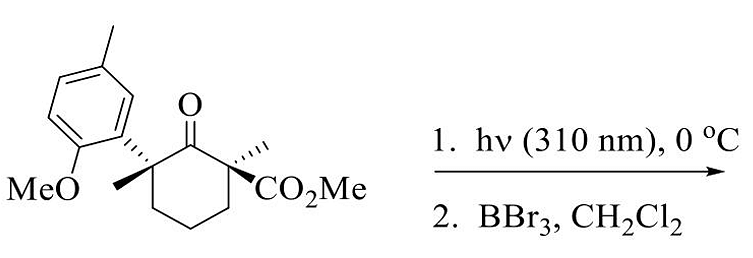
 what is the final product
 intensity ratio of final product