Question:
The commonest organism causing cellulitis is:
The commonest organism causing cellulitis is:
Show Hint
Streptococcus pyogenes is the classic cause of non-purulent cellulitis.
Updated On: Jul 8, 2026
- Streptococcus pyogenes
- Streptococcus faecalis
- Streptococcus viridans
- Microaerophilic streptococci
Show Solution

Verified By Collegedunia
The Correct Option is A
Solution and Explanation
Step 1: Recall what cellulitis is.
Cellulitis is a spreading infection of the skin and the tissue just under it, usually showing up as redness, warmth, swelling and pain over the affected area, without a well-defined pus filled pocket.
Step 2: Recall the usual germs behind it.
Classic, non-purulent cellulitis, without an abscess, is most often caused by beta hemolytic streptococci, and among these, Streptococcus pyogenes, group A streptococcus, is the organism most commonly responsible. It spreads through tissue easily because it makes enzymes that break down the barriers between tissue planes.
Step 3: Rule out the other organisms listed.
Streptococcus faecalis, now usually called Enterococcus faecalis, is more linked to urinary tract and biliary infections, not typical skin cellulitis. Streptococcus viridans is part of the normal mouth flora and is better known as a cause of infective endocarditis and dental infections. Microaerophilic streptococci are associated with mixed, low oxygen wound infections and abscesses, such as in synergistic gangrene, rather than being the leading cause of ordinary cellulitis.
Step 4: Final Answer.
Streptococcus pyogenes remains the most common organism causing cellulitis.
\[ \boxed{\text{Streptococcus pyogenes}} \]
Cellulitis is a spreading infection of the skin and the tissue just under it, usually showing up as redness, warmth, swelling and pain over the affected area, without a well-defined pus filled pocket.
Step 2: Recall the usual germs behind it.
Classic, non-purulent cellulitis, without an abscess, is most often caused by beta hemolytic streptococci, and among these, Streptococcus pyogenes, group A streptococcus, is the organism most commonly responsible. It spreads through tissue easily because it makes enzymes that break down the barriers between tissue planes.
Step 3: Rule out the other organisms listed.
Streptococcus faecalis, now usually called Enterococcus faecalis, is more linked to urinary tract and biliary infections, not typical skin cellulitis. Streptococcus viridans is part of the normal mouth flora and is better known as a cause of infective endocarditis and dental infections. Microaerophilic streptococci are associated with mixed, low oxygen wound infections and abscesses, such as in synergistic gangrene, rather than being the leading cause of ordinary cellulitis.
Step 4: Final Answer.
Streptococcus pyogenes remains the most common organism causing cellulitis.
\[ \boxed{\text{Streptococcus pyogenes}} \]
Was this answer helpful?
0
0
Top NEET PG Surgery Questions
- A 55-year-old male presented with verrucous carcinoma around the glans of the penis. Examination reveals that the inguinal lymph nodes are not enlarged. What is the appropriate management for this patient?
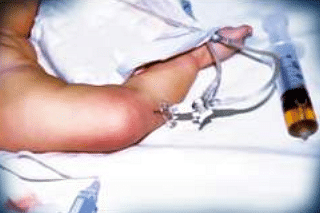
- Identify the procedure being performed in the image given below.
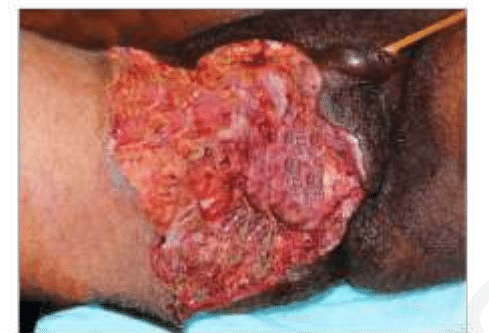
- A diabetic patient presents with sudden-onset perineal pain. On examination, foul-smelling discharge, and necrotic tissue as seen in the image is noted. Which of the following is true about the given condition?
- Which of the following is the most common complication following ligation of the first vessel during abdominoperineal resection for rectal carcinoma?(APR Abdominoperineal resection)
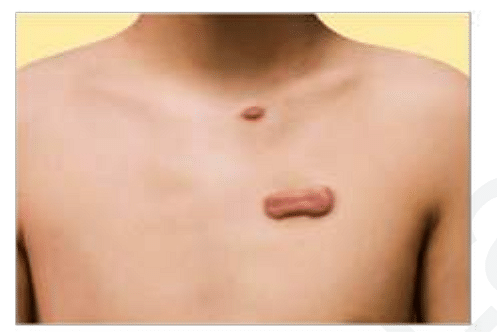
- A patient presents to the clinic with the lesion given in the image. He had a traumatic injury to the chest one year ago. What is the most likely diagnosis?
View More Questions
Top NEET PG Questions
- A patient hailing from Delhi presents with fever, arthralgia, and extensive petechial rash for 3 days. Lab investigations revealed a hemoglobin of 9 g/ dL, a white blood cell count of 9000 cells/mm3, a platelet count of 20000 cells/mm3, and a prolonged bleeding time. The clotting time was normal. What is the most likely diagnosis?
- Which of the following statements is true about Trichomonas vaginalis?
- A lady from West Rajasthan presented with an ulcer surrounded by erythema on the right leg. Microscopy of the biopsy from the edge of the ulcer showed organisms with dark staining nuclei and kinetoplast. What is the most likely causative agent?
- A child presents with a fever and a rash. Urine examination showed cells with owl's eye appearance. What is the most likely diagnosis?
- Infection with Clonorchis sinensis is associated with an increased risk of__?
View More Questions