The area of the region given by A={(x,y); \(x^2\)≤y≤min{x+2,4−3x}} is
\(\frac{31}{8}\)
\(\frac{17}{6}\)
\(\frac{19}{6}\)
\(\frac{27}{8}\)

The Correct Option is B
Solution and Explanation
A = {(x, y) : x2 ≤ y ≤ min {x + 2, 4 – 3x}
So, the area of the required region
A=\(\int_{-1}^{\frac{1}{2}}\)(x+2−x2)dx+\(\int_{1}^{\frac{1}{2}}\)(4−3x−x2)dx
=[\(\frac{x^2}{2}+2x-\frac{x^3}{3}\)]\(^{\frac{1}{2}}\)-1+[4x−\(\frac{3x^2}{2}\)−\(\frac{x^3}{3}\)]\(^{\frac{1}{2}}\)1
=(\(\frac{1}{8}\)+1−\(\frac{1}{24}\))−(\(\frac{1}{2}\)−2+\(\frac{1}{3}\))+(4−\(\frac{3}{2}\)−\(\frac{1}{3}\))−(2−\(\frac{3}{8}\)−\(\frac{1}{24}\))=\(\frac{17}{6}\)
Top JEE Main Mathematics Questions
- The value of is
- The number of terms of an is even. The sum of the odd terms is and of the even terms is . The last term exceeds the first by . Then the number of terms in the series is ______.
- If , then the general value of is:
- The general solution of
- If the constant term in the binomial expansion of $\left(\frac{x^{\frac{3}{2}}}{2}-\frac{4}{x^l}\right)^9$ is $-84$ and the coefficient of $x^{-3 l}$ is $2^\alpha \beta$, where $\beta<0$ is an odd number, then $|\alpha l-\beta|$ is equal to_____
Top JEE Main Area between Two Curves Questions
- Let the area of the region enclosed by the curves \( y = 3x \), \( 2y = 27 - 3x \), and \( y = 3x - x\sqrt{x} \) be \( A \). Then \( 10A \) is equal to:
- Let $A$ be the area of the region
$\left\{(x, y): y \geq x^2, y \geq(1-x)^2, y \leq 2 x(1-x)\right\}$.
Then $540 A$ is equal to ______. - The area of the region enclosed by the curves \( y = x^2 - 4x + 4 \) and \( y^2 = 16 - 8x \) is:
- The area of the region \[ \{ (x, y) : x^2 + 4x + 2 \leq y \leq |x| + 2 \} \] is equal to:
- The area of the region enclosed by the curves \( y = x^2 - 4x + 4 \) and \( y^2 = 16 - 8x \) is:
Top JEE Main Questions
- In a hydrogen like atom, when an electron jumps from the $M$ - shell to the $L$ - shell, the wavelength of emitted radiation is $\lambda$. If an electron jumps from $N$-shell to the $L$-shell, the wavelength of emitted radiation will be :
- Two masses $m$ and $\frac{m}{2}$ are connected at the two ends of a massless rigid rod of length $l$. The rod is suspended by a thin wire of torsional constant $k$ at the centre of mass of the rod-mass system(see figure). Because of torsional constant $k$, the restoring torque is $\tau =k\theta$ for angular displacement $\theta$. If the rod is rota ted by $\theta_0$ and released, the tension in it when it passes through its mean position will be:
What will be the equilibrium constant of the given reaction carried out in a \(5 \,L\) vessel and having equilibrium amounts of \(A_2\) and \(A\) as \(0.5\) mole and \(2 \times 10^{-6}\) mole respectively?
The reaction : \(A_2 \rightleftharpoons 2A\)- The value of is
- The number of terms of an is even. The sum of the odd terms is and of the even terms is . The last term exceeds the first by . Then the number of terms in the series is ______.
Concepts Used:
Approximations
The theory that is part of mathematics is the approximation theory. An approximation is employed when it becomes difficult to seek out the exact value of any number. It is also essential to round off the errors resulting in approximation.
Symbol of Approximation:
In general, the wavy equal “≈” sign is used to represent the approximate values that stand for “almost equal to”.
For Example ⇢ π ≈ 3.14
Approximations of Derivatives:
Consider y = f(x) = any function of x.
Let,
Δx = the small change in x
Δy = the corresponding change in y
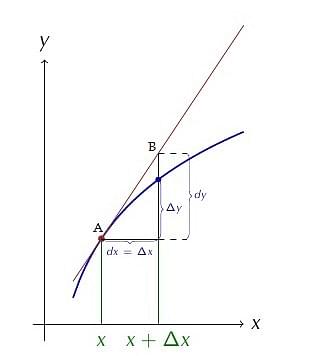
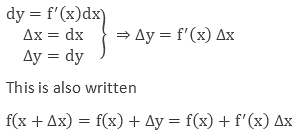
Here are some of the essential points that are required to be remembered:
- The differential of the dependent variable can not be equal to the increase of the variable whereas the differential of the independent variable can be equal to the increase of the variable.
- Absolute error in x is the change Δx.