Question:
Suppose that Box I contains \(6\) red balls and \(9\) green balls, and Box II contains \(8\) red balls and \(12\) green balls. All the balls of Box I and Box II are mixed together and a ball is chosen at random from them. Let \(E_1\) be the event that the ball chosen belonged to Box I and let \(E_2\) be the event that the ball chosen belonged to Box II. Let \(F_1\) be the event that the ball chosen is red and let \(F_2\) be the event that the ball chosen is green.
Then which of the following statements is (are) TRUE?
Suppose that Box I contains \(6\) red balls and \(9\) green balls, and Box II contains \(8\) red balls and \(12\) green balls. All the balls of Box I and Box II are mixed together and a ball is chosen at random from them. Let \(E_1\) be the event that the ball chosen belonged to Box I and let \(E_2\) be the event that the ball chosen belonged to Box II. Let \(F_1\) be the event that the ball chosen is red and let \(F_2\) be the event that the ball chosen is green.
Then which of the following statements is (are) TRUE?
Show Hint
Before doing any big calculation, check whether every box has the same red-to-green ratio. If it does, picking a box tells you nothing about colour, and that one observation answers most of the independence-type statements immediately.
Updated On: Aug 18, 2026
- The events \(E_1\) and \(F_1\) are independent
- The events \(E_2\) and \(F_2\) are dependent
- The conditional probability \(P(F_1|E_1)\) is equal to the conditional probability \(P(F_1|E_2)\)
- The conditional probability \(P(F_1|E_1)\) is greater than the conditional probability \(P(F_2|E_2)\)
Show Solution

Verified By Collegedunia
The Correct Option is A
Approach Solution - 1
Step 1: Find total balls and probabilities.
Box I: \[ 6\ \mathrm{red},\quad 9\ \mathrm{green} \] Total: \[ 15 \] Box II: \[ 8\ \mathrm{red},\quad 12\ \mathrm{green} \] Total: \[ 20 \] Overall total: \[ 35 \]
Step 2: Check Option (A).
\[ P(E_1)=\frac{15}{35}=\frac37 \] Total red balls: \[ 6+8=14 \] Thus: \[ P(F_1)=\frac{14}{35}=\frac25 \] Now: \[ P(E_1\cap F_1)=\frac6{35} \] Also: \[ P(E_1)P(F_1)=\frac37\times\frac25 \] \[ =\frac6{35} \] Since: \[ P(E_1\cap F_1)=P(E_1)P(F_1) \] events are independent. Therefore: \[ \Rightarrow \mathrm{Option\ (A)\ is\ Correct} \]
Step 3: Check Option (B).
\[ P(E_2)=\frac{20}{35}=\frac47 \] Total green balls: \[ 9+12=21 \] \[ P(F_2)=\frac{21}{35}=\frac35 \] Now: \[ P(E_2\cap F_2)=\frac{12}{35} \] And: \[ P(E_2)P(F_2)=\frac47\times\frac35 \] \[ =\frac{12}{35} \] Thus: \[ E_2\ \mathrm{and}\ F_2 \] are independent. Therefore: \[ \Rightarrow \mathrm{Option\ (B)\ is\ Incorrect} \]
Step 4: Check Option (C).
\[ P(F_1|E_1)=\frac6{15}=\frac25 \] \[ P(F_1|E_2)=\frac8{20}=\frac25 \] Hence: \[ P(F_1|E_1)=P(F_1|E_2) \] Therefore: \[ \Rightarrow \mathrm{Option\ (C)\ is\ Correct} \]
Step 5: Check Option (D).
\[ P(F_1|E_1)=\frac25 \] \[ P(F_2|E_2)=\frac{12}{20}=\frac35 \] Since: \[ \frac25<\frac35 \] Therefore: \[ \Rightarrow \mathrm{Option\ (D)\ is\ Incorrect} \]
Step 6: Identify the correct options.
Hence: \[ \boxed{\mathrm{(A)\ and\ (C)}} \]
Box I: \[ 6\ \mathrm{red},\quad 9\ \mathrm{green} \] Total: \[ 15 \] Box II: \[ 8\ \mathrm{red},\quad 12\ \mathrm{green} \] Total: \[ 20 \] Overall total: \[ 35 \]
Step 2: Check Option (A).
\[ P(E_1)=\frac{15}{35}=\frac37 \] Total red balls: \[ 6+8=14 \] Thus: \[ P(F_1)=\frac{14}{35}=\frac25 \] Now: \[ P(E_1\cap F_1)=\frac6{35} \] Also: \[ P(E_1)P(F_1)=\frac37\times\frac25 \] \[ =\frac6{35} \] Since: \[ P(E_1\cap F_1)=P(E_1)P(F_1) \] events are independent. Therefore: \[ \Rightarrow \mathrm{Option\ (A)\ is\ Correct} \]
Step 3: Check Option (B).
\[ P(E_2)=\frac{20}{35}=\frac47 \] Total green balls: \[ 9+12=21 \] \[ P(F_2)=\frac{21}{35}=\frac35 \] Now: \[ P(E_2\cap F_2)=\frac{12}{35} \] And: \[ P(E_2)P(F_2)=\frac47\times\frac35 \] \[ =\frac{12}{35} \] Thus: \[ E_2\ \mathrm{and}\ F_2 \] are independent. Therefore: \[ \Rightarrow \mathrm{Option\ (B)\ is\ Incorrect} \]
Step 4: Check Option (C).
\[ P(F_1|E_1)=\frac6{15}=\frac25 \] \[ P(F_1|E_2)=\frac8{20}=\frac25 \] Hence: \[ P(F_1|E_1)=P(F_1|E_2) \] Therefore: \[ \Rightarrow \mathrm{Option\ (C)\ is\ Correct} \]
Step 5: Check Option (D).
\[ P(F_1|E_1)=\frac25 \] \[ P(F_2|E_2)=\frac{12}{20}=\frac35 \] Since: \[ \frac25<\frac35 \] Therefore: \[ \Rightarrow \mathrm{Option\ (D)\ is\ Incorrect} \]
Step 6: Identify the correct options.
Hence: \[ \boxed{\mathrm{(A)\ and\ (C)}} \]
Was this answer helpful?
0
0
Show Solution
Verified By Collegedunia
Approach Solution -2
Concept:
Step 1: Write the red-to-green ratio for each box in simplest form.
Box I: $6$ red to $9$ green $=2:3$.
Box II: $8$ red to $12$ green $=2:3$.
Both boxes carry the exact same $2:3$ ratio.
Step 2: Read off what the matching ratio means.
Since red makes up $\frac{2}{5}$ of the balls in both boxes, the conditional probability of red is the same no matter which box is picked. This already signals that colour and box choice do not affect each other.
Step 3: Confirm statement (A) using $P(F_1|E_1)=P(F_1)$.
$P(F_1|E_1)=\frac{6}{15}=\frac{2}{5}$.
Total red balls overall: $6+8=14$ out of $35$, so $P(F_1)=\frac{14}{35}=\frac{2}{5}$.
Since $P(F_1|E_1)=P(F_1)$, $E_1$ and $F_1$ are independent. Statement (A) is TRUE.
Step 4: Confirm statement (B) the same way.
$P(F_2|E_2)=\frac{12}{20}=\frac{3}{5}$.
Total green balls overall: $9+12=21$ out of $35$, so $P(F_2)=\frac{21}{35}=\frac{3}{5}$.
Since $P(F_2|E_2)=P(F_2)$, $E_2$ and $F_2$ are independent, not dependent. Statement (B) is FALSE.
Step 5: Compare $P(F_1|E_1)$ with $P(F_1|E_2)$ for statement (C).
Both boxes share the $2:3$ ratio, so $P(F_1|E_1)=P(F_1|E_2)=\frac{2}{5}$. Statement (C) is TRUE.
Step 6: Compare $P(F_1|E_1)$ with $P(F_2|E_2)$ for statement (D).
$P(F_1|E_1)=\frac{2}{5}$ and $P(F_2|E_2)=\frac{3}{5}$. Since $\frac{2}{5}$ is less than $\frac{3}{5}$, statement (D) is FALSE.
Final Answer: Statements (A) and (C) are the correct ones.
- If every box has the same ratio of red to green balls, then knowing which box a ball came from gives no extra information about its colour -- the two events are automatically independent, with no computation needed.
- Formally, two events A and B are independent when $P(B|A)=P(B)$, meaning the conditional probability equals the plain, unconditional probability.
- Comparing the conditional probability from each box directly is usually faster than checking $P(A \cap B)=P(A)P(B)$ term by term.
Step 1: Write the red-to-green ratio for each box in simplest form.
Box I: $6$ red to $9$ green $=2:3$.
Box II: $8$ red to $12$ green $=2:3$.
Both boxes carry the exact same $2:3$ ratio.
Step 2: Read off what the matching ratio means.
Since red makes up $\frac{2}{5}$ of the balls in both boxes, the conditional probability of red is the same no matter which box is picked. This already signals that colour and box choice do not affect each other.
Step 3: Confirm statement (A) using $P(F_1|E_1)=P(F_1)$.
$P(F_1|E_1)=\frac{6}{15}=\frac{2}{5}$.
Total red balls overall: $6+8=14$ out of $35$, so $P(F_1)=\frac{14}{35}=\frac{2}{5}$.
Since $P(F_1|E_1)=P(F_1)$, $E_1$ and $F_1$ are independent. Statement (A) is TRUE.
Step 4: Confirm statement (B) the same way.
$P(F_2|E_2)=\frac{12}{20}=\frac{3}{5}$.
Total green balls overall: $9+12=21$ out of $35$, so $P(F_2)=\frac{21}{35}=\frac{3}{5}$.
Since $P(F_2|E_2)=P(F_2)$, $E_2$ and $F_2$ are independent, not dependent. Statement (B) is FALSE.
Step 5: Compare $P(F_1|E_1)$ with $P(F_1|E_2)$ for statement (C).
Both boxes share the $2:3$ ratio, so $P(F_1|E_1)=P(F_1|E_2)=\frac{2}{5}$. Statement (C) is TRUE.
Step 6: Compare $P(F_1|E_1)$ with $P(F_2|E_2)$ for statement (D).
$P(F_1|E_1)=\frac{2}{5}$ and $P(F_2|E_2)=\frac{3}{5}$. Since $\frac{2}{5}$ is less than $\frac{3}{5}$, statement (D) is FALSE.
Final Answer: Statements (A) and (C) are the correct ones.
Was this answer helpful?
0
0
Top JEE Advanced Mathematics Questions
- In a $\triangle$ ABC w ith fixed base BC, the vertex A moves such that cos B + cos C = 4 $ sin^2 \frac{A}{2}$. If a, b and c denote th e lengths of th e sides of th e triangle opposite to the angles A, B and C respectively, then
- Let $P=[a_{ij}]$ be a $3\times3$ matrix and let $Q=[b_{ij}]$ where $b_{ij}=2^{i+j} a_{ij}$ for $1 \le i, j \le $.If the determinant of $P$ is $2$, then the determinant of the matrix $Q$ is
- For the equation $3x^2+px+3=0,p>0,$ if one of the root is square of the other, then p is equal to
- The equation $\sqrt{x+1}-\sqrt{x-1}=\sqrt{4x-1}$ has
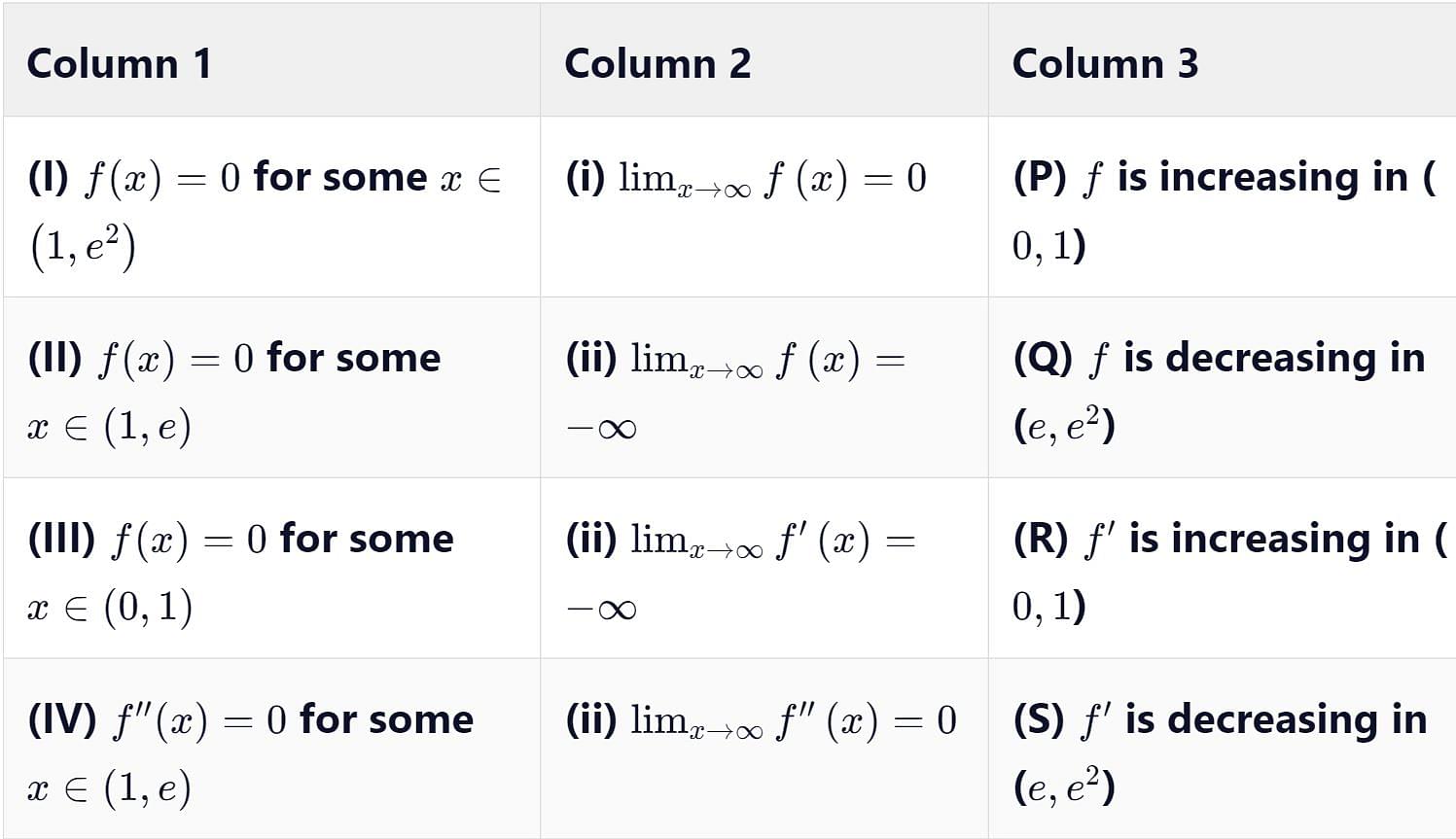
Let \(f(x)=x+log_{e}x−xlog_{e}x,\text{ }x∈(0,∞)\).
- Column 1 contains information about zeros of \(f(x)\), \(f'(x)\) and \(f''(x)\).
- Column 2 contains information about the limiting behavior of \(f(x)\), \(f'(x)\) and \(f''(x)\) at infinity.
- Column 3 contains information about increasing/decreasing nature of \(f(x)\) and \(f'(x)\).
View More Questions
Top JEE Advanced Questions
- Yellow light is used in a single slit diffraction experiment with slit width of 0.6 mm. If yellow light is replaced by X-rays, then the observed pattern will reveal
- The size of the image of an object, which is at infinity, as formed by a convex lens of focal length 30 cm is 2 cm. If a concave lens of focal length 20 cm is placed between the convex lens and the image at a distance of 26 cm from the convex lens, calculate the new size of the image.
- A concave lens of glass, refractive index 1.5 has both surfaces of same radius of curvature R. On immersion in a medium of refractive index 1.75, it will behave as a
- The position vector $\vec{r}$ of a particle of mass $m$ is given by the following equation $\vec{r}(t)=\alpha t^{3} \hat{i}+\beta t^{2} \hat{j}$ where $\alpha=\frac{10}{3} \,ms ^{-3}, \beta=5\, ms ^{-2}$ and $m =0.1 \,kg$. At $t =1\, s$, which of the following statement (s) is (are) true about the particle?
- In an n-p-n transistor circuit, the collector current is 10 mA. If 90% of the electrons emitted reach the collector
View More Questions