Question:
Pathological anatomy of axonotmesis does NOT include
Pathological anatomy of axonotmesis does NOT include
Show Hint
Recall Seddon's three grades of nerve injury and which one promises a full, rapid recovery.
Updated On: Jul 16, 2026
- Disruption of myelin sheath
- Disruption of perineurium and epineurium
- Wallerian degeneration
- Axonal regeneration and complete recovery
Show Solution

Verified By Collegedunia
The Correct Option is D
Solution and Explanation
Step 1: Understanding the Question:
This is a Seddon's classification of nerve injury question. It asks which listed feature is NOT part of the pathological picture of axonotmesis, the intermediate grade of nerve injury between neurapraxia and neurotmesis.
Step 2: Key Concept or Approach:
In axonotmesis, the axon and its myelin sheath are physically disrupted at the site of injury, and this is followed by Wallerian degeneration of the distal segment. The supporting connective-tissue tubes largely stay in continuity, which is why regenerating axon sprouts can find their way back down the original endoneural tube at roughly one millimetre a day. Recovery in axonotmesis is therefore possible without surgery, but because some sprouts still get misdirected into the wrong tubes and regrowth is slow, the recovery is usually good rather than truly complete. A full, rapid, and complete recovery is the hallmark of the milder neurapraxia, not axonotmesis.
Step 3: Working Through the Options:
Disruption of myelin sheath happens in axonotmesis because the axon itself is interrupted at the injury site. Wallerian degeneration is a defining and expected feature distal to the site of an axonotmesis injury. Disruption of perineurium and epineurium describes the connective-tissue architecture around the nerve fascicles, which is a separate structural point from the outcome being tested here. Axonal regeneration and complete recovery combines two ideas: regeneration does occur, but pairing it with a guarantee of complete recovery overstates what axonotmesis reliably produces, since some regenerating fibres are misdirected and function is often good but incomplete.
Step 4: Conclusion:
The correct answer is axonal regeneration and complete recovery. Axonotmesis allows regeneration and usually a good recovery, but not one that is reliably complete.
This is a Seddon's classification of nerve injury question. It asks which listed feature is NOT part of the pathological picture of axonotmesis, the intermediate grade of nerve injury between neurapraxia and neurotmesis.
Step 2: Key Concept or Approach:
In axonotmesis, the axon and its myelin sheath are physically disrupted at the site of injury, and this is followed by Wallerian degeneration of the distal segment. The supporting connective-tissue tubes largely stay in continuity, which is why regenerating axon sprouts can find their way back down the original endoneural tube at roughly one millimetre a day. Recovery in axonotmesis is therefore possible without surgery, but because some sprouts still get misdirected into the wrong tubes and regrowth is slow, the recovery is usually good rather than truly complete. A full, rapid, and complete recovery is the hallmark of the milder neurapraxia, not axonotmesis.
Step 3: Working Through the Options:
Disruption of myelin sheath happens in axonotmesis because the axon itself is interrupted at the injury site. Wallerian degeneration is a defining and expected feature distal to the site of an axonotmesis injury. Disruption of perineurium and epineurium describes the connective-tissue architecture around the nerve fascicles, which is a separate structural point from the outcome being tested here. Axonal regeneration and complete recovery combines two ideas: regeneration does occur, but pairing it with a guarantee of complete recovery overstates what axonotmesis reliably produces, since some regenerating fibres are misdirected and function is often good but incomplete.
Step 4: Conclusion:
The correct answer is axonal regeneration and complete recovery. Axonotmesis allows regeneration and usually a good recovery, but not one that is reliably complete.
Was this answer helpful?
0
0
Top NEET PG Anatomy Questions
- A defect in which of the following forms the structure marked below?

- A student had his jaw locked while yawning. Which of the following muscles is attached to the articular disc of the temporomandibular joint?
- The given histology image is of ?

- A defect in which of the following aortic arches causes the defect shown in the image?
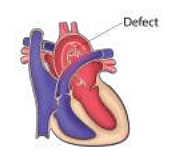
- Which of the following structures develops from the structure marked 4?
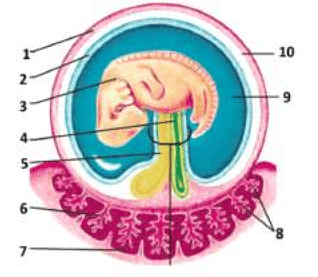
View More Questions
Top NEET PG Questions
- A patient hailing from Delhi presents with fever, arthralgia, and extensive petechial rash for 3 days. Lab investigations revealed a hemoglobin of 9 g/ dL, a white blood cell count of 9000 cells/mm3, a platelet count of 20000 cells/mm3, and a prolonged bleeding time. The clotting time was normal. What is the most likely diagnosis?
- Which of the following statements is true about Trichomonas vaginalis?
- A lady from West Rajasthan presented with an ulcer surrounded by erythema on the right leg. Microscopy of the biopsy from the edge of the ulcer showed organisms with dark staining nuclei and kinetoplast. What is the most likely causative agent?
- A child presents with a fever and a rash. Urine examination showed cells with owl's eye appearance. What is the most likely diagnosis?
- Infection with Clonorchis sinensis is associated with an increased risk of__?
View More Questions