Question:
P and Q are two Hermitian matrices and there exists a matrix \( R \), which diagonalizes both of them, such that \( RPR^{-1} = S_1 \) and \( RQR^{-1} = S_2 \), where \( S_1 \) and \( S_2 \) are diagonal matrices. The correct statement(s) is(are)
P and Q are two Hermitian matrices and there exists a matrix \( R \), which diagonalizes both of them, such that \( RPR^{-1} = S_1 \) and \( RQR^{-1} = S_2 \), where \( S_1 \) and \( S_2 \) are diagonal matrices. The correct statement(s) is(are)
Show Hint
If two Hermitian matrices can be diagonalized by the same matrix, they commute. Also, the eigenvalues of Hermitian matrices are always real.
Updated On: Dec 29, 2025
- All the elements of both matrices \( S_1 \) and \( S_2 \) are real.
- The matrix \( PQ \) can have complex eigenvalues.
- The matrix \( QP \) can have complex eigenvalues.
- The matrices \( P \) and \( Q \) commute.
Show Solution

Verified By Collegedunia
The Correct Option is A, D
Solution and Explanation
We are given two Hermitian matrices \( P \) and \( Q \), and a matrix \( R \) that diagonalizes both of them. The matrices \( S_1 = RPR^{-1} \) and \( S_2 = RQR^{-1} \) are diagonal matrices. We are tasked with identifying the correct statements about these matrices.
Step 1: Option (A) – Real Elements of \( S_1 \) and \( S_2 \)
Hermitian matrices have real eigenvalues, and since \( R \) is an invertible matrix, the transformation \( RPR^{-1} = S_1 \) and \( RQR^{-1} = S_2 \) does not change the eigenvalues. Thus, all elements of \( S_1 \) and \( S_2 \), which are the eigenvalues of \( P \) and \( Q \), are real. Therefore, Option (A) is correct. Step 2: Option (B) – Complex Eigenvalues of \( PQ \)
The product of two Hermitian matrices \( P \) and \( Q \) can have complex eigenvalues. This is because the product of two matrices does not necessarily preserve the Hermitian property, and hence the eigenvalues can be complex. Thus, Option (B) is incorrect. Step 3: Option (C) – Complex Eigenvalues of \( QP \)
Similar to Option (B), the matrix \( QP \) does not necessarily have real eigenvalues since the product of two Hermitian matrices does not always result in a Hermitian matrix. Hence, Option (C) is incorrect. Step 4: Option (D) – Commutativity of \( P \) and \( Q \)
If there exists a matrix \( R \) that diagonalizes both \( P \) and \( Q \), it implies that \( P \) and \( Q \) commute, i.e., \( PQ = QP \). Therefore, Option (D) is correct. Final Answer: (A), (D)
Hermitian matrices have real eigenvalues, and since \( R \) is an invertible matrix, the transformation \( RPR^{-1} = S_1 \) and \( RQR^{-1} = S_2 \) does not change the eigenvalues. Thus, all elements of \( S_1 \) and \( S_2 \), which are the eigenvalues of \( P \) and \( Q \), are real. Therefore, Option (A) is correct. Step 2: Option (B) – Complex Eigenvalues of \( PQ \)
The product of two Hermitian matrices \( P \) and \( Q \) can have complex eigenvalues. This is because the product of two matrices does not necessarily preserve the Hermitian property, and hence the eigenvalues can be complex. Thus, Option (B) is incorrect. Step 3: Option (C) – Complex Eigenvalues of \( QP \)
Similar to Option (B), the matrix \( QP \) does not necessarily have real eigenvalues since the product of two Hermitian matrices does not always result in a Hermitian matrix. Hence, Option (C) is incorrect. Step 4: Option (D) – Commutativity of \( P \) and \( Q \)
If there exists a matrix \( R \) that diagonalizes both \( P \) and \( Q \), it implies that \( P \) and \( Q \) commute, i.e., \( PQ = QP \). Therefore, Option (D) is correct. Final Answer: (A), (D)
Was this answer helpful?
0
0
Top GATE PH Mathematical Physics Questions
- If \( F_1(Q, q) = Qq \) is the generating function of a canonical transformation from \((p, q)\) to \((P, Q)\), then which one of the following relations is correct?
- Consider a volume integral
\(I=\int_V\nabla^2(\frac{1}{r})dv\)
over a volume \( V \), where \( r = \sqrt{x^2 + y^2 + z^2} \). Which of the following statements is/are correct? - The complex function \( e^{-\left(\frac{2}{z-1}\right)} \) has:
- Consider two matrices: \( P = \begin{bmatrix} 1 & 2 \\ 0 & 1 \end{bmatrix} \) and \( Q = \begin{bmatrix} 1 & 0 \\ 0 & 1 \end{bmatrix} \). Which of the following statements is/are true?
- Consider a vector field \( \vec{F} = (2xz + 3y^2)\hat{y} + 4yz^2\hat{z} \). The closed path (\( \Gamma \): \( A \rightarrow B \rightarrow C \rightarrow D \rightarrow A \)) in the \( z = 0 \) plane is shown in the figure.
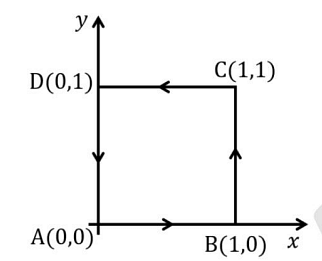
\( \oint_\Gamma \vec{F} \cdot d\vec{l} \) denotes the line integral of \( \vec{F} \) along the closed path \( \Gamma \). Which of the following options is/are true?
View More Questions
Top GATE PH Questions
- If \( F_1(Q, q) = Qq \) is the generating function of a canonical transformation from \((p, q)\) to \((P, Q)\), then which one of the following relations is correct?
- When an unpolarized plane electromagnetic wave in a dielectric medium with refractive index \( n_1 \) is incident on a plane interface separating it from another dielectric medium with refractive index \( n_2 \) (where \( n_2 > n_1 \)), and the angle of incidence is \(\tan^{-1} \left( \frac{n_2}{n_1} \right) \), the following statement is true:
- The wavefunction of a particle in an infinite one-dimensional potential well at time \( t \) is
\[ \Psi(x, t) = \sqrt{\frac{2}{3}} e^{-iE_1 t/\hbar}\psi_1(x) + \frac{1}{\sqrt{6}} e^{i\pi/6} e^{-iE_2 t/\hbar} \psi_2(x) + \frac{1}{\sqrt{6}} e^{i\pi/4} e^{-iE_3 t/\hbar} \psi_3(x) \]where \(\psi_1\), \(\psi_2\), and \(\psi_3\) are the normalized ground state, the normalized first excited state, and the normalized second excited state, respectively. \(E_1\), \(E_2\), and \(E_3\) are the eigen-energies corresponding to \(\psi_1\), \(\psi_2\), and \(\psi_3\), respectively. The expectation value of energy of the particle in state \(\Psi(x,t)\) is - If a thermodynamical system is adiabatically isolated and experiences a change in volume under an externally applied constant pressure, then the thermodynamical potential minimized at equilibrium is the
- The mean distance between the two atoms of an HD molecule is \( r \), where H and D denote hydrogen and deuterium, respectively. The mass of the hydrogen atom is \( m_H \). The energy difference between the two lowest lying rotational states of HD in multiples of \(\frac{h^2}{m_H r^2}\) is:
View More Questions