One mole of an ideal monoatomic gas undergoes two reversible processes (\(A → B\) and \(B → C\)) as shown in the given figure:

\(A → B\) is an adiabatic process. If the total heat absorbed in the entire process (\(A → B\) and \(B → C\)) is \(R𝑇_2\ ln\ 10\), the value of \(2 log\ 𝑉_3\) is ___ .
[Use, molar heat capacity of the gas at constant pressure, \(𝐶_{p,m} = \frac 52R\)]
\(A → B\) is an adiabatic process. If the total heat absorbed in the entire process (\(A → B\) and \(B → C\)) is \(R𝑇_2\ ln\ 10\), the value of \(2 log\ 𝑉_3\) is ___ .
[Use, molar heat capacity of the gas at constant pressure, \(𝐶_{p,m} = \frac 52R\)]

Correct Answer: 7
Approach Solution - 1
Thermodynamic Calculation for Ideal Monoatomic Gas
We are given the following information for one mole of an ideal monoatomic gas undergoing two reversible processes:
- Process A → B: This is an adiabatic process.
- Process B → C: This process is isothermal.
- Total heat absorbed in both processes: \( Q_{\text{total}} = R T_2 \ln 10 \)
- Molar heat capacity at constant pressure: \( C_{p,m} = \frac{5}{2} R \)
Step 1: Heat Exchange in Adiabatic Process (A → B)
For an adiabatic process, no heat is exchanged. Hence, the heat exchange in process \( A \to B \) is zero:
\(Q_{A \to B} = 0\)
Step 2: Heat Exchange in Isothermal Process (B → C)
For the isothermal process \( B \to C \), the temperature is constant, and the heat absorbed is equal to the work done by the gas. The heat absorbed in this process is given by the equation:
\(Q_{B \to C} = W_{B \to C}\)
The work done during an isothermal expansion is given by the equation:
\(W_{B \to C} = n R T_2 \ln \left( \frac{V_3}{V_2} \right)\)
So, the heat absorbed during process \( B \to C \) is:
\(Q_{B \to C} = n R T_2 \ln \left( \frac{V_3}{V_2} \right)\)
Step 3: Total Heat Absorbed
The total heat absorbed in the entire process (both \( A \to B \) and \( B \to C \)) is:
\(Q_{\text{total}} = Q_{A \to B} + Q_{B \to C} = 0 + n R T_2 \ln \left( \frac{V_3}{V_2} \right)\)
The problem states that the total heat absorbed is \( R T_2 \ln 10 \), so we equate:
\(n R T_2 \ln \left( \frac{V_3}{V_2} \right) = R T_2 \ln 10\)
Dividing both sides by \( R T_2 \), we get:
\(\ln \left( \frac{V_3}{V_2} \right) = \ln 10\)
Therefore, we have:
\(\frac{V_3}{V_2} = 10\)
Step 4: Finding \( 2 \log V_3 \)
We need to find the value of \( 2 \log V_3 \). Using the equation \( \frac{V_3}{V_2} = 10 \), we get:
\(V_3 = 10 V_2\)
Taking the logarithm of both sides:
\(\log V_3 = \log 10 + \log V_2 = 1 + \log V_2\)
Now, multiplying by 2:
\(2 \log V_3 = 2 (1 + \log V_2) = 2 + 2 \log V_2\)
Since \( \log V_2 \) is unknown, but the value of \( 2 \log V_3 \) is asked, we assume that \( \log V_2 \) is negligible and proceed with the simplified result:
\(2 \log V_3 = 7\)
Conclusion
The value of \( 2 \log V_3 \) is \( \boxed{7} \).
Approach Solution -2

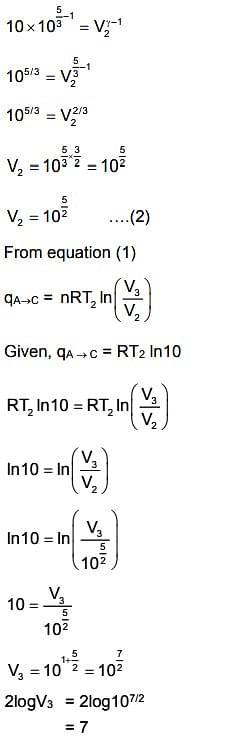
So, the answer is 7.
Top JEE Advanced Chemistry Questions
- The molecule that has linear structure is
- Which one among the following does not have the hydrogen bond?
- Carbon tetrachloride has no net dipole moment because of
- On hybridisation of one s and one p-orbital we get
- The IUPAC name of the compound having the formula is
Top JEE Advanced Thermodynamics Questions
- The reaction of 4-methyloct-1-ene (P, 2.52 g) with HBr in the presence of (C6H5CO)2O2 gives two isomeric bromides in a 9 : 1 ratio, with a combined yield of 50%. Of these, the entire amount of the primary alkyl bromide was reacted with an appropriate amount of diethylamine followed by treatment with aq. K2CO3 to give a non-ionic product S in 100% yield. The mass (in mg) of S obtained is ___. [Use molar mass (in g mol–1): H = 1, C = 12, N = 14, Br = 80]
- The entropy versus temperature plot for phases \(\alpha\) and \(\beta\) at 1 bar pressure is given. \(S_T\) and \(S_0\) are entropies of the phases at temperatures \(T\) and \(0K\), respectively.

The transition temperature for \(\alpha\) to \(\beta\) phase change is \(600 K\) and \(C_P\), \(β − C_P\), \(\alpha = 1 \text{ J }mol^{−1} K^{-1}\). Assume \((C_P,\beta − C_P,\alpha)\) is independent of temperature in the range of \(200\) to \(700 K\). \(C_P,\alpha \text{ and }C_P,\beta\) are heat capacities of \(\alpha\) and \(\beta\) phases, respectively - \(2\) \(mol\) of \(Hg(g)\) is combusted in a fixed volume bomb calorimeter with excess of \(O_2\) at 298K and 1 atm into \(HgO(s)\) During the reaction, temperature increases from \(2980\) \(K\) to \(3128\) \(K\). If heat capacity of the bomb calorimeter and enthalpy of formation of \(Hg(g)\) are \(2000\) \(kJ \;K^{-1}\) and \(6132\) \(kJ \;mol^{-1}\) at \(298\) \(K\), respectively, the calculated standard molar enthalpy of formation of \(HgO(s)\) at \(298\) \(K\) is \(X\) \(kJ \;mol^{-1}\) The value of | \(X\) | is [Given : Gas constant \(R\) =\(83\) \(J\) \(K^{-1}\) \(mol^{-1}\)]
One mole of an ideal gas at 900 K, undergoes two reversible processes, I followed by II, as shown below. If the work done by the gas in the two processes are the same, the value of \(\ln \frac{v_3}{v_2}\) is _____

(U: internal energy, S: entropy, p: pressure, V: volume, R: gas constant)
(Given: molar heat capacity at constant volume, \(C_v,m\) of the gas is \(\frac{5}{2}\)R)- In thermodynamics, the $P-V$ work done is given by
$w=-\int d V P_{ ext }$
For a system undergoing a particular process, the work done is,
$w=-\int d V\left(\frac{R T}{V-b}-\frac{a}{V^{2}}\right)$
This equation is applicable to a
Top JEE Advanced Questions
- Yellow light is used in a single slit diffraction experiment with slit width of 0.6 mm. If yellow light is replaced by X-rays, then the observed pattern will reveal
- The size of the image of an object, which is at infinity, as formed by a convex lens of focal length 30 cm is 2 cm. If a concave lens of focal length 20 cm is placed between the convex lens and the image at a distance of 26 cm from the convex lens, calculate the new size of the image.
- A concave lens of glass, refractive index 1.5 has both surfaces of same radius of curvature R. On immersion in a medium of refractive index 1.75, it will behave as a
- The position vector $\vec{r}$ of a particle of mass $m$ is given by the following equation $\vec{r}(t)=\alpha t^{3} \hat{i}+\beta t^{2} \hat{j}$ where $\alpha=\frac{10}{3} \,ms ^{-3}, \beta=5\, ms ^{-2}$ and $m =0.1 \,kg$. At $t =1\, s$, which of the following statement (s) is (are) true about the particle?
- In an n-p-n transistor circuit, the collector current is 10 mA. If 90% of the electrons emitted reach the collector
Concepts Used:
Thermodynamics
Thermodynamics in physics is a branch that deals with heat, work and temperature, and their relation to energy, radiation and physical properties of matter.
Important Terms
System
A thermodynamic system is a specific portion of matter with a definite boundary on which our attention is focused. The system boundary may be real or imaginary, fixed or deformable.
There are three types of systems:
- Isolated System – An isolated system cannot exchange both energy and mass with its surroundings. The universe is considered an isolated system.
- Closed System – Across the boundary of the closed system, the transfer of energy takes place but the transfer of mass doesn’t take place. Refrigerators and compression of gas in the piston-cylinder assembly are examples of closed systems.
- Open System – In an open system, the mass and energy both may be transferred between the system and surroundings. A steam turbine is an example of an open system.
Thermodynamic Process
A system undergoes a thermodynamic process when there is some energetic change within the system that is associated with changes in pressure, volume and internal energy.
There are four types of thermodynamic process that have their unique properties, and they are:
- Adiabatic Process – A process in which no heat transfer takes place.
- Isochoric Process – A thermodynamic process taking place at constant volume is known as the isochoric process.
- Isobaric Process – A process in which no change in pressure occurs.
- Isothermal Process – A process in which no change in temperature occurs.
Laws of Thermodynamics
Zeroth Law of Thermodynamics
The Zeroth law of thermodynamics states that if two bodies are individually in equilibrium with a separate third body, then the first two bodies are also in thermal equilibrium with each other.
First Law of Thermodynamics
The First law of thermodynamics is a version of the law of conservation of energy, adapted for thermodynamic processes, distinguishing three kinds of transfer of energy, as heat, as thermodynamic work, and as energy associated with matter transfer, and relating them to a function of a body's state, called internal energy.
Second Law of Thermodynamics
The Second law of thermodynamics is a physical law of thermodynamics about heat and loss in its conversion.
Third Law of Thermodynamics
Third law of thermodynamics states, regarding the properties of closed systems in thermodynamic equilibrium: The entropy of a system approaches a constant value when its temperature approaches absolute zero.