Number of isomeric products formed by monochlorination of 2-methylbutane in presence of sunlight is _______.

Correct Answer: 6
Approach Solution - 1
To determine the number of isomeric products formed by monochlorination of 2-methylbutane in the presence of sunlight, we need to consider the possible different hydrogen atoms that can be replaced by a chlorine atom. 2-Methylbutane, also known as isopentane, has the structural formula:
CH3
|
CH3-CH-CH2-CH3
|
CH3
The molecule has a total of four types of hydrogen positions: the primary carbon hydrogens (1°) on both terminal methyl (CH3) groups, the secondary carbon hydrogens (2°) on the middle methylene (CH2) group, and the tertiary carbon hydrogen (3°) on the central carbon bonded to three other carbons. By analyzing these positions, we can determine the distinct monochlorinated products:
- Chlorination at a primary hydrogen on the terminal methyl group generates 1-chloro-2-methylbutane or 2-chloro-2-methylbutane (2 each due to symmetry).
- Chlorination at the secondary hydrogen on the methylene group forms 3-chloro-2-methylbutane.
- Chlorination at the tertiary hydrogen on the central carbon forms 2-chloro-2-methylbutane.
Overall, this results in 6 distinct constitutional isomers:
| Position | Isomers |
|---|---|
| 1° (external CH3) | 1-chloro-2-methylbutane (2 isomers) |
| 1° (internal CH3) | 2-chloro-2-methylbutane |
| 2° (CH2) | 3-chloro-2-methylbutane |
| 3° (internal CH) | 2-chloro-2-methylbutane |
The number of isomeric products is thus 6. This value is confirmed to fall within the expected range of 6,6.
Approach Solution -2
In the monochlorination of 2-methylbutane, chlorine can replace a hydrogen atom at different positions, leading to the formation of structural and stereoisomeric products. The possible isomeric products are:
\[ \text{CH}_3 - \text{CH}(\text{Cl}) - \text{CH}_2 - \text{CH}(\text{CH}_3) - \text{CH}_3 \, (\pm) \] \[ \text{CH}_3 - \text{CH}(\text{CH}_3) - \text{CH}_2 - \text{CH}(\text{Cl}) - \text{CH}_3 \] \[ \text{CH}_3 - \text{C}(\text{Cl})(\text{CH}_3) - \text{CH}_2 - \text{CH}_3 \, (\pm) \]Therefore, there are 6 isomeric products.
Top JEE Main Chemistry Questions
What will be the equilibrium constant of the given reaction carried out in a \(5 \,L\) vessel and having equilibrium amounts of \(A_2\) and \(A\) as \(0.5\) mole and \(2 \times 10^{-6}\) mole respectively?
The reaction : \(A_2 \rightleftharpoons 2A\)- At equilibrium the concentrations of and in a sealed vessel at . What will be for the reaction
- Find out the major products from the following reactions

Cobalt chloride when dissolved in water forms pink colored complex $X$ which has octahedral geometry. This solution on treating with cone $HCl$ forms deep blue complex, $\underline{Y}$ which has a $\underline{Z}$ geometry $X, Y$ and $Z$, respectively, are
- The correct order of atomic radii is:
Top JEE Main Hydrocarbons Questions
- A \(10\) \(mL\) hydrocarbon \((C_2H_4)\) on combustion give \(40\) \(mL\) \(CO_2\) and \(50\) \(mL\) \(H_20\). Calculate the value of \(x+y\)
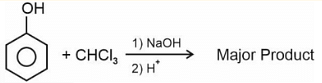
The major product in the above reaction is- 3-Methylhex-2-ene on reaction with HBr in presence of peroxide forms an addition product (A). The number of possible stereoisomers for 'A' is ______.
- Cyclohexene
 is _________ type of an organic compound.
- Find product P of the following reaction-
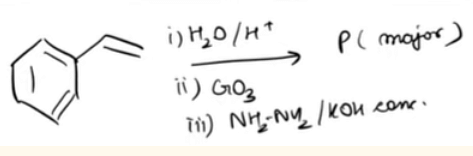
Top JEE Main Questions
- Two masses $m$ and $\frac{m}{2}$ are connected at the two ends of a massless rigid rod of length $l$. The rod is suspended by a thin wire of torsional constant $k$ at the centre of mass of the rod-mass system(see figure). Because of torsional constant $k$, the restoring torque is $\tau =k\theta$ for angular displacement $\theta$. If the rod is rota ted by $\theta_0$ and released, the tension in it when it passes through its mean position will be:
What will be the equilibrium constant of the given reaction carried out in a \(5 \,L\) vessel and having equilibrium amounts of \(A_2\) and \(A\) as \(0.5\) mole and \(2 \times 10^{-6}\) mole respectively?
The reaction : \(A_2 \rightleftharpoons 2A\)- The value of is
- The number of terms of an is even. The sum of the odd terms is and of the even terms is . The last term exceeds the first by . Then the number of terms in the series is ______.
A black body is at a temperature of 2880 K. The energy of radiation emitted by this body with wavelength between 499 nm and 500 nm is U1, between 999 nm and 1000 nm is U2 and between 1499 nm and 1500 nm is U3. The Wien's constant, b = 2.88×10⁶ nm-K. Then,