Match List I with List II
List I List II A 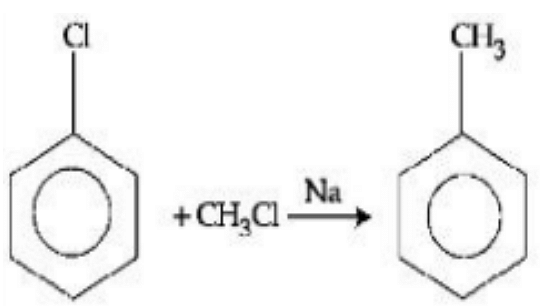
I Fittig reaction B 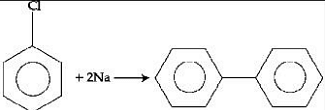
II Wurtz Fittig reaction C 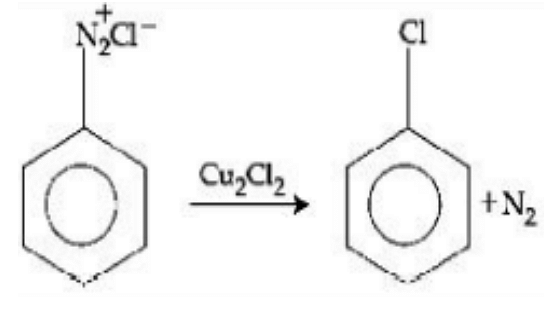
III Finkelstein reaction D \(C_{2}H_{5}CI + NaI \rightarrow C_{2}H_{5}I + NaCl\) IV Sandmeyer reaction
Choose the correct answer from the options given below:
Match List I with List II
| List I | List II | ||
| A | | I | Fittig reaction |
| B | | II | Wurtz Fittig reaction |
| C | | III | Finkelstein reaction |
| D | \(C_{2}H_{5}CI + NaI \rightarrow C_{2}H_{5}I + NaCl\) | IV | Sandmeyer reaction |
Choose the correct answer from the options given below:
- A - III, B - II, C - IV, D - I
- A - II, B - I, C - IV, D - III
- A - IV, B - II, C - III, D - I
- A - II, B - I, C - III, D - IV

The Correct Option is B
Solution and Explanation
 kk
kk
So, the correct answer is (B): A - II, B - I, C - IV, D - III
Top JEE Main Chemistry Questions
What will be the equilibrium constant of the given reaction carried out in a \(5 \,L\) vessel and having equilibrium amounts of \(A_2\) and \(A\) as \(0.5\) mole and \(2 \times 10^{-6}\) mole respectively?
The reaction : \(A_2 \rightleftharpoons 2A\)- At equilibrium the concentrations of and in a sealed vessel at . What will be for the reaction
- Find out the major products from the following reactions

Cobalt chloride when dissolved in water forms pink colored complex $X$ which has octahedral geometry. This solution on treating with cone $HCl$ forms deep blue complex, $\underline{Y}$ which has a $\underline{Z}$ geometry $X, Y$ and $Z$, respectively, are
- The correct order of atomic radii is:
Top JEE Main Haloalkanes and Haloarenes Questions
- The major product (A) formed in the reaction given below is :
\includegraphics[width=0.6\linewidth]{image43.png} - Which of the following sets of elements can be detected by Lassaigne's Test ?
- What will be the reactivity order of following compounds towards electrophilic substitution reaction ?

CH$_3$–Br $\xrightarrow{\text{CH$_3$OH/Nu}}$ CH$_3$OH
Correct order of rate of this reaction for given nucleophile:
- Compare rate of S$_N^1$

Top JEE Main Questions
- Two masses $m$ and $\frac{m}{2}$ are connected at the two ends of a massless rigid rod of length $l$. The rod is suspended by a thin wire of torsional constant $k$ at the centre of mass of the rod-mass system(see figure). Because of torsional constant $k$, the restoring torque is $\tau =k\theta$ for angular displacement $\theta$. If the rod is rota ted by $\theta_0$ and released, the tension in it when it passes through its mean position will be:
What will be the equilibrium constant of the given reaction carried out in a \(5 \,L\) vessel and having equilibrium amounts of \(A_2\) and \(A\) as \(0.5\) mole and \(2 \times 10^{-6}\) mole respectively?
The reaction : \(A_2 \rightleftharpoons 2A\)- The value of is
- The number of terms of an is even. The sum of the odd terms is and of the even terms is . The last term exceeds the first by . Then the number of terms in the series is ______.
A black body is at a temperature of 2880 K. The energy of radiation emitted by this body with wavelength between 499 nm and 500 nm is U1, between 999 nm and 1000 nm is U2 and between 1499 nm and 1500 nm is U3. The Wien's constant, b = 2.88×10⁶ nm-K. Then,
Concepts Used:
Haloalkanes and Haloarenes
The hydrocarbons such as Haloalkanes and Haloarenes are the ones, in which one or more hydrogen atoms are replaced with halogen atoms. The main difference between Haloalkanes and Haloarenes is that Haloalkanes are derived from open chained hydrocarbons, also called alkanes, and Haloarenes are derived from aromatic hydrocarbons.
- Haloalkanes have hydrocarbons made up of aliphatic alkanes and one or more hydrogen atoms replaced by halogens (elements such as Chlorine, Bromine, Fluorine, Iodine, etc.) whereas, haloarenes consist of aromatic ring or rings and one or more hydrogen atoms replaced by halogens.
- In haloalkanes, the halogen atom is attached to the sp3 hybridized carbon atom of the alkyl group whereas, in haloarenes, the halogen atom is attached to the sp3 hybridized carbon atom of the alkyl group.
- Haloalkanes are saturated organic compounds where all the chemical bonds are attached to the carbon atom with single bonds and a single carbon atom is attached to the Halogen atom, whereas, the haloarenes differ from Haloalkanes by their method of preparation and properties.
- Haloalkanes are made by aliphatic alkanes by the process of free radical halogenation, whereas, haloarenes are made by direct halogenation of aromatic rings.
- Haloalkanes are odorless compounds, whereas, haloarenes have a sweet odor.
- Haloalkanes precipitate in SN2 substitution reactions, whereas, haloarenes do not precipitate in SN2 substitution reactions.
- Example of haloalkanes is CH3Cl (Methyl Chloride) and CH3CH2Br (Ethyl Bromide) and the example of haloarenes is Chlorobenzene, Bromobenzene.