Match List I with List II :
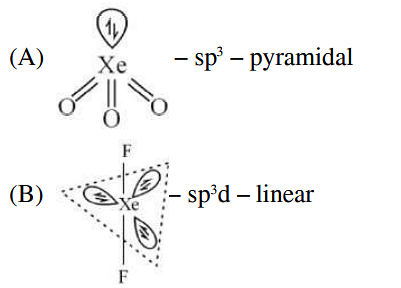
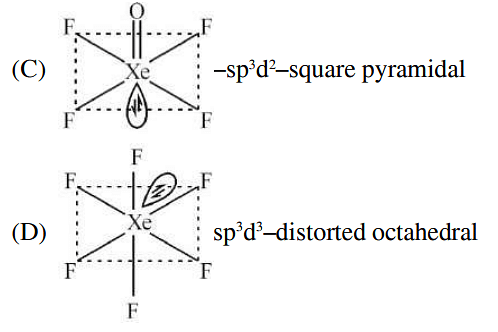
List-I (molecule) List-II (hybridization; shape) A XeO3 i sp3d ; linear B XeF2 ii sp3; pyramidal C XeOF4 iii sp3d3; distorted octahedral D XeF6 iv sp3d2 ;square pyramidal
Choose the correct answer from the options given below:
Match List I with List II :
| List-I (molecule) | List-II (hybridization; shape) | ||
|---|---|---|---|
| A | XeO3 | i | sp3d ; linear |
| B | XeF2 | ii | sp3; pyramidal |
| C | XeOF4 | iii | sp3d3; distorted octahedral |
| D | XeF6 | iv | sp3d2 ;square pyramidal |
Choose the correct answer from the options given below:
- A-II, B-I, C-IV, D-III
- A-II, B-IV, C-III, D-I
- A-IV, B-II, C-III, D-I
- A-IV, B-II, C-I, D-III

The Correct Option is A
Solution and Explanation
Top JEE Main Chemistry Questions
What will be the equilibrium constant of the given reaction carried out in a \(5 \,L\) vessel and having equilibrium amounts of \(A_2\) and \(A\) as \(0.5\) mole and \(2 \times 10^{-6}\) mole respectively?
The reaction : \(A_2 \rightleftharpoons 2A\)- At equilibrium the concentrations of and in a sealed vessel at . What will be for the reaction
- Find out the major products from the following reactions

Cobalt chloride when dissolved in water forms pink colored complex $X$ which has octahedral geometry. This solution on treating with cone $HCl$ forms deep blue complex, $\underline{Y}$ which has a $\underline{Z}$ geometry $X, Y$ and $Z$, respectively, are
- The correct order of atomic radii is:
Top JEE Main Chemical bonding and molecular structure Questions
- Statement I: Since fluorine is more electronegative than nitrogen, the net dipole moment of NF3 is greater than NH3.
Statement II: In NH3, the orbital dipole due to the lone pair and the dipole moment of NH bonds are in opposite directions, but in NF3, the orbital dipole due to the lone pair and the dipole moments of N-F bonds are in the same direction.
In light of the above statements, choose the most appropriate from the options given below: - What is the structure of Mn2(CO)10?
- Consider the following two statements Statement I: \(π\) \(2p\) bonding molecular orbital has low electron density above & below internuclear axis Statement II: \(π\times2p\) antibonding molecular orbital has only one nodal plane
- Consider the following two statements Statement I: \(SiO_2\) and GeO₂\(GeO_2\) are acidic, \(SnO\) and \(PbO\) are amphoteric Statement II: Allotropes of carbon are formed due to catenation and \(dπ - ρπ\) bond
- Number of compounds with one lone pair of electrons on central atom amongst following is
\(CIF_3, XeO_3, BrF_5, XeF_4, O_3, NH_3\),\( H_2O\)
Top JEE Main Questions
- Two masses $m$ and $\frac{m}{2}$ are connected at the two ends of a massless rigid rod of length $l$. The rod is suspended by a thin wire of torsional constant $k$ at the centre of mass of the rod-mass system(see figure). Because of torsional constant $k$, the restoring torque is $\tau =k\theta$ for angular displacement $\theta$. If the rod is rota ted by $\theta_0$ and released, the tension in it when it passes through its mean position will be:
What will be the equilibrium constant of the given reaction carried out in a \(5 \,L\) vessel and having equilibrium amounts of \(A_2\) and \(A\) as \(0.5\) mole and \(2 \times 10^{-6}\) mole respectively?
The reaction : \(A_2 \rightleftharpoons 2A\)- The value of is
- The number of terms of an is even. The sum of the odd terms is and of the even terms is . The last term exceeds the first by . Then the number of terms in the series is ______.
A black body is at a temperature of 2880 K. The energy of radiation emitted by this body with wavelength between 499 nm and 500 nm is U1, between 999 nm and 1000 nm is U2 and between 1499 nm and 1500 nm is U3. The Wien's constant, b = 2.88×10⁶ nm-K. Then,
Concepts Used:
Chemical Bonding and Molecular Structure
Such a group of atoms is called a molecule. Obviously, there must be some force that holds these constituent atoms together in the molecules. The attractive force which holds various constituents (atoms, ions, etc.) together in different chemical species is called a chemical bond.
Types of Chemical Bonds:
There are 4 types of chemical bonds which are formed by atoms or molecules to yield compounds.
- Ionic Bonds - Ionic bonding is a type of chemical bonding which involves a transfer of electrons from one atom or molecule to another.
- Covalent Bonds - Compounds that contain carbon commonly exhibit this type of chemical bonding.
- Hydrogen Bonds - It is a type of polar covalent bonding between oxygen and hydrogen wherein the hydrogen develops a partial positive charge
- Polar Bonds - In Polar Covalent chemical bonding, electrons are shared unequally since the more electronegative atom pulls the electron pair closer to itself and away from the less electronegative atom.
Factors Affecting Bond Enthalpy in Chemical Bonding:
- Size of the Atom
- Multiplicity of Bonds
- Number of Lone Pair of Electrons Present
- Bond Angle