Question:
Match List I (Clinical Conditions) with List II (Nerves involved) and select the correct answer using the codes given below the lists:
List I (Clinical Conditions) List II (Nerves involved) A. Wrist drop 1. Ulnar nerve B. Winging of Scapula 2. Radial nerve C. Pointing index 3. Long Thoracic nerve D. Claw hand 4. Median nerve
Codes:
Match List I (Clinical Conditions) with List II (Nerves involved) and select the correct answer using the codes given below the lists:
Codes:
| List I (Clinical Conditions) | List II (Nerves involved) |
|---|---|
| A. Wrist drop | 1. Ulnar nerve |
| B. Winging of Scapula | 2. Radial nerve |
| C. Pointing index | 3. Long Thoracic nerve |
| D. Claw hand | 4. Median nerve |
Show Hint
Radial nerve gives wrist drop, long thoracic nerve gives winging of scapula, median nerve gives a pointing index, ulnar nerve gives a claw hand.
Updated On: Jul 7, 2026
- A-2, B-3, C-4, D-1
- A-1, B-4, C-3, D-2
- A-2, B-4, C-3, D-1
- A-1, B-3, C-4, D-2
Show Solution

Verified By Collegedunia
The Correct Option is A
Solution and Explanation
Step 1: Understanding the Question.
We must match four clinical hand and shoulder signs with the nerve responsible for each, then pick the code that lists the pairs correctly.
Step 2: Match wrist drop.
Wrist drop is the inability to extend the wrist and fingers, seen when the radial nerve is damaged (for example, in a mid-shaft humerus fracture or "Saturday night palsy"). So A matches with 2, radial nerve.
Step 3: Match winging of scapula.
Winging of the scapula, where the medial border of the shoulder blade sticks out, happens when the long thoracic nerve is injured, because this nerve supplies serratus anterior, the muscle that holds the scapula flat against the chest wall. So B matches with 3, long thoracic nerve.
Step 4: Match pointing index and claw hand.
Pointing index, where the index finger stays straight while the others try to flex (as in trying to make a fist), points to median nerve damage, since the median nerve supplies the muscles that flex the index and middle fingers. So C matches with 4, median nerve.
Claw hand, with hyperextension at the knuckles and flexion at the finger joints of the ring and little fingers, is caused by ulnar nerve damage, since the ulnar nerve supplies most of the small hand muscles. So D matches with 1, ulnar nerve.
Step 5: Assemble the code.
Putting these together gives A-2, B-3, C-4, D-1, which matches option (a), option 1 in our list.
Step 6: Final Answer.
\[ \boxed{A\text{-}2,\ B\text{-}3,\ C\text{-}4,\ D\text{-}1} \]
We must match four clinical hand and shoulder signs with the nerve responsible for each, then pick the code that lists the pairs correctly.
Step 2: Match wrist drop.
Wrist drop is the inability to extend the wrist and fingers, seen when the radial nerve is damaged (for example, in a mid-shaft humerus fracture or "Saturday night palsy"). So A matches with 2, radial nerve.
Step 3: Match winging of scapula.
Winging of the scapula, where the medial border of the shoulder blade sticks out, happens when the long thoracic nerve is injured, because this nerve supplies serratus anterior, the muscle that holds the scapula flat against the chest wall. So B matches with 3, long thoracic nerve.
Step 4: Match pointing index and claw hand.
Pointing index, where the index finger stays straight while the others try to flex (as in trying to make a fist), points to median nerve damage, since the median nerve supplies the muscles that flex the index and middle fingers. So C matches with 4, median nerve.
Claw hand, with hyperextension at the knuckles and flexion at the finger joints of the ring and little fingers, is caused by ulnar nerve damage, since the ulnar nerve supplies most of the small hand muscles. So D matches with 1, ulnar nerve.
Step 5: Assemble the code.
Putting these together gives A-2, B-3, C-4, D-1, which matches option (a), option 1 in our list.
Step 6: Final Answer.
\[ \boxed{A\text{-}2,\ B\text{-}3,\ C\text{-}4,\ D\text{-}1} \]
Was this answer helpful?
0
0
Top NEET PG Anatomy Questions
- A defect in which of the following forms the structure marked below?

- A student had his jaw locked while yawning. Which of the following muscles is attached to the articular disc of the temporomandibular joint?
- The given histology image is of ?

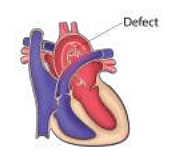
- A defect in which of the following aortic arches causes the defect shown in the image?
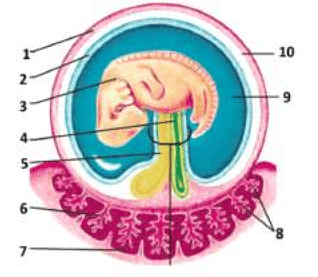
- Which of the following structures develops from the structure marked 4?
View More Questions
Top NEET PG Questions
- A patient hailing from Delhi presents with fever, arthralgia, and extensive petechial rash for 3 days. Lab investigations revealed a hemoglobin of 9 g/ dL, a white blood cell count of 9000 cells/mm3, a platelet count of 20000 cells/mm3, and a prolonged bleeding time. The clotting time was normal. What is the most likely diagnosis?
- Which of the following statements is true about Trichomonas vaginalis?
- A lady from West Rajasthan presented with an ulcer surrounded by erythema on the right leg. Microscopy of the biopsy from the edge of the ulcer showed organisms with dark staining nuclei and kinetoplast. What is the most likely causative agent?
- A child presents with a fever and a rash. Urine examination showed cells with owl's eye appearance. What is the most likely diagnosis?
- Infection with Clonorchis sinensis is associated with an increased risk of__?
View More Questions