Question:
M = $\begin{bmatrix} \cos\theta & -\sin\theta \\ \sin\theta & \cos\theta \end{bmatrix}$ , $\theta$ = $\frac{2\pi}{5}$ then M$^{2026}$ = ?
M = $\begin{bmatrix} \cos\theta & -\sin\theta \\ \sin\theta & \cos\theta \end{bmatrix}$ , $\theta$ = $\frac{2\pi}{5}$ then M$^{2026}$ = ?
Show Hint
When asked to find a large power of a rotation matrix, first find its order 'n' (the smallest power for which $M^n = I$). Then, calculate the exponent modulo n. For an angle $\theta = \frac{p}{q} 2\pi$ (in lowest terms), the order of the matrix is 'q'. Here, $\theta = \frac{1}{5} 2\pi$, so the order is 5. We then just need to compute $2026 \pmod 5 = 1$, so $M^{2026} = M^1$.
Updated On: Feb 23, 2026
- M$^2$
- M
- I
- M$^{-1}$
Show Solution

Verified By Collegedunia
The Correct Option is B
Solution and Explanation
Step 1: Understanding the Question:
We are given a 2x2 matrix M, which is a standard 2D rotation matrix, and we need to calculate a high power of this matrix, $M^{2026}$.
Step 2: Key Formula or Approach:
A property of 2D rotation matrices is that raising them to a power 'k' is equivalent to rotating by 'k' times the original angle. \[ M^k = \begin{pmatrix} \cos\theta & -\sin\theta
\sin\theta & \cos\theta \end{pmatrix}^k = \begin{pmatrix} \cos(k\theta) & -\sin(k\theta)
\sin(k\theta) & \cos(k\theta) \end{pmatrix} \] An alternative approach is to find the smallest integer 'n' for which $M^n = I$ (the identity matrix) and then use modular arithmetic on the exponent.
Step 3: Detailed Explanation:
Let's use the second approach, which is often simpler. We want to find the order of the matrix M. Let's find the smallest positive integer n such that $n\theta$ is a multiple of $2\pi$. \[ n \times \frac{2\pi}{5} = m \times 2\pi \] \[ \frac{n}{5} = m \] The smallest integer n that satisfies this is n=5 (which gives m=1). So, for n=5, the angle of rotation is $5\theta = 5 \times \frac{2\pi}{5} = 2\pi$. Let's calculate $M^5$: \[ M^5 = \begin{pmatrix} \cos(2\pi) & -\sin(2\pi)
\sin(2\pi) & \cos(2\pi) \end{pmatrix} = \begin{pmatrix} 1 & 0
0 & 1 \end{pmatrix} = I \] Now we can compute $M^{2026}$ by using this property. We can divide the exponent 2026 by 5. \[ 2026 = 5 \times 405 + 1 \] So we can rewrite the expression as: \[ M^{2026} = M^{5 \times 405 + 1} = M^{5 \times 405} \times M^1 = (M^5)^{405} \times M \] Since $M^5 = I$: \[ M^{2026} = (I)^{405} \times M = I \times M = M \] Step 4: Final Answer:
The matrix $M^{2026}$ is equal to the matrix M.
We are given a 2x2 matrix M, which is a standard 2D rotation matrix, and we need to calculate a high power of this matrix, $M^{2026}$.
Step 2: Key Formula or Approach:
A property of 2D rotation matrices is that raising them to a power 'k' is equivalent to rotating by 'k' times the original angle. \[ M^k = \begin{pmatrix} \cos\theta & -\sin\theta
\sin\theta & \cos\theta \end{pmatrix}^k = \begin{pmatrix} \cos(k\theta) & -\sin(k\theta)
\sin(k\theta) & \cos(k\theta) \end{pmatrix} \] An alternative approach is to find the smallest integer 'n' for which $M^n = I$ (the identity matrix) and then use modular arithmetic on the exponent.
Step 3: Detailed Explanation:
Let's use the second approach, which is often simpler. We want to find the order of the matrix M. Let's find the smallest positive integer n such that $n\theta$ is a multiple of $2\pi$. \[ n \times \frac{2\pi}{5} = m \times 2\pi \] \[ \frac{n}{5} = m \] The smallest integer n that satisfies this is n=5 (which gives m=1). So, for n=5, the angle of rotation is $5\theta = 5 \times \frac{2\pi}{5} = 2\pi$. Let's calculate $M^5$: \[ M^5 = \begin{pmatrix} \cos(2\pi) & -\sin(2\pi)
\sin(2\pi) & \cos(2\pi) \end{pmatrix} = \begin{pmatrix} 1 & 0
0 & 1 \end{pmatrix} = I \] Now we can compute $M^{2026}$ by using this property. We can divide the exponent 2026 by 5. \[ 2026 = 5 \times 405 + 1 \] So we can rewrite the expression as: \[ M^{2026} = M^{5 \times 405 + 1} = M^{5 \times 405} \times M^1 = (M^5)^{405} \times M \] Since $M^5 = I$: \[ M^{2026} = (I)^{405} \times M = I \times M = M \] Step 4: Final Answer:
The matrix $M^{2026}$ is equal to the matrix M.
Was this answer helpful?
0
0
Top GATE DA Data Science and Artificial Intelligence Questions
- Consider performing depth-first search (DFS) on an undirected and unweighted graph G starting at vertex s. For any vertex u in G, d[u] is the length of the shortest path from s to u. Let (u, v) be an edge in G such that d[u] < d[v]. If the edge (u, v) is explored first in the direction from u to v during the above DFS, then (u, v) becomes a _____ edge.
- Three fair coins are tossed independently. T is the event that two or more tosses result in heads. S is the event that two or more tosses result in tails. What is the probability of the event T ∩ S?
- Consider the matrix \(M=\begin{bmatrix} 2 & -1 \\ 3 & 1 \end{bmatrix}\).
Which ONE of the following statements is TRUE ? - For any twice differentiable function ƒ: R → R, if at some x* ∈ R, f'(x*) = 0 and f'(x*) > 0, then the function f necessarily has a ______ at x = x*.
Note : R denotes the set of real numbers. - Match the items in Column 1 with the items in Column 2 in the following table :
Column 1 Column 2 (p) First In First Out (i) Stacks (q) Lookup Operation (ii) Queues (r) Last In First Out (iii) Hash Tables
View More Questions
Top GATE DA Linear Algebra Questions
- Consider the two neural networks (NNs) shown in Figures 1 and 2, with ReLU activation (ReLU(z) = max{0, z}, ∀z ∈ R). R denotes the set of real numbers. The connections and their corresponding weights are shown in the Figures. The biases at every neuron are set to 0. For what values of p, q, r in Figure 2 are the two NNs equivalent, when x1, x2, x3 are positive ?
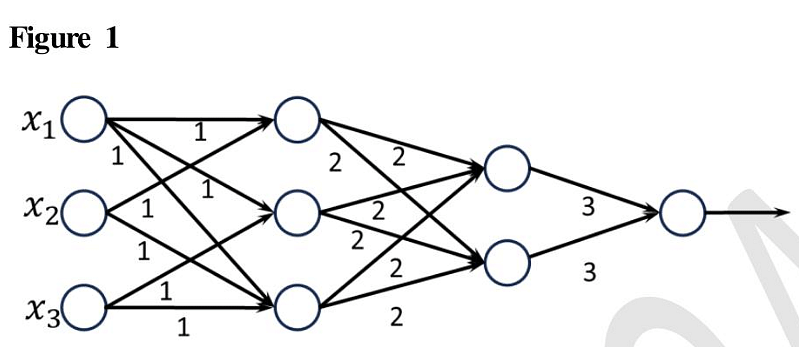
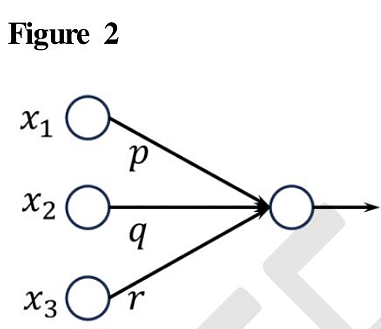
- Select all choices that are subspaces of \(\R^3\).
Note : \(\R\) denotes the set of real numbers. - Which of the following statements is/are TRUE ?
Note: \(\R\) denotes the set of real numbers. - Let \(\R\) be the set of real numbers, U be a subspace of \(\R^3\) and M ∈ \(\R^{3×3}\) be the matrix corresponding to the projection on to the subspace U.
Which of the following statements is/are TRUE ? - Consider the directed acyclic graph (DAG) below :
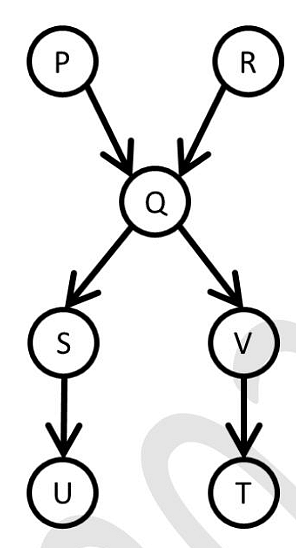
Which of the following is/are valid vertex orderings that can be obtained from a topological sort of the DAG ?
View More Questions
Top GATE DA Questions
- Consider performing depth-first search (DFS) on an undirected and unweighted graph G starting at vertex s. For any vertex u in G, d[u] is the length of the shortest path from s to u. Let (u, v) be an edge in G such that d[u] < d[v]. If the edge (u, v) is explored first in the direction from u to v during the above DFS, then (u, v) becomes a _____ edge.
- Three fair coins are tossed independently. T is the event that two or more tosses result in heads. S is the event that two or more tosses result in tails. What is the probability of the event T ∩ S?
- Consider the matrix \(M=\begin{bmatrix} 2 & -1 \\ 3 & 1 \end{bmatrix}\).
Which ONE of the following statements is TRUE ? - For any twice differentiable function ƒ: R → R, if at some x* ∈ R, f'(x*) = 0 and f'(x*) > 0, then the function f necessarily has a ______ at x = x*.
Note : R denotes the set of real numbers. - Match the items in Column 1 with the items in Column 2 in the following table :
Column 1 Column 2 (p) First In First Out (i) Stacks (q) Lookup Operation (ii) Queues (r) Last In First Out (iii) Hash Tables
View More Questions