Let
\(\frac{x-2}{3} = \frac{y+1}{-2} = \frac{z+3}{-1}\)
lie on the plane px – qy + z = 5, for some p, q ∈ ℝ. The shortest distance of the plane from the origin is :
Let
\(\frac{x-2}{3} = \frac{y+1}{-2} = \frac{z+3}{-1}\)
lie on the plane px – qy + z = 5, for some p, q ∈ ℝ. The shortest distance of the plane from the origin is :
\(\sqrt{\frac{3}{109}}\)
\(\sqrt{\frac{5}{142}}\)
\(\frac{5}{\sqrt{71}}\)
\(\frac{1}{\sqrt{142}}\)

The Correct Option is B
Solution and Explanation
The correct answer is (B) : \(\sqrt{\frac{5}{142}}\)
Given:
Line L: \(\frac{(x - 2)}{3} = \frac{(y + 1)}{- 2} = \frac{(z + 3)}{- 1}\)
And plane P: px - qy + z = 5
∵ Line L lies on the plane p
∴ Point (2, -1, -3) will satisfy the equation of plane
So, 2p + q - 3 = 5
⇒ 2p + q = 8 .... (i)
The line is also parallel to the plane.
∴ 3p - 2q - 1 = 0
3p - 2q =1...(ii)
By solving equation (i) and equation (ii),
we get p = 15 ,q = - 22
Therefore , Equation of plane is 15x + 22y + z - 5 = 0
Now , distance of plane from origin is d \(= | \frac{5 }{\sqrt{(15)²+(22)²+1²}} |\)
\(⇒ d = \frac{5}{\sqrt{710}} = \sqrt{\frac{25}{710}} \)
\(= \sqrt{\frac{5}{142}}\)
Top JEE Main Mathematics Questions
- The value of is
- The number of terms of an is even. The sum of the odd terms is and of the even terms is . The last term exceeds the first by . Then the number of terms in the series is ______.
- If , then the general value of is:
- The general solution of
- If the constant term in the binomial expansion of $\left(\frac{x^{\frac{3}{2}}}{2}-\frac{4}{x^l}\right)^9$ is $-84$ and the coefficient of $x^{-3 l}$ is $2^\alpha \beta$, where $\beta<0$ is an odd number, then $|\alpha l-\beta|$ is equal to_____
Top JEE Main Three Dimensional Geometry Questions
- If the foot is perpendicular from (1, 2, 3) to the line \(\frac{x+1}{2} = \frac{y-2}{5} = \frac{z-1}{1}\) is \(( a, \beta, \gamma)\), then find \(a + \beta + \gamma\)
- The sum of all values of $\alpha$, for which the shortest distance between the lines $\dfrac{x+1}{\alpha}=\dfrac{y-2}{-1}=\dfrac{z-4}{-\alpha}$ and $\dfrac{x}{\alpha}=\dfrac{y-1}{2}=\dfrac{z-1}{2\alpha}$ is $\sqrt{2}$, is
- If the distances of the point \( (1,2,a) \) from the line \[ \frac{x-1}{1}=\frac{y}{2}=\frac{z-1}{1} \] along the lines \[ L_1:\ \frac{x-1}{3}=\frac{y-2}{4}=\frac{z-a}{b} \quad \text{and} \quad L_2:\ \frac{x-1}{1}=\frac{y-2}{4}=\frac{z-a}{c} \] are equal, then \( a+b+c \) is equal to:
- The value of the integral \( \int_{\frac{\pi}{24}}^{\frac{5\pi}{24}} \frac{dx}{1 + \sqrt[3]{\tan 2x}} \) is :
- If $\lambda_1<\lambda_2$ are two values of $\lambda$ such that the angle between the planes $P_1: \vec{r}(3 \hat{i}-5 \hat{j}+\hat{k})=7$ and $P_2: \vec{r} \cdot(\lambda \hat{i}+\hat{j}-3 \hat{k})=9$ is $\sin ^{-1}\left(\frac{2 \sqrt{6}}{5}\right)$, then the square of the length of perpendicular from the point $\left(38 \lambda_1, 10 \lambda_2, 2\right)$ to the plane $P_1$ is _____
Top JEE Main Questions
- In a hydrogen like atom, when an electron jumps from the $M$ - shell to the $L$ - shell, the wavelength of emitted radiation is $\lambda$. If an electron jumps from $N$-shell to the $L$-shell, the wavelength of emitted radiation will be :
- Two masses $m$ and $\frac{m}{2}$ are connected at the two ends of a massless rigid rod of length $l$. The rod is suspended by a thin wire of torsional constant $k$ at the centre of mass of the rod-mass system(see figure). Because of torsional constant $k$, the restoring torque is $\tau =k\theta$ for angular displacement $\theta$. If the rod is rota ted by $\theta_0$ and released, the tension in it when it passes through its mean position will be:
What will be the equilibrium constant of the given reaction carried out in a \(5 \,L\) vessel and having equilibrium amounts of \(A_2\) and \(A\) as \(0.5\) mole and \(2 \times 10^{-6}\) mole respectively?
The reaction : \(A_2 \rightleftharpoons 2A\)- The value of is
- The number of terms of an is even. The sum of the odd terms is and of the even terms is . The last term exceeds the first by . Then the number of terms in the series is ______.
Concepts Used:
Three Dimensional Geometry
Mathematically, Geometry is one of the most important topics. The concepts of Geometry are derived w.r.t. the planes. So, Geometry is divided into three major categories based on its dimensions which are one-dimensional geometry, two-dimensional geometry, and three-dimensional geometry.
Direction Cosines and Direction Ratios of Line:
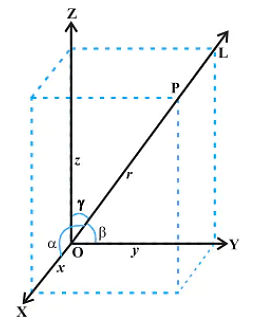
Consider a line L that is passing through the three-dimensional plane. Now, x,y and z are the axes of the plane and α,β, and γ are the three angles the line makes with these axes. These are commonly known as the direction angles of the plane. So, appropriately, we can say that cosα, cosβ, and cosγ are the direction cosines of the given line L.